
Guide
Are LED lights safe? Eyes, home and health — what the evidence actually says
Short answer: yes, for normal home use, LEDs are among the safest lights you can buy — no mercury, almost no UV, and far less heat than the bulbs they replaced. But "safe" has fine print. A cheap driver can flicker enough to give you headaches. A bulb trapped in a sealed fitting slowly cooks itself. Bright, cool-white light late in the evening can push your sleep later. This is what eye doctors, European safety scientists and government energy agencies actually say — including where they don't fully agree with each other — plus the two things an Indian buyer can check in the shop itself: the BIS registration mark on the pack, and whether the bulb is rated for enclosed fittings. It finishes with the bit almost everyone gets wrong: what to do with a lamp when it finally dies.
Short answer first, because that's what most people clicking this actually want: yes. For normal use at home, LED lights are about as safe as lighting gets. No mercury. Almost no ultraviolet. Much less heat than the yellow bulbs most of us grew up with.
But "safe" has fine print. Three things genuinely deserve attention: the quality of the driver (the small circuit that powers the chip), heat building up where it shouldn't, and how you use light in the evening. The rest — the headlines about blue light frying your retinas — mostly dissolves when you read what regulators and eye specialists actually concluded.
Your eyes, and the blue light question
Every white LED starts from a blue chip under a phosphor coating, so yes, LED light contains blue. So does daylight, in much larger amounts — the sun is by far our biggest source of blue light, and a ceiling light isn't close.
When the European Commission's scientific committee (SCHEER) reviewed the evidence in 2018, it concluded there is no evidence of direct adverse health effects from LED emissions in normal use by the healthy general population. The American Academy of Ophthalmology is blunter: so far, the evidence shows no meaningful link between blue light and damage to human retinas, or between blue light and age-related macular degeneration. The cell and animal studies behind the frightening headlines used exposures that don't resemble a person sitting in a lit room.
France's safety agency, ANSES, reads some of the same science more cautiously — it treats blue light as genuinely toxic to the retina at high doses and worries about long-term exposure. Both positions can hold at once: the harm findings concern intense sources at close range. Lamps are classified under the IEC 62471 photobiological standard into risk groups, and in the EU only the two lowest groups (RG0 and RG1) may be sold for home lighting. A normally lit room is nowhere near those levels.
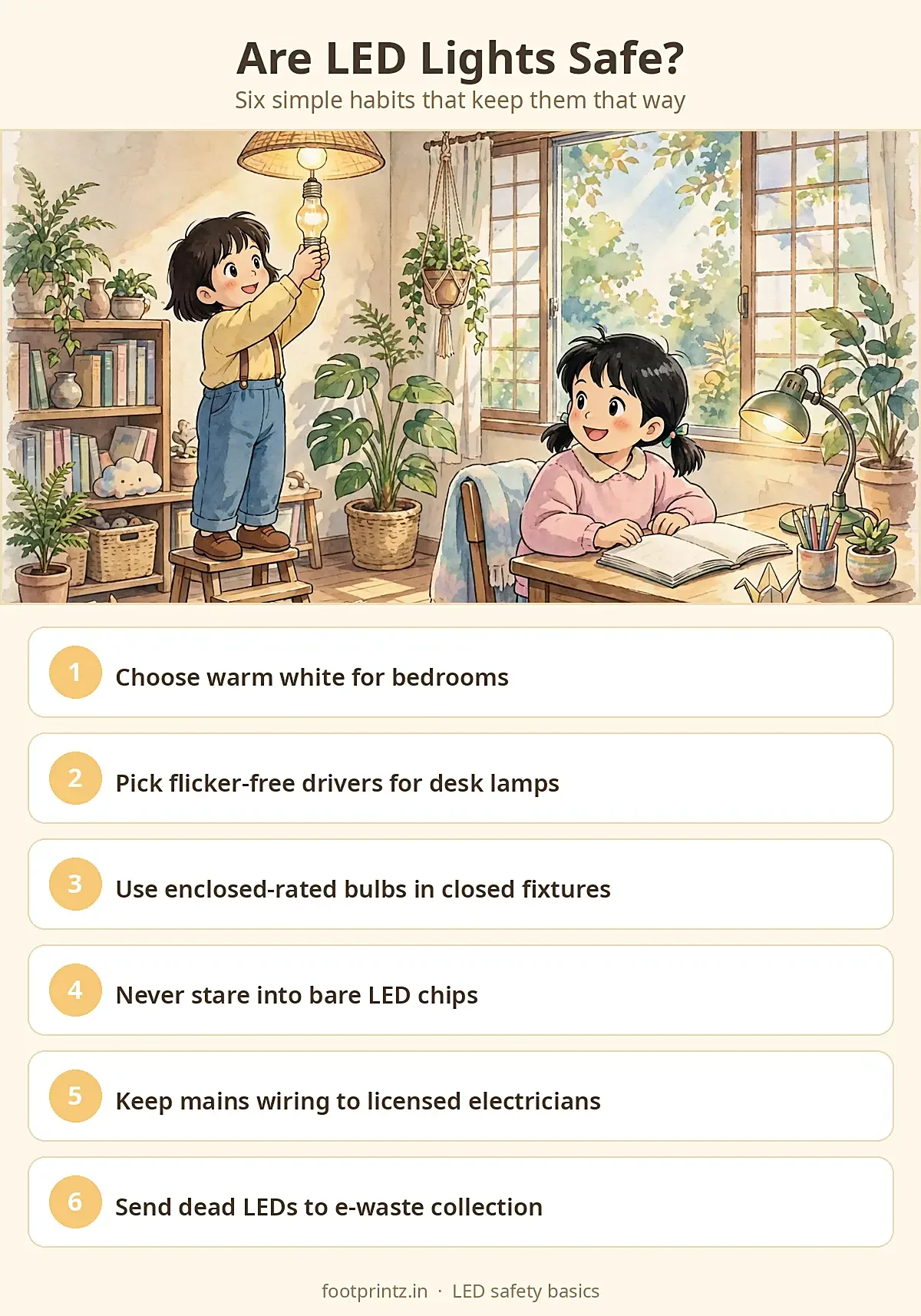
So: don't stare into bare high-power chips or torches at close range — treat them the way you'd treat the sun. Be a bit more careful with small children, whose eyes are more sensitive and who hold glowing toys right up to their faces. Shades and diffusers help too; they spread the source out and kill glare.
Those tired eyes after a long day are usually not the light's fault anyway. We blink about half as often when concentrating on screens or close work, so the eye's surface dries out. That's also why you can skip the blue-light glasses, whatever the ads promise — the Academy of Ophthalmology doesn't recommend them for screen use, because the discomfort was never coming from the blue light.
The caveat nobody markets: flicker
This one genuinely matters when you're buying, and almost nobody mentions it in the shop.
An LED chip responds instantly to its power supply, so any waviness in that supply shows up as flicker. The waviness comes from the driver. A well-made driver feeds the chip smooth, steady current; a cheap one doesn't, and the light pulses — sometimes visibly, more often just fast enough that you can't see it but still end up with a headache or eyestrain. An old dimmer paired with a bulb never meant for dimming makes it worse.
The engineering reference is IEEE 1789, a recommended practice that maps flicker depth against frequency: deep flicker at low frequencies is the problem zone, while modulation above roughly 1,250 cycles a second is treated as no concern. The EU's ecodesign rules put legal caps on flicker; India has no equivalent label yet, so "flicker-free" on a box is a claim, not a certification. Judge it in the room: a lamp that headaches you at your desk, or strobes when you wave a pen under it, is telling you something about its driver.
Who should care most? People who get migraines, anyone doing long hours of close work under one lamp, and the small minority with photosensitive epilepsy, for whom flashing light in certain low-frequency ranges is a known trigger. For a desk lamp — the light you sit under for hours — a good driver beats extra brightness.
Heat, and the fire question
LEDs run cool compared to what came before: an incandescent bulb turns about 90% of its electricity into heat, a CFL about 80%, an LED far less. That's why an LED's outer surface stays comfortable where a halogen would burn your fingers.
Cool doesn't mean cold all over, though. The waste heat an LED does produce is pulled backwards into a metal heat sink at the base, and that base can get properly hot. The driver's electronics dislike heat, which produces the one rule in this article worth memorising: an LED bulb in an enclosed fitting needs to be rated for enclosed fittings. Trap a regular bulb inside a sealed glass cover or a tight recessed housing and it usually won't catch fire — it will just cook its own electronics and die young, sometimes very young. Downlights are the same story: keep ceiling insulation off fittings that aren't rated to be covered by it.
When LED installations have caused fires, the culprits are generally familiar — a failed cheap driver, a loose connection, damaged wiring — not the diode itself. Your lighting's fire safety is mostly your wiring's fire safety, and leaving a correctly installed LED on overnight is not a risk worth losing sleep over.
The electrical side: 230 volts is 230 volts
Because an LED bulb feels like a gadget, people treat changing one like unplugging a phone charger. But an LED bulb in its holder sits at full mains voltage — 230 volts in India, same as the bulb it replaced. Changing a bulb with dry hands and the switch off, fine. Rewiring a fitting, replacing a separate driver, cutting downlights into a ceiling — that's an electrician's job, not a weekend experiment.
Low-voltage lighting is the exception. Strips running on 12 or 24 volts from a separate adapter are far more forgiving on the low-voltage side — the side you actually handle. But the adapter plugs into the mains, so it should be a properly isolated, certified one, not the lightest, cheapest brick in the drawer.
One check that's actually useful in India: LED lamps may only be sold here with Bureau of Indian Standards registration — look for the registration mark and R-number on the packaging. It means the lamp was tested for electric-shock protection, insulation and temperature limits. An unbranded import with no mark has skipped that gate entirely. It's the closest thing to a safety label we have. Use it.
Evening light and sleep
Here's where honesty matters, because the evidence is thinner than most articles admit.
It's established that light in the evening can suppress melatonin, the hormone that signals the day is over, and blue-rich light does this most strongly. But the EU committee graded the evidence that evening LED light affects our body clock as low level, and said openly that it isn't yet clear whether that disturbance causes actual health harm. The eye doctors' practical advice is aimed mostly at screens: cut them back before bed, use the warm night mode.
Translated to a home, that's a habit, not a rule. Bedrooms and the last hour or two of the day are where warmer, dimmer light makes sense — 2700K warm white rather than a bluey 6500K daylight tube at full glare. Rooms where you work can stay brighter and whiter. Just don't marinate in bright, cool light right up to the moment you expect to fall asleep.
When it dies: it's e-waste, not rubbish
An LED has no mercury — a real advantage over the CFL it probably replaced. A broken CFL needs its room aired and its debris collected carefully, because the mercury is sealed safely inside the tube precisely until the tube breaks. A broken LED is just broken electronics.
Electronics is the operative word. A dead LED lamp contains a circuit board, solder and metals, and in India LED lamps and luminaires are listed as lighting equipment under the E-Waste (Management) Rules, 2022. The crossed-out dustbin symbol on the packaging means what it says: not the household bin. Take dead lamps and drivers to an authorised e-waste collection point, a municipal collection drive, or a seller take-back where one exists. A drawer of dead bulbs waiting for the next drive beats the landfill.
So, are they safe?
Yes — with a shorter list of conditions than any lighting technology before them. Buy ones with the BIS registration mark. Spend on the driver, not the marketing: steady, flicker-free light where you sit and work. Match the bulb to the fitting, especially enclosed ones. Warm and dim in the evening. And don't bin the dead ones.
Do those five things and there's very little left to worry about. The rest is just light.
Sources: SCHEER, "Potential risks to human health of LEDs" (European Commission, 2018); American Academy of Ophthalmology, "Digital Devices and Your Eyes"; ANSES, recommendations on LED blue light (2019); US Department of Energy, LED Lighting and solid-state lighting fact sheets; US EPA, guidance on broken CFLs; IEEE Std 1789-2015; E-Waste (Management) Rules, 2022 (India).
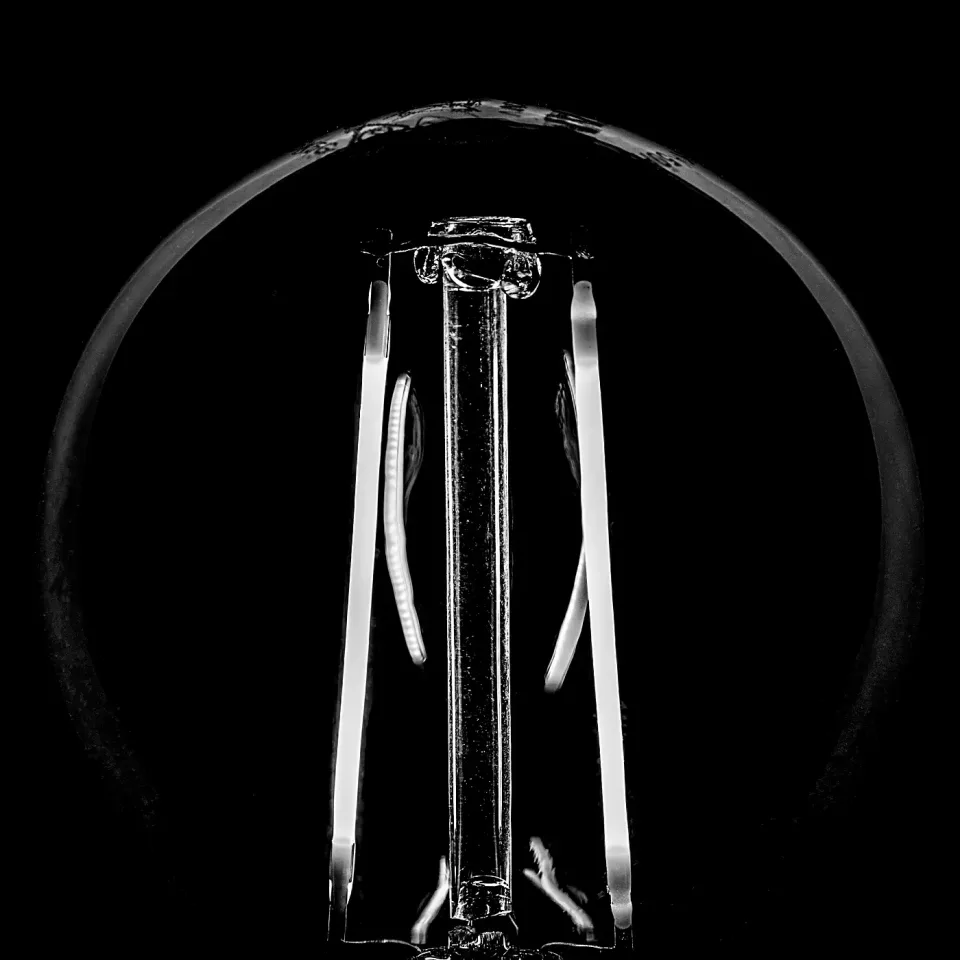
Featured photo: "Bulb" by Sergio Boscaino, via Wikimedia Commons — CC BY 2.0.
Frequently asked questions
Will LED lights damage my child's eyes?
There's no evidence that normal home lighting harms children's eyes. Children are more sensitive to blue light and glare, so use shaded or diffused fittings in their rooms, keep bare high-power lamps away from face level, and don't let them stare into torches or glowing toys up close.
Do I need blue-light glasses for my desk lamp or screen?
No. The American Academy of Ophthalmology doesn't recommend them for screen use; discomfort comes from blinking less and staring at close range, not from blue light. Breaks and distance help more than lenses.
Can an LED bulb catch fire if I leave it on all night?
A correctly installed LED in a suitable fitting is very unlikely to. Real-world problems come from faulty cheap drivers, loose connections and poor wiring. Do respect enclosed fittings — a bulb not rated for them overheats its own electronics and fails early.
My LED flickers when I dim it. Is that dangerous?
Usually it's a mismatch: a non-dimmable bulb on a dimmer, or a dimmer and driver that don't get along. For most people it's a comfort problem — headaches, eyestrain — rather than a danger, but worth fixing, especially if you get migraines. Use a dimmable bulb with a compatible dimmer, or drop the dimmer.
Can I throw dead LED bulbs in the regular bin?
Please don't. In India they're e-waste under the E-Waste (Management) Rules, 2022. Take them to an authorised e-waste collection point or a municipal collection drive.