
Guide
COB vs SMD: Which LED Type Suits Which Light?
COB and SMD are two ways of building almost every LED light you will ever buy, and neither is "the better one". A COB packs many bare chips onto a single plate under one phosphor coating, so it shines as one even disc of light that a reflector can aim precisely — the natural choice for downlights and spotlights. An SMD mounts individually packaged chips across a board, spreading light wide and gentle, which is why panels, strips and bulbs use it. This article compares the two fairly: how each is built, how the light looks, glare, heat, what happens when one fails, and a simple rule for choosing — focused beam, think COB; broad even coverage, think SMD. It also settles two common mix-ups along the way: neither format automatically lasts longer than the other, and the dots visible through a cheap panel cover are a diffuser problem, not a chip problem.
Open the specifications of almost any LED light and two abbreviations turn up again and again: COB and SMD. They are not quality grades, and one is not the upgraded version of the other. They are two different ways of arranging the same basic thing — LED chips — and that arrangement decides how the light looks, how well it can be aimed, and what happens when something fails. If you know which is which, the rest of any light's description gets much easier to read.
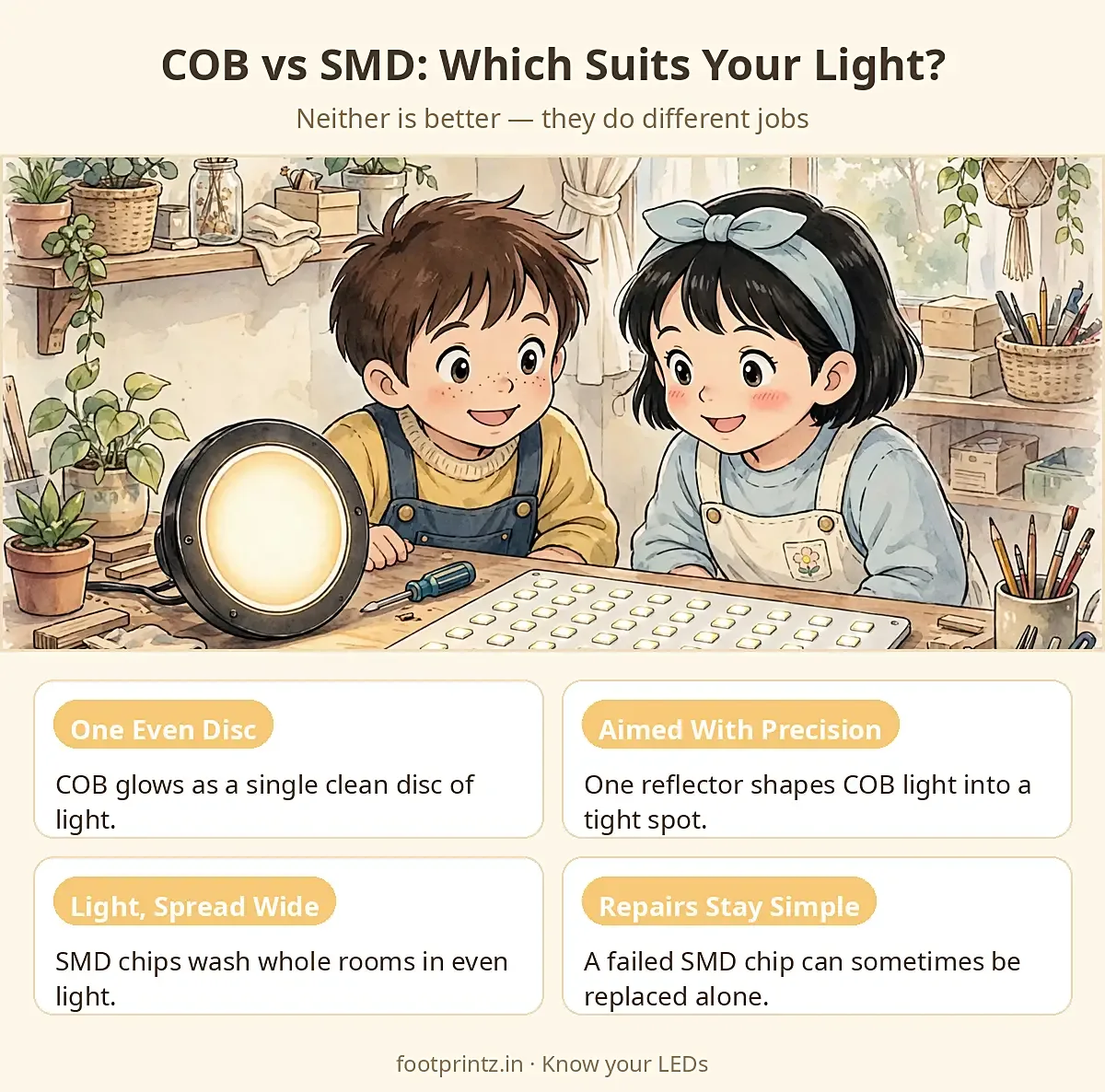
It starts with how the chips are packed
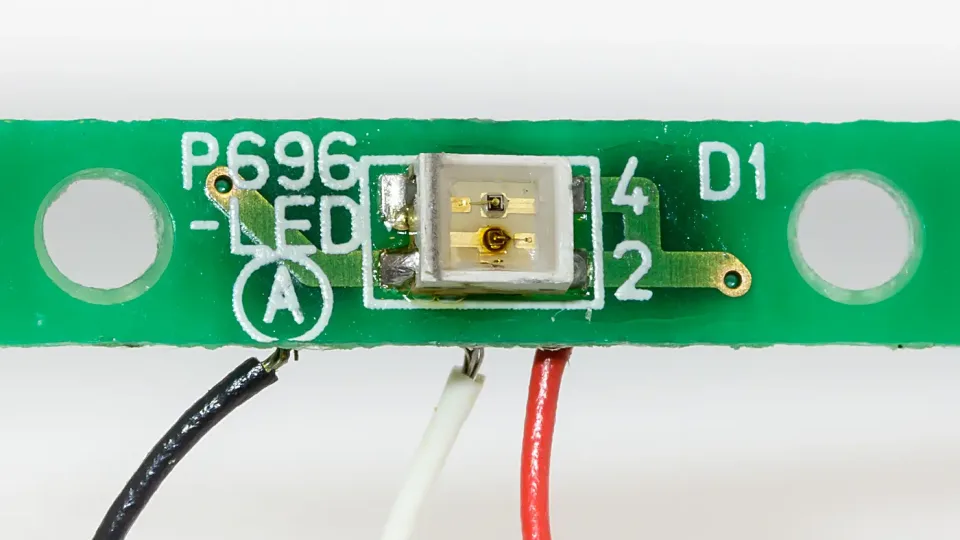
An SMD — surface-mount device — chip is a finished little package. Inside its small plastic housing sits one LED die with its own phosphor coating and its own electrical contacts. A light maker buys these packages by the reel and solders them onto a circuit board, in a row down a strip or in a grid across a panel. Every package is its own separate point of light, and the package numbers you see, like 2835 or 5050, are simply its dimensions in millimetres.
A COB — chip-on-board — skips the packages entirely. Dozens of bare dies, sometimes hundreds, are bonded directly onto a single metal or ceramic plate, wired together, and covered with one shared layer of phosphor. The whole plate takes a single two-wire connection and behaves as one light source. Where an SMD board is a crowd of individual lamps, a COB is a single glowing disc.
How the light actually looks
This is the difference you notice first, and it follows directly from the construction. Look up at a COB downlight and you see one even, continuous disc of light. Objects lit by it cast a single, clean shadow, the way they do under one bulb — because optically, that is what it is.
Look at an SMD light with a clear or lightly frosted cover and you can pick out every individual dot. Hold your hand under one and the shadow is not one shadow but several overlapping ones, one from each row of chips. None of this makes SMD light bad — it makes it different. Put a proper opal diffuser in front of the board, as every decent panel light does, and the dots merge into a soft, even sheet of light that is genuinely pleasant to sit under. The diffuser costs a little brightness and softens any beam, which matters for some jobs and not at all for others.
Aiming the beam, and the glare question
Aiming light is where COB earns its keep. Because its light comes from one small surface, a single reflector or lens can collect nearly all of it and shape it into a tight, controlled spot. That is why showroom track lights, focus lights and good recessed downlights are usually COB: the beam lands where you point it, with a clean edge.
SMD chips spread their light widely by nature. That is exactly what you want for washing a whole room, a workbench or a shop floor evenly — and exactly what fights you if you want a narrow beam. Forcing dozens of spread-out points into one tight spot takes complicated lens arrays and wastes light on the way, so fitting makers rarely bother.
Glare cuts the other way, and it is the thing brochures leave out. A COB squeezes a lot of brightness into a small glowing area, so staring straight at an exposed COB is genuinely uncomfortable. Well-designed COB fittings hide the source deep inside a reflector for this reason; shallow, cheap ones don't, and they are the downlights people complain about. SMD spreads its brightness across many weak points, which is softer to look at — though a bare, undiffused board still looks harsh and dotty. In a living room, a diffused SMD panel or a deeply recessed COB both work. A shallow COB at eye level does not.
Heat: short path, small footprint vs spread out
LED chips hate heat, and the two formats handle it in opposite ways. A COB's dies sit directly on their plate, so heat has a short, low-resistance path out — good design. But all of that heat leaves through one small footprint, so the fitting needs a serious heatsink with a proper thermal joint, and a COB starved of heatsinking cooks itself quickly.
SMD spreads the same total heat across the whole board, a little from each package's solder joints. The heat density is gentler and the heatsinking can be lighter, but there are more joints and interfaces in the path. Neither format is cool-running by magic; in both cases the metal you can't see decides how long the light lasts.
When one dies
Here the formats differ in a way that matters to your wallet. If a single SMD package fails on an accessible board, it can sometimes be replaced on its own — a workbench job with hot-air tools and a matching chip, worth doing on a good fitting, rarely worth it on a cheap sealed one, and strips at least let you cut away and rejoin a dead section. A COB offers no such option. Its dies are bonded under one shared phosphor skin and cannot be serviced individually, so a failed COB means replacing the whole module — or, in sealed fittings, the whole light.
On cost, keep your expectations plain: SMD packages are mass-produced commodities on simple boards, so SMD is usually the economical way to cover a large area evenly. A good COB fitting carries extra cost in its precision reflector and heavier heatsink. You are paying for beam quality and compactness, not for the letters on the box — and build quality moves any light's price more than its format does.
So, which one for which light?
| COB | SMD | |
|---|---|---|
| Construction | Many bare dies on one plate, one shared phosphor layer | Individual packaged chips soldered across a board |
| Light look | One even disc, no visible dots, single clean shadow | Visible points unless diffused; overlapping shadows |
| Glare | Intense from a small area — needs a deep reflector | Gentler per point; soft once diffused |
| Heat | Short path out, but concentrated — needs a real heatsink | Spread over the board, gentler density |
| Repair | Whole module replaced when it fails | Single chip sometimes replaceable; strips can be sectioned |
| Found in | Downlights, track and focus lights, high-bay lights | Panels, strips, bulbs, battens |
Choose COB when the light has a job to do in one place: a downlight over a kitchen counter, a track light picking out a display, a focus light on a reading chair, a high-bay over a workstation. You want the beam shaped and the source hidden in a reflector.
Choose SMD when the light's job is coverage: a panel that lights a whole room without drama, a strip glowing under a cabinet, a batten in a corridor, a bulb that should behave like the old bulb it replaces. You want it wide, even and easy on the eyes.
And when a light mixes both jobs — many modern fittings do — judge it the way you now can: by the beam it makes, the heatsink it carries, and whether the glowing part is somewhere your eyes won't meet it directly. The abbreviation was never the point.
Sources consulted for this article: US Department of Energy Solid-State Lighting program notes on packaging and thermal resistance; Illuminating Engineering Society–referenced comparisons of COB and SMD packaging; technical explainers from lighting and PCB industry publications (chip-on-board construction, light-emitting-surface optics, maintenance profiles). Figures that vary by product — efficiency, lifespan, price — are described as ranges of behaviour, not universal numbers, because no honest universal numbers exist.
Featured photo: "Duo SMD LED Module on a printed circuit board" by Raimond Spekking, via Wikimedia Commons — CC BY-SA 4.0.
Frequently asked questions
Is COB brighter than SMD?
Per unit of glowing area, yes — a COB packs far more chips into a small disc, so it is much more intense from a compact source. Total brightness is another matter: an SMD panel with enough chips over a large board can put out just as much light overall. It depends on the specific light, not the format.
Which lasts longer, COB or SMD?
Neither, by format alone. Life is decided mainly by how well the fitting removes heat and by its driver. A well-heatsinked example of either will outlast a poorly cooled example of the other, whatever the brochure says.
Why does my SMD light show dots?
Because each SMD package is a separate point of light, and the cover on your fitting is too clear or too close to the board to blend them. A more opal diffuser, or a fitting with more space between board and cover, hides them.
Can a dead COB light be repaired?
Not chip by chip — the dies are bonded under one shared phosphor layer. The COB module itself can be swapped in fittings designed for it; in sealed fittings, the whole light is replaced.
Is COB always more expensive?
Fittings with COB often cost more because of their reflectors and heatsinks, but prices overlap a lot, and a cheap COB fitting is not automatically better than a well-made SMD one. Compare the beam, the build and the warranty, not just the label.