
Guide
Dimmable LED lights and dimmer switches: making them get along
Screw a dimmable LED light into a fitting run by an old wall dimmer and you can get flicker at the bottom of the range, a bulb that refuses to start until the knob is a third of the way up, a faint buzz, or a light that gives up and drops out halfway down. None of that means the bulb is faulty. Dimming an LED light is a negotiation between two electronic devices — the dimmer, which chops the mains waveform into pieces, and the bulb's driver, which has to read those pieces as an instruction. When the two were never introduced, they argue. This post explains what each side is doing, why an incandescent never had this problem, what the four classic symptoms are telling you, and the honest ladder of fixes — from checking the maker's compatibility list to the option that skips the wall dimmer altogether.
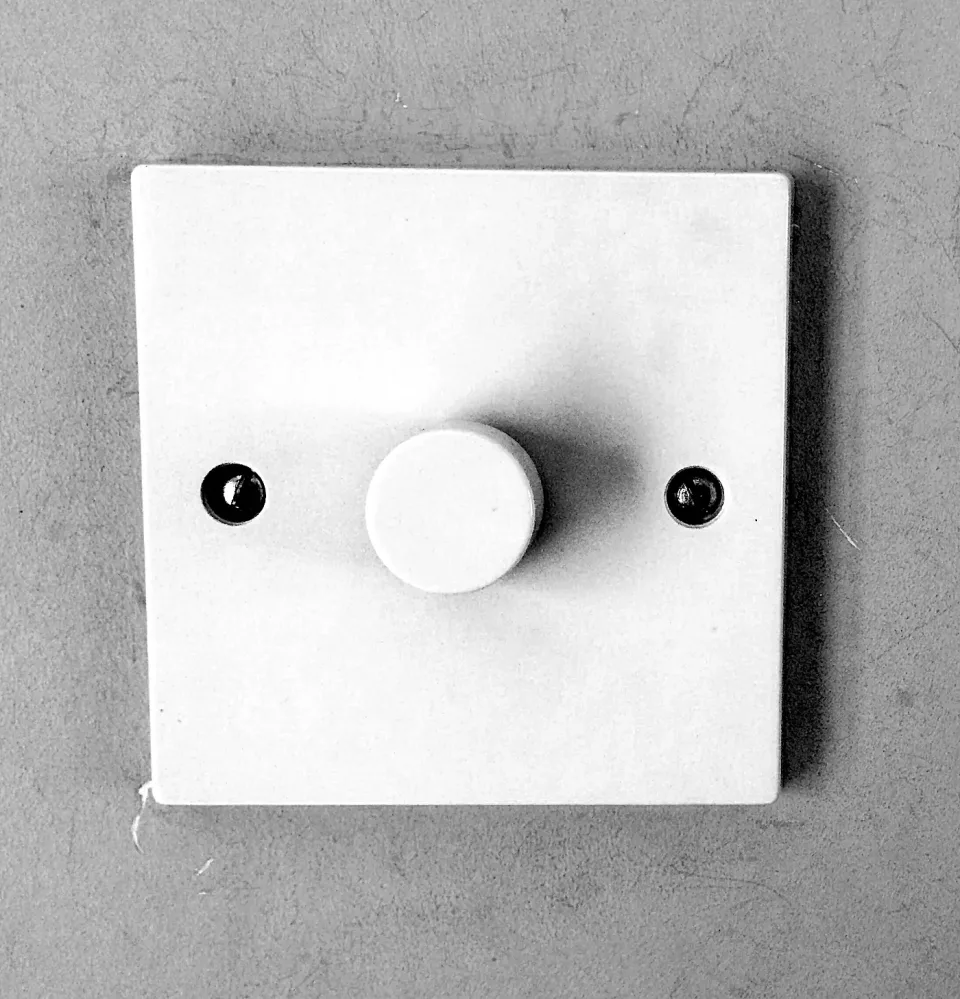
The old bulb dimmed beautifully. The new LED light — sold as dimmable, in a box that says so in large friendly letters — flickers like a candle in a draught, buzzes faintly, and will only dim about halfway before it quits. It is very tempting to blame the bulb. Usually, the bulb is innocent. What you have is two electronic devices that were designed in different eras, connected by a wire, each assuming the other behaves like something it isn't.
Why an incandescent never argued
An incandescent bulb is about as simple as an electrical load gets: a wire filament that glows when current passes through it. A traditional dimmer works by chopping each cycle of the mains — removing a slice of every wave so the filament receives less average power. Less power, cooler filament, dimmer light. The filament even smooths the chopping for free, because it can't heat and cool fifty times a second; it just glows at the average.
An LED light is not a load like that. Inside it sits a driver — a small electronic power supply that takes mains AC in and delivers a carefully regulated low-voltage DC current to the LED chips. The chip answers current changes almost instantly; there's no filament's thermal patience to hide behind.
So when a dimmer chops the incoming wave, the driver has to interpret the missing slices: how much of each wave survived? That must be how bright they want me. A dimmable driver is one built to do exactly that translation. A driver and dimmer never designed with each other in mind can mistranslate in a dozen entertaining ways — the entire subject of this post.
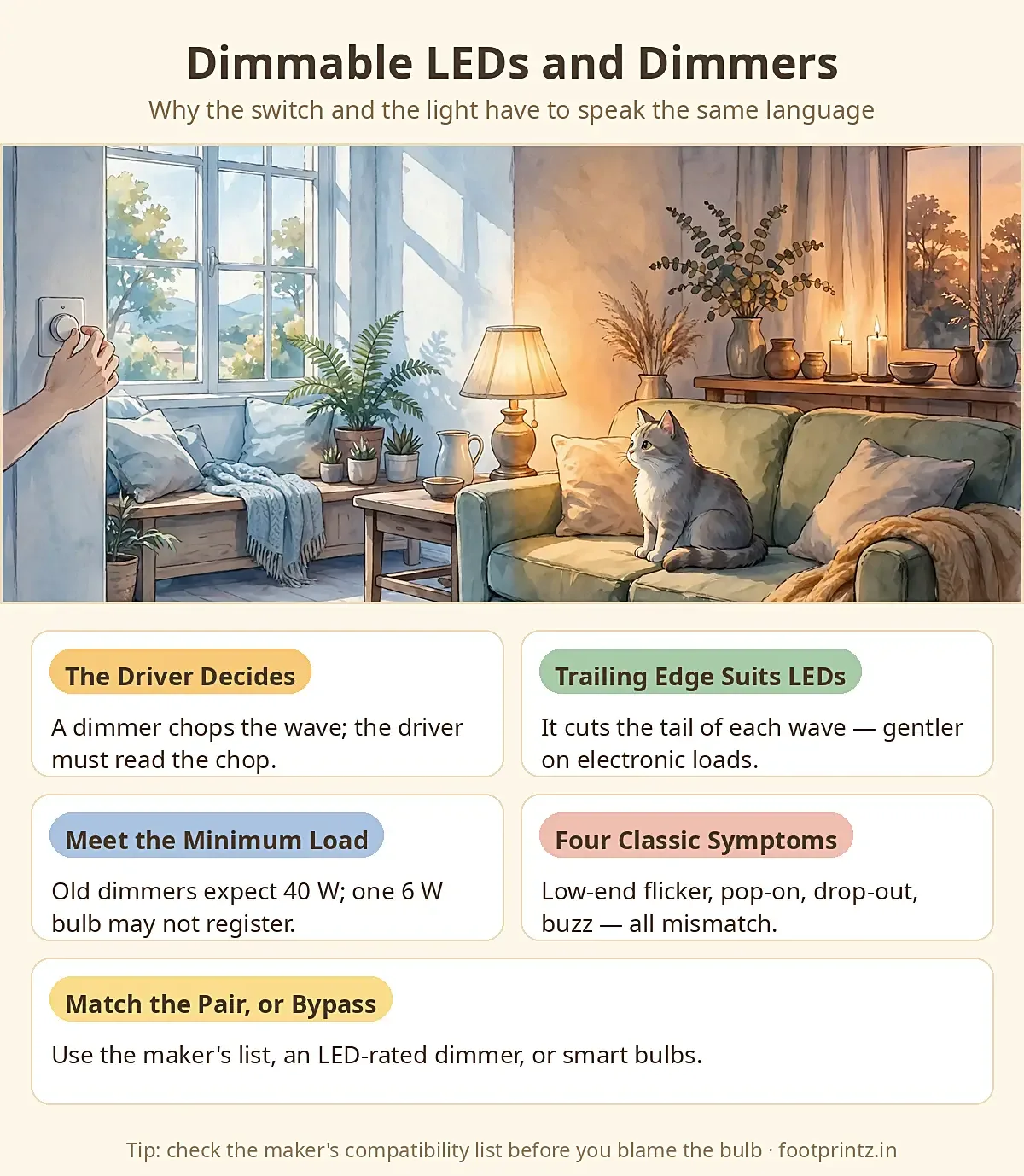
Leading edge, trailing edge — one wave, two ways to cut it
Phase-cut dimmers come in two flavours, named for which part of each half-wave they remove.
A leading-edge dimmer waits at the start of each half-cycle, then switches on part-way through. It cuts the front off the wave. This is the classic design — the kind built for incandescent lamps and still sitting in millions of walls. Its switch-on moment is abrupt, a small electrical jolt delivered a hundred times a second, which a dumb filament never minded.
A trailing-edge dimmer does the mirror image: it switches on right at the start of the half-cycle and cuts the tail off, switching off part-way through. It was developed later, for electronic low-voltage transformers, and switching off is a gentler act than switching on mid-wave — with electronic loads it is generally quieter and better behaved.
For LED loads, trailing-edge is the usual recommendation, and an LED-rated dimmer is almost always a trailing-edge design. But hold the general rule loosely: each dimmable driver is specified for leading edge, trailing edge, or sometimes both, and the driver's word wins. A bulb whose driver expects one kind can misbehave on the other just as thoroughly as a non-dimmable bulb misbehaves on anything.
The four classic symptoms
Compatibility failures have a recognisable repertoire. The US Department of Energy and the lighting industry body NEMA catalogue them; if your light performs any of these, it's speaking this language.
Flicker at the low end. Smooth at full brightness, shimmering or strobing as you turn it down. Near the bottom of the range the surviving slice of each wave gets small, and a driver that can't read it cleanly lets the light output wobble with every cycle.
Pop-on. The light is off, the dimmer is set low, you switch on — nothing. You nudge the control up, up… and at a third or more of its travel the light suddenly pops on, after which you can dim it back down below the level it refused to start at. The driver needs a bigger slice of wave to wake up than it needs to stay awake.
Drop-out. The mirror fault: dimming down smoothly, then at some point well above the bottom the light simply cuts out, instead of fading the rest of the way. The driver has fallen below the input it can work with and shut down rather than glow feebly.
Buzz. A hum or buzz from the bulb, the fitting, or the dimmer itself — components physically vibrating as the chopped wave hits them in repeated jolts. Add to these the range problem: a pairing that works but only dims to, say, half brightness, spending the rest of the knob's travel doing nothing at all. That dead travel is a symptom too.
The minimum-load trap
Underneath several of these sits one number most people never meet: minimum load. A dimmer's own electronics need a certain amount of current passing through them to switch cleanly and stay stable, so every dimmer has a smallest load it can run. Dimmers from the incandescent era were designed for a world of 40-watt and 60-watt bulbs; their minimums commonly sit around the tens of watts.
Now hang a single 6-watt LED light on one. The total load may not even reach the dimmer's minimum — the LED light draws so little that, as far as the old dimmer is concerned, there's barely anything connected. The result is the misfiring, flickering and pop-on described above, from a bulb and a dimmer that are both working exactly as built.
Ratings mislead in the other direction too. A wall dimmer marked "600 W" earned that number with incandescent loads; LED drivers draw sharp peaks of current many times their average, so makers derate the same dimmer heavily for LED use — 600 W of incandescent can become 150 W of LED on the very same unit. Neither the wattage on the bulb nor the wattage on the dimmer means what it meant in 1995.
"Dimmable" is a promise with fine print
Here is the sentence this whole post hangs on: when a maker labels an LED light dimmable, the tested claim is that its driver can take a dimmed signal from a specific type of dimmer — not that it will behave on your dimmer. Even certification testing only proves a lamp on a small set of test dimmers.
That's why makers publish compatibility lists: documents naming the exact dimmer models a bulb or driver has been tested with, often with notes on lamps per dimmer and how the pairing behaved. They look like tedious paperwork. They are, in fact, the only honest answer to "will this work in my house?" — the Department of Energy's own guidance puts a maker-recommended combination at the top of its list, above every rule of thumb.
Two practical corollaries. First, one dimmer, one model of bulb: drivers differ from product to product, so mixing bulbs on one circuit gives the dimmer several different loads to please at once, and they will disagree about the bottom of the range — one glowing, one flickering, one out. Second, if a pairing works, write down what it was. The next replacement bulb, "equivalent" in every printed spec, has a different driver inside.
How the dimming actually happens inside
One short detour, because it explains the driver's side of the argument. Once a driver has decided how bright to be, it mostly dims the chips one of two ways. With PWM (pulse-width modulation) it switches the LED fully on and fully off thousands of times a second; the fraction of each cycle spent on — the duty cycle — sets the brightness. Because the chip always runs at its rated current when it's on, its colour stays put across the range. With analogue dimming (constant current reduction) it simply turns the current down and leaves it there: no switching at all, but a chip's colour can drift slightly at low currents and the very bottom of the range gets less predictable. Some drivers use one method at the top of the range and the other at the bottom. Either way, all of this happens after the driver has read the wall dimmer's chopped wave — two translations, two places for things to go wrong.
The honest options ladder
In rough order of effort:
Check the list, then swap bulbs, not wiring. If your dimmer is a model the bulb maker has tested, a listed pairing often cures everything with no tools at all. If you're buying bulbs for an existing dimmer, shop from the dimmer maker's compatibility list instead.
Match the pair deliberately. Choosing a bulb and an LED-rated (usually trailing-edge) dimmer that name each other — or at least the same edge type, with loadings inside both makers' minimum and derated maximum — is the reliable route for a room you care about.
Skip the wall dimmer. Smart LED bulbs dim themselves internally, on a plain on/off switch, controlled from a phone or remote — the wall control stops chopping the wave, so there is nothing to mistranslate. Plug-in lamp dimmers do the same job for a table lamp without touching fixed wiring. For one awkward room, this is often the cheapest honest fix.
Have the dimmer replaced. A new LED-rated dimmer matched to your lights will usually end the argument — but be plain about whose job this is: replacing a wall dimmer is mains wiring work, inside the switch box. That is a licensed electrician's job, not a weekend experiment. Swap bulbs yourself; do not swap the switch yourself.
Do those in order and most dimming misery resolves at step one or two. The pairing was always the product.
Sources: NEMA LSD 49-2010, "Solid State Lighting for Incandescent Replacement — Best Practices for Dimming"; US Department of Energy, "Dimming LEDs with Phase-Cut Dimmers: The Specifier's Process for Maximizing Success" and report PNNL-22945 on phase-cut dimming; ENERGY STAR Lamps specification, dimming requirements (maximum/minimum output, flicker, audible noise); RS DesignSpark, "LED Dimming with Pulse Width Modulation". Full research notes with per-claim citations are kept with this draft.
Featured photo: "Dimmer Light Switch" by Paolomarco, via Wikimedia Commons — CC BY-SA 4.0.
Frequently asked questions
Why does my dimmable LED light flicker only when it's turned down low?
Array
Can I use my old incandescent dimmer with LED lights?
Array
What is the difference between leading-edge and trailing-edge dimmers?
Array
Why do the bulbs on one dimmer dim unevenly?
Array
My lights buzz on the dimmer. Is that dangerous?
Array