
Guide
How LED colours are made: phosphor, RGB and tunable white
Every other light you own makes its colour at the surface — a filter, a coloured glass, a glowing filament. An LED makes its colour in the crystal itself, before it is ever switched on. The semiconductor's band gap decides whether the chip can only ever glow red, green or blue, which is why "white LED" is a small lie: no chip emits white. White is built afterwards, by coating a blue chip in phosphor, or by mixing separate coloured chips. This post walks through all three recipes — direct colour from the crystal, phosphor white and how its blend is tuned from warm to cool, RGB and RGBW mixing, and tunable white's two channels — then explains the factory sorting called binning, and why two bulbs with the same colour printed on the box can still clash on your ceiling.
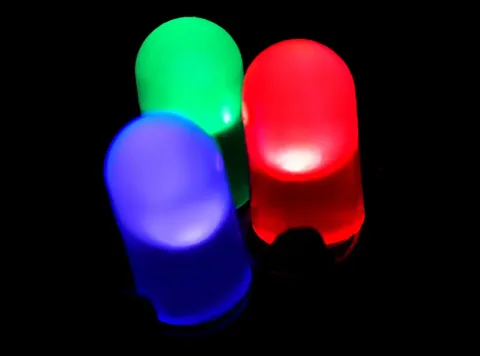
A coloured bulb in the old world was a white bulb wearing a costume — paint, gel or tinted glass over a light that was white underneath. An LED light works the opposite way round. There is no white underneath. Each LED chip is born one colour and can never be anything else, because its colour was settled in the crystal it was grown from. Understanding LED colour means understanding three separate tricks: how the crystal fixes a colour, how makers fake white on top of a blue chip, and how mixing chips lets a light change its mind.
Colour is baked into the crystal
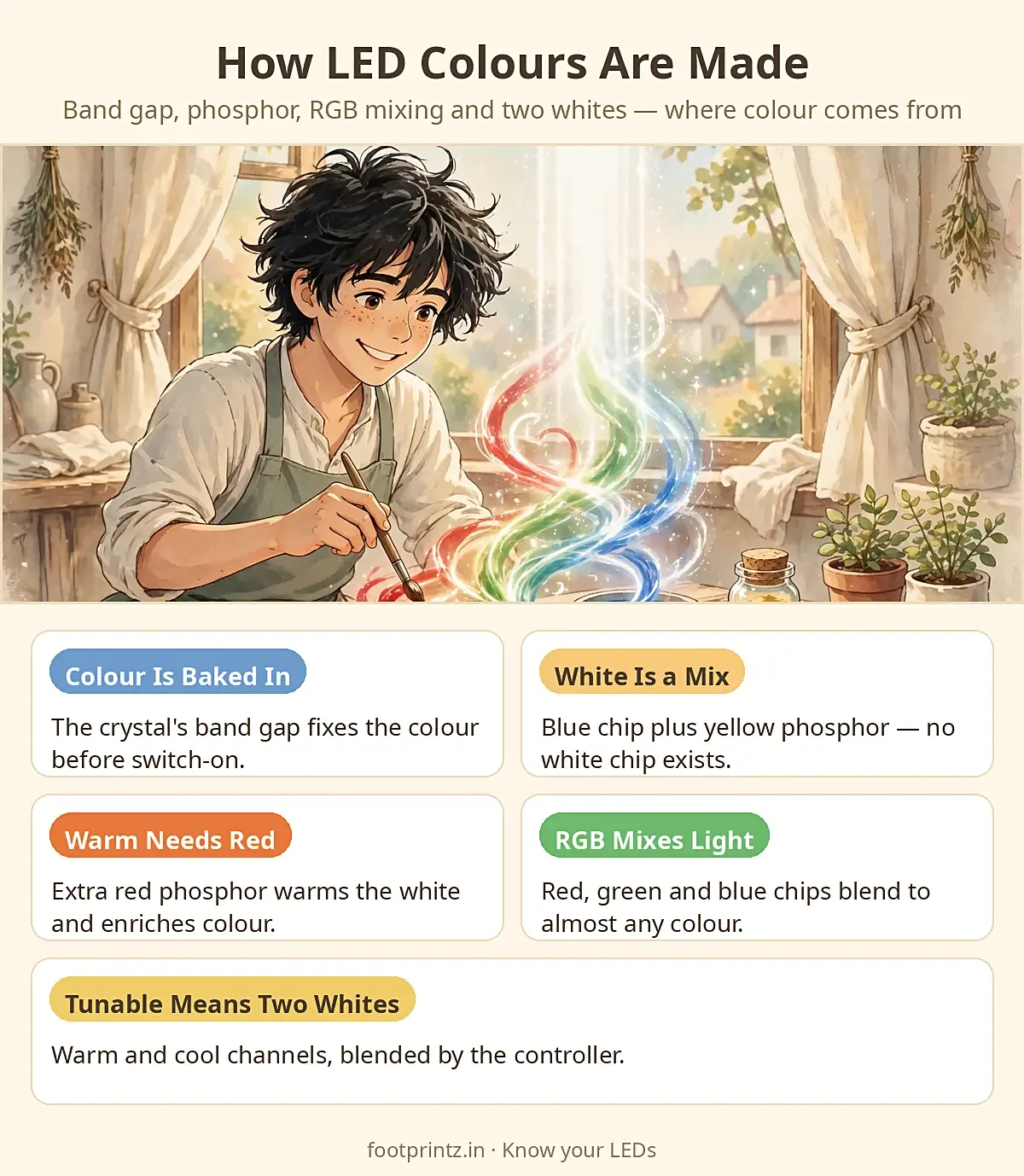
In the chip post we saw how an LED makes light: an electron falls across an energy gap inside the semiconductor, and the energy it sheds leaves as one photon. The size of that gap — the band gap — is a property of the material, and it sets the photon's energy, and therefore its colour. A wide gap sheds energetic photons: short wavelengths, blue and violet. A narrow gap sheds lazy ones: long wavelengths, red and infrared. The chip cannot be retuned later. Colour is not a setting on an LED; it is a consequence of what it is made of.
That is why the LED world runs on two material families. The phosphide family — aluminium gallium indium phosphide and its relatives — has gaps in the red-to-yellow range, so it makes red, orange, amber and yellow chips directly. The nitride family — indium gallium nitride — has wider gaps, so it covers blue and violet, and, with more indium stirred into the alloy to shrink the gap, green as well. When you see a red traffic signal and a blue indicator glowing side by side, you are looking at two different crystals that happen to share a job title.
White is not a chip colour
Here is the awkward fact the whole lighting industry is built on: no semiconductor recipe emits white. White light is a broad spread of wavelengths, and a chip emits one narrow band. So the "white LED" in almost every LED light you own is an arrangement, not a colour. The US Department of Energy lists three ways of getting white from LEDs — phosphor conversion, mixing coloured chips, or a hybrid of both — and the first one won the market so completely that it is worth understanding properly.
A phosphor-converted white LED starts as a blue chip. Over it sits a layer of phosphor — a material that absorbs some of the blue light and re-emits it at longer wavelengths. The classic phosphor glows a broad yellow. Part of the blue escapes through the layer untouched, part comes back out as yellow, and your eye adds the two together and reads white. It is the same additive trick as mixing paints of light, done inside a blob of resin on top of the chip.
Two honest consequences follow. First, the conversion is not free: a re-emitted photon always carries less energy than the blue photon that was absorbed, and the difference leaks away as heat. Physicists call it the Stokes loss, and it is where most of the energy loss inside a white LED happens. Second — and this is the part you can shop by — the white is in the recipe, not the chip. Use more phosphor, or a blend that leans further from blue, and the white comes out warm and golden. Use less, and it comes out cool and blue-white. Add red-emitting phosphors to the blend and two things improve at once: the white warms further, and colours under it look richer, because a plain blue-and-yellow mix is thin exactly where skin tones, wood and food need red. Same blue chip underneath; completely different light, decided by whoever mixed the coating.
RGB: three chips, mixed in your eye
The second recipe skips phosphor entirely and mixes at the source. Put a red chip, a green chip and a blue chip close together — close enough that your eye cannot separate them — and drive each at a different brightness. The proportions do the rest. Equal and bright reads as white; red and green together read as yellow; kill the green and red with blue reads as magenta. This is additive mixing, the same principle as a phone screen, and it is how colour-changing strips produce their whole rainbow from three fixed colours.
If you read the SMD numbers post, you have already met the packaging for this: the 5050 package, 5.0 × 5.0 mm, is the standard three-in-one home for an RGB strip — one red, one green and one blue die in a single square. RGBW adds a fourth die, a dedicated white one (usually a small phosphor-converted chip, like the one described above). It earns its place because mixed RGB "white" is a compromise — three narrow spikes of colour pretending to be a spectrum — while the white die makes everyday white directly and lets the coloured three get back to making colour.
Tunable white: two whites and a dimmer with opinions
Tunable white looks like magic — one LED light sliding from candle-warm to daylight-cool — but it is the simplest mixing of all. Inside are two sets of ordinary phosphor white chips: a warm channel made with a warm phosphor blend, and a cool channel made with a cool one. A two-channel controller feeds them independently. All warm channel: 2700K-ish. All cool: 6500K-ish. Both together, in any ratio: everything in between, with brightness controlled separately from colour.
One wrinkle worth knowing, since it explains a tint you may have seen: two whites blended in a straight line do not follow the ideal warm-to-cool curve perfectly, so mid-range settings on simple tunable lights can sit a touch greenish or pinkish compared with the ends. Better systems add correction channels to hold the blend on the ideal line. It is a small effect — but it has the same cause as the bigger mismatch in the next section, and your eye is annoyingly good at spotting both.
Why two "identical" bulbs can clash
Chips come off a production line the way biscuits come out of an oven: nominally identical, measurably not. The blue peak wanders slightly from chip to chip, and the phosphor coat is never exactly the same thickness twice, so raw output varies in brightness, voltage and — most visibly — colour point. Makers deal with this by testing every chip and sorting it into bins: groups whose members measured close enough to pass as the same.
Colour tolerance is described in MacAdam steps, a scale built on how small a colour difference the human eye can just detect. A tight bin — one to three steps — puts bulbs side by side that nobody can tell apart. A loose bin, five steps and beyond, allows differences your eye catches instantly when two bulbs share a ceiling, even though each bulb alone looks perfectly fine and matches the number on its box.
And there is a second axis the box number hides. Colour temperature measures where a white sits on the warm–cool line, but a white can also drift off that line — toward green on one side, toward pink or magenta on the other. That off-line distance is called Duv. Two 4000K bulbs, one a little above the line and one a little below, are both honestly 4000K — and one will look faintly green next to the other's faint pink. That, plus loose bins, is the whole answer to "same box, different light". Buying matched bulbs from the same batch, for one room, is the cheap insurance.
A short, honest note on green
One colour is still genuinely hard. Direct green and yellow chips are far less efficient than their blue and red cousins — researchers call it the green gap — because pushing the nitride crystal toward green means more indium, more strain, and more of the energy lost before it becomes light. It remains an active research problem, with public funding behind it. The green gap quietly explains a design choice you've now seen twice in this post: mainstream white light is made with a blue chip and a phosphor, rather than by mixing direct red, green and blue — because one of those three ingredients is, for now, the weak one.
Meanwhile, where a pure colour is the whole job, direct emission wins outright. A red traffic signal uses a red chip making red light directly — saturated, narrow-band colour is what an LED does natively and efficiently — rather than a white light straining through a red filter and throwing most of itself away. Same logic in exit signs, brake lights and indicator dots everywhere: when the colour is fixed, bake it into the crystal and skip the conversion losses entirely.
Sources: US Department of Energy, "LED Basics" and its green-gap research programme; Wikipedia, "Light-emitting diode physics" (band gaps and material families); Ohio University phosphor review in Compound Semiconductor (YAG:Ce conversion, Stokes loss, CCT/CRI control); lighting-industry binning references (ANSI C78.377 chromaticity bins, MacAdam steps, Duv).
Featured photo: "R, G, and B LEDs" by PiccoloNamek, via Wikimedia Commons — CC BY-SA 3.0.
Frequently asked questions
Is there such a thing as a white LED chip?
No. A chip emits one narrow band of colour set by its crystal. Every "white LED" is a system: almost always a blue chip under a phosphor coating that converts part of the blue to yellow, with the mixture reading as white. The white lives in the coating recipe, not the chip.
Can an RGB strip make proper white?
It can make a white-looking mix — red, green and blue at the right proportions — but it is three narrow spikes of colour rather than a full spectrum, so surfaces under it can render oddly and the tint may lean green or pink. That is why RGBW strips add a fourth, dedicated white die for everyday white light.
Why do two bulbs with the same colour temperature look different?
Because colour temperature is only one axis. Chips vary slightly in production and are sorted into bins of varying tightness, and a white can also drift off the warm–cool line toward green or pink — measured as Duv. Two bulbs can share a Kelvin number and still differ on both counts.
What is the difference between tunable white and RGB?
Tunable white mixes two phosphor whites — a warm channel and a cool channel — to slide along the warm-to-cool range only. RGB mixes red, green and blue chips to make colours across the rainbow, including a rough white. One is a better white; the other is colour.
Why are green LEDs such a research problem?
Green sits in the awkward middle: the phosphide family runs out of reach below yellow, and the nitride family needs heavy indium loading to reach green, which strains the crystal and increases losses — the "green gap". Blue and red chips are far more efficient, which is also why phosphor white, not RGB mixing, lights most rooms.