
Guide
How to read an LED light's label like an electrician
An electrician picks up a lamp box and reads it in about ten seconds — not because the label is simple, but because they know which numbers answer which questions, and in what order to ask them. This post walks an LED light's label field by field, the way that reading actually goes: lumens first, because brightness is the job; watts second, because that's the running cost; then the two divided together for the efficiency check no seller can argue with. After that come the colour fields — Kelvin for the colour of the light, CRI for how honestly it shows the colours of everything else — then fit and supply: base code, voltage range, IP code, power factor. It finishes with rated life and what L70 really promises, the BEE star label you'll meet on Indian lamps, and the red flags that should send a box straight back to the shelf.
Stand in a lighting aisle and watch two kinds of buyer. The first reads the biggest number on the box and pays. The second turns the box over, spends ten seconds on the small print, and sometimes puts it back. Same label. Different reading.
The small print on an LED light is not decoration or legal padding — it is a compressed spec sheet, and almost every field answers a specific question. Watts: what will it cost to run? Lumens: how much light do I get? Kelvin: what colour is the light? Read in the right order, a label lets you compare two lamps honestly in under a minute. Read in the wrong order — biggest number first — and you'll buy the wrong lamp confidently.
Start with lumens. Always lumens.
Brightness lives in exactly one field: lumens (lm), the total amount of visible light the lamp produces. More lumens, more light. Everything else on the label is secondary to that.
The reason this needs saying is the habit older bulbs trained into us. With incandescent lamps, watts and brightness rose together, so "a 100-watt bulb" worked as a brightness description. LED lights broke that link — deliberately: a modern LED light can produce an old 100 W bulb's light (roughly 1,600 lumens) while consuming a fraction of the power. The familiar equivalents still help as a rough map — about 450 lumens replaces a 40 W bulb, 800 a 60 W, 1,100 a 75 W — but they describe the lamp you're replacing, not the one in your hand.
Watts second — that's the bill, not the brightness
The watt figure is real power consumed: what the lamp draws and what your meter bills you for, hour by hour. Lower watts for the same lumens is pure saving — which is why watts come second, right after the lumens they must be compared against.
Two lamps with identical lumens and different watts are not equal — one converts more of your electricity into heat. You can't tell which from either number alone. You need them together, which is the next field.
Divide them: lumens per watt is the sanity check
lm/W — lumens divided by watts — is the lamp's efficiency, and the hardest number on the box to fake convincingly, because anyone can recompute it from the two fields above it. A box boasting "high efficiency" that prints 700 lumens at 10 watts is claiming, in arithmetic, 70 lm/W — and the arithmetic wins.
This ratio matters beyond your bill: in India, the BEE star label for household LED lamps is graded on exactly this figure, so the stars are a certified version of the division you just did.
Kelvin: the colour of the light itself
Colour temperature, printed in Kelvin (K), describes the colour appearance of the light: lower numbers are warm and yellowish, higher numbers cool and bluish. Around 2700–3000 K is the warm white of living rooms; 3600–5500 K is the cooler light of kitchens, studies and shops. Neither is "better" — but mixing them in one room looks like a mistake even when it isn't, so keep one K number per room.
Kelvin says nothing about how accurately colours will look under the light. That's a different field — the most misunderstood one on the box.
CRI: how honestly the light shows colour
CRI (colour rendering index, often printed Ra on labels) measures how faithfully colours appear under the lamp compared with a reference light of the same colour temperature. The scale tops out at 100; an old incandescent bulb scores 100.
Here's the catch almost nobody prints: Ra is an average of eight test colours, all gentle, pastel shades. The ninth sample — a strong, saturated red, called R9 — is left out of the average entirely, so a lamp can post a respectable Ra while handling reds poorly. And reds are what you look at most: skin is full of red and pink tones, and so is food — fruit, vegetables, cooked meat, spices. This is why a kitchen or dining room is where mediocre CRI gets found out: faces look grey, dinner looks tired, and people blame the cooking. If a datasheet offers an R9 figure alongside Ra, that's a maker confident about reds — worth paying a little for.
Beam angle: where the light goes
Total lumens tell you how much light exists; beam angle tells you its shape. Technically it's the angle within which the light's intensity stays above half its maximum — in shop language, a narrow angle (think 24–38°) concentrates the lumens into a spot for a counter or a display, while a wide angle (120° and beyond on a plain bulb) spreads them as a flood. The same 800 lumens feel fierce in a 24° spot, gentle in a wide bulb.
The fit fields: base code and voltage
Turn from the box to the lamp itself — two fields printed on its body or base, checked before anything is screwed in.
The base code is an international shorthand: a letter for the connection family, a number for the size in millimetres. B22 is the 22 mm push-and-twist bayonet common in Indian homes; E27 the 27 mm screw; E14 the smaller screw, GU10 the twist-lock spotlight base. The code only promises the lamp will physically fit the holder — nothing about whether it should. That's the next field's job.
The voltage range states the supply the lamp is built for, and it must cover your mains. Indian-market lamps are normally printed 220–240 V (the BEE scheme here covers single-phase lamps up to 250 V, 50 Hz); wider-range lamps tolerate voltage swings more gracefully. A lamp printed for some other single voltage — a souvenir from a 110 V country — goes back on the shelf, however good its other numbers look.
IP code: the two digits for dust and water
IP followed by two digits is the enclosure's report card, graded under IEC 60529. First digit: solids and dust, 0 (nothing) to 6 (dust-tight). Second digit: water, from 0 up through splashes and jets (5) to temporary immersion (7). A bathroom or outdoor lamp wants both digits present and decent — IP65 is the common outdoor answer. A dry-room lamp often carries no IP marking at all, and that's fine.
Power factor: the grid's field, mostly
PF is the ratio between the real power a lamp uses (its watts) and the apparent power the supply must deliver to it. Below a perfect 1.0, the lamp draws more current than its watts suggest — it does not consume more watts, and since a home meter bills real energy, low PF doesn't directly raise a household's bill for the same light.
So why does the field exist? Scale: a building full of low-PF lamps loads cables, transformers and grid capacity, so standards bother — India's IS 16102 (Part 2), which a BEE-labelled lamp must satisfy, sets power-factor requirements. For a buyer, PF is a quality tell, not a bill item: a lamp printing PF 0.9 or above has a better-mannered driver than one hiding the field entirely.
Rated life: hours, and the L70 behind them
An LED light rarely dies the way an old bulb did, with a pop and darkness. It fades — so "life" on the label is defined by fading: the hours figure is normally an L70 rating, the operating time at which output is expected to have fallen to 70% of new. Below that, the light counts as spent, even though it still glows.
Two reading habits follow. First, an honest life figure rests on testing: lumen maintenance is measured over thousands of hours (the LM-80 test runs at least 6,000) and projected forward by a standard method (TM-21) that caps how far the projection may stretch. Second, treat the words "up to" as a warning label of their own. "Up to 25,000 hours" promises only that the lamp will not exceed that figure — the ceiling, dressed as the expectation. A plain "rated life: 15,000 hours (L70)" is a smaller-sounding claim that means more.
The BEE stars (India)
On a household LED lamp sold in India, look for the BEE label — it carries, by regulation, the maker's or importer's name, the model, the watts, the lumens, the lm/W figure, the star level and the label's validity period. The stars grade efficiency only, awarded on luminous efficacy: five stars says the lamp wastes little electricity for its light, and nothing about colour quality, beam or build. A certified grade on top of the other fields — not a substitute for reading them.
Red flags, and the 60-second routine
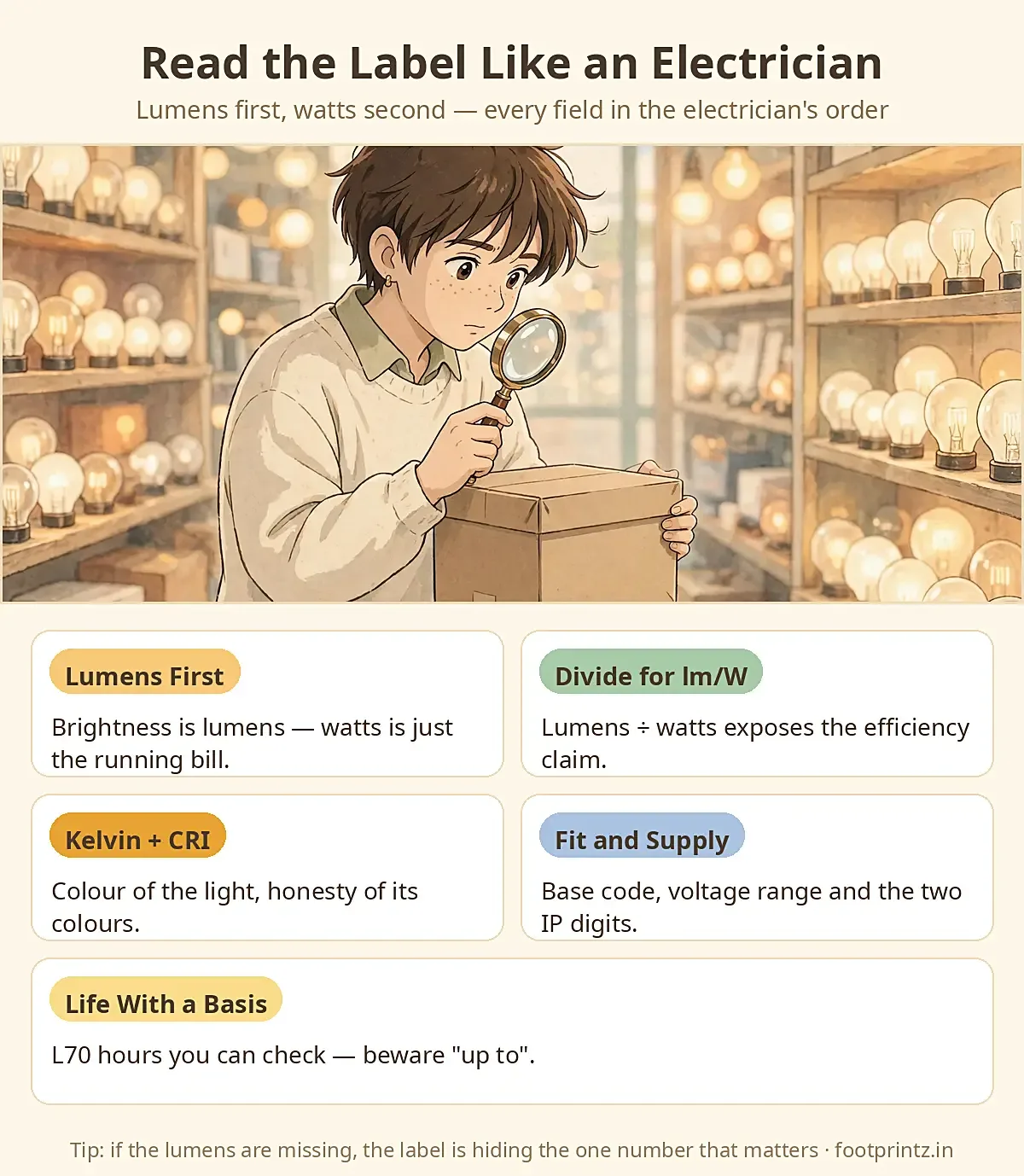
The routine, compressed: lumens → watts → divide → Kelvin and CRI → base and voltage → IP and PF if relevant → life, L70 or "up to". Sixty seconds, once it's a habit.
Put the box back if you meet any of these:
- No lumens anywhere — only "equivalent to 100 W" or a bare wattage in a huge font. Brightness is the product; a maker who won't state it is telling you why not.
- No voltage range — or a range that doesn't include your supply.
- No maker's name — no manufacturer or importer identity means nobody stands behind the other numbers either.
- A life claim with no basis — enormous hours, "up to" doing the heavy lifting, no L70 or test reference anywhere.
None of this needs equipment or apps. It needs the label, read in the right order — which is all the electrician's ten seconds ever was.
Sources: US DOE, "Lighting Facts" factsheet (lumens, watts, lm/W, CCT, CRI); ENERGY STAR, "Lighting Made Easy" (incandescent-equivalent lumen guide); BEE Schedule-20 for LED lamps and Ministry of Power notification S.O. 3631(E) (efficacy = lumens ÷ watts; star level basis; IS 16102 power-factor requirements); BEE label regulations (particulars displayed on the label); IEC 60061 cap codes (E27, B22); IEC 60529 (IP code); IES LM-80 / TM-21 (lumen maintenance and L70 life projection); CIE 13.3 (CRI/Ra and the R9 sample). Full source notes are kept with this post's research file.
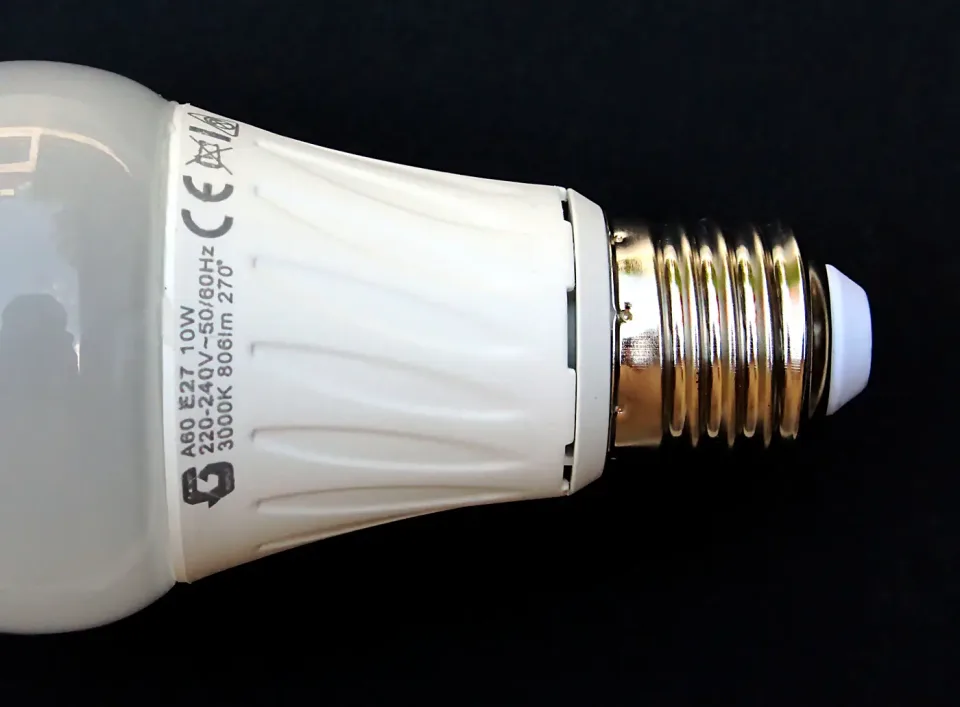
Featured photo: LED lamp with printed specifications, by Zátonyi Sándor (Fizped), via Wikimedia Commons — CC BY 3.0.
Frequently asked questions
Which matters more, watts or lumens?
Lumens, for choosing. Lumens tell you how much light you get; watts only tell you what it costs to run. Compare lamps by lumens first, then prefer the one that delivers those lumens for fewer watts.
What is a good lm/W for a home LED light?
Higher is better, and the division is the point — work it out from the printed lumens and watts rather than trusting an "energy saving" slogan. In India the BEE star grade is built on this same figure, so a high star count is a certified hint that the lm/W is strong for its class.
My room looks dull under a high-CRI lamp I bought. What else could be wrong?
Check the other colour field first: Kelvin. A very cool colour temperature can make a warm-decorated room feel flat even with good CRI. Also check the lumens — honest colour in too little light still looks dull. CRI, Kelvin and brightness are three separate fields doing three separate jobs.
Does a low power factor mean my lamp uses more electricity than its watts?
No. It draws more *current* than the watts alone suggest, but your home meter bills real power — watts over time — so the bill follows the watt figure. Low PF is a grid and wiring concern that matters at building scale, and a general quality tell about the driver.
Is a 50,000-hour life claim believable?
Ask what it rests on. Life figures are projections from lumen-maintenance testing, and the standard projection method caps how far test data may be stretched — so a very large claim needs a lot of test hours behind it. "Up to 50,000 hours" with no L70 and no test reference is a ceiling, not a promise.