
Guide
IP ratings decoded: what IP65, IP66 and IP67 actually promise
Two small digits decide whether an LED light belongs in your living room, your garden or your pond — and they are misread constantly. The first digit of an IP rating grades dust and solid objects, the second grades water, and each one names a specific laboratory test: a nozzle size, a flow rate, a depth, a number of minutes. This post decodes both scales exactly as the standard writes them, climbs the ladder you'll actually meet — IP20, IP44, IP65, IP66, IP67, IP68 — and then deals with the traps: why IP65 drowns, why a bigger water digit doesn't quietly include the smaller tests, why the rating lives or dies at the cable entry, and why a bathroom is really a map of zones. By the end you'll read any IP code the way an electrician does, and know what to buy for each spot.
"Waterproof," says the box. Underneath, in smaller print: IP65. Those two statements are not the same statement, and the gap between them is where outdoor lights go to die. An IP rating is not an adjective. It is the result of a laboratory test with a defined nozzle, flow rate, depth and duration — and once you know which test each digit stands for, the code stops being marketing and starts being a promise you can hold a light to.
The letters stand for Ingress Protection, and the system is IEC 60529, the international standard for how well an enclosure keeps things out. Two digits follow the letters. Read them separately, because they answer different questions.
How to read the code
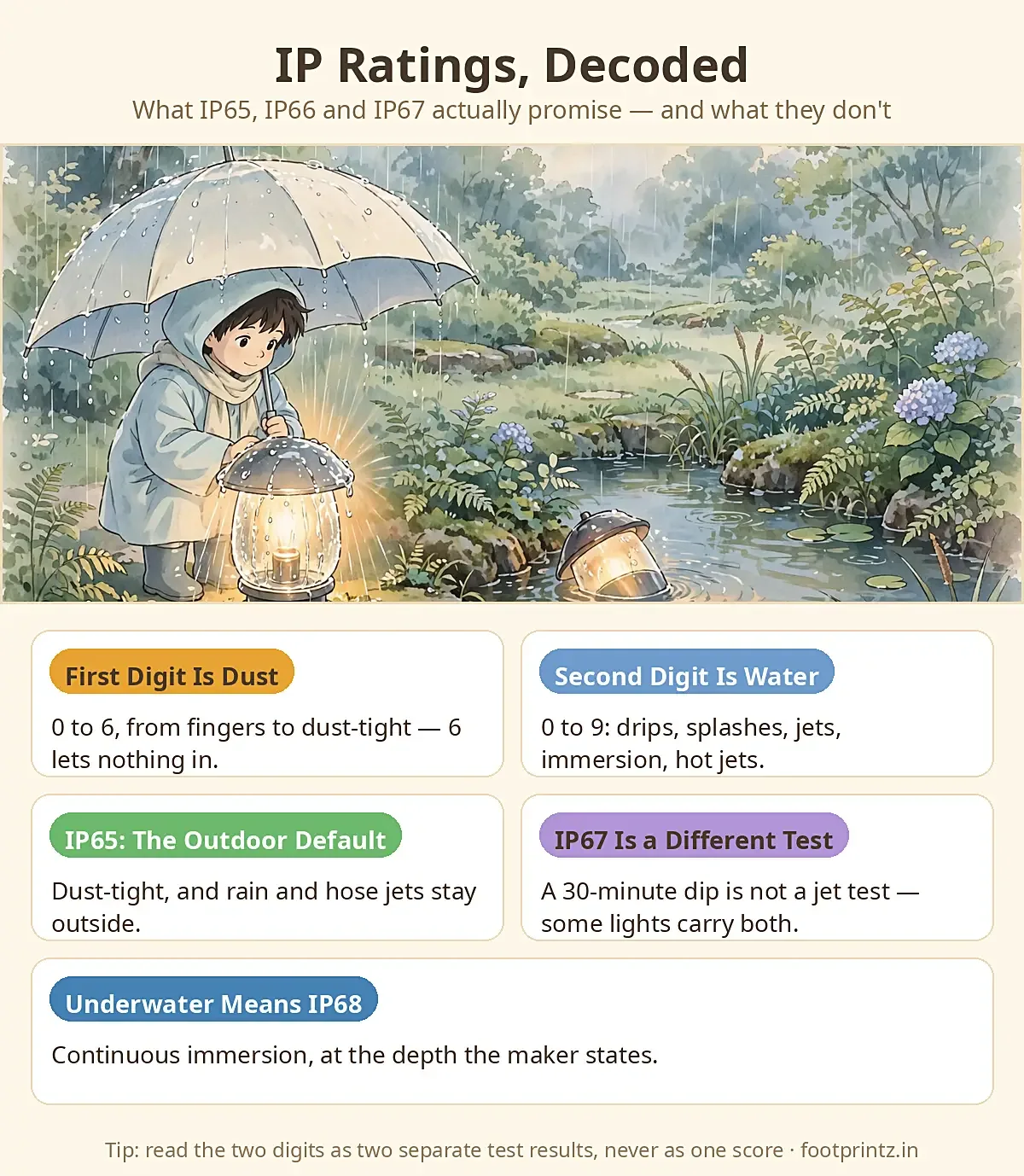
The first digit, 0 to 6, grades solids — and it does two jobs at once. It says how well the enclosure keeps solid objects and dust out, and how well it stops you touching anything hazardous inside. It climbs from nothing (0), past the back of a hand (1, objects over 50 mm), a finger (2, over 12.5 mm), tools and thick wire (3, over 2.5 mm) and thin wires (4, over 1 mm), to the two dust grades. A 5 is dust-protected: a little dust may get in, but not enough to interfere. A 6 is dust-tight: none gets in at all, in a test that pulls a vacuum on the enclosure and leaves it in a dust chamber for hours. Six is the ceiling. There is no 7 for dust.
The second digit, 0 to 9, grades water, and each step is a different test:
| Digit | The test, in plain words |
|---|---|
| 0 | No protection |
| 1 | Water dripping vertically |
| 2 | Dripping water, enclosure tilted up to 15° |
| 3 | Spraying water, up to 60° from vertical |
| 4 | Splashing water from any direction |
| 5 | Water jets — 6.3 mm nozzle, 12.5 litres a minute |
| 6 | Powerful jets — 12.5 mm nozzle, 100 litres a minute |
| 7 | Temporary immersion — 1 metre down, 30 minutes |
| 8 | Continuous immersion — depth and time stated by the maker |
| 9 | Close-range jets of hot water at high pressure (80 °C) |
And the letter X? It fills a position that wasn't tested or declared. IPX4 is splash-tested for water and says nothing either way about dust. X does not mean zero — it means nobody checked. That distinction matters when a fitting shows you only the digit it passed.
The ladder you'll actually meet
IP20 is the ordinary indoor fitting: finger-proof, no water protection at all. Perfectly correct for a living room or bedroom ceiling, wrong anywhere damp. IP44 keeps out wires and shrugs off splashing from any direction — the damp-room grade, at home in bathrooms away from direct spray and under porches and eaves. IP65 is dust-tight and jet-proof, and it is the outdoor default for a reason: rain, wind-blown dust and a garden hose are all inside its test. IP66 faces the same dust test but a far heavier jet — eight times the water per minute — for exposed sites, coastal weather and places that get hosed down hard.
Then the ladder changes character. IP67 is dust-tight and survives temporary immersion: half an hour, a metre down. IP68 is continuous immersion — but note what the standard does with it. It does not fix a depth. It requires the maker to state conditions more severe than IP67's, so an IP68 claim is only as good as the depth and duration printed next to it. An IP68 light with no stated depth is a sentence with the ending missing.
Trap one: the digits are not a ladder above 6
Here is the misunderstanding that floods fittings. The water tests up to 6 build on each other. Above 6, they split. Jets and immersion are different attacks: a jet is moving water with pressure behind it, trying to force its way past a seal; immersion is still water pressing quietly and constantly on every seam at once. Passing one says nothing about the other. The standard is blunt about it: a light rated IP67 is not automatically rated for the IP65 or IP66 jet tests.
That is why honest datasheets sometimes carry two markings — IP65/IP68, say — meaning the enclosure sat both exams. And it cuts both ways. An IP65 garden light left sitting in a flooded flower bed is outside its promise, however tough the box sounded. IP65 handles water that arrives and leaves. Water that stays is an immersion problem, and immersion starts at 7.
Trap two: the rating belongs to the box, as tested
An IP rating certifies an enclosure in the condition it was tested — seals intact, cover fitted, every opening closed the way the maker closed it. Your installation then gets a vote. The usual weak point is where the cable enters: an entry sealed with a gland rated below the enclosure, or a gland left loose, drops the whole fitting to that entry's level, whatever the badge says. A cover refitted crookedly after a repair, a gasket nicked or perished with age, an extra hole drilled for convenience — each one quietly rewrites the rating. The tests are also done with fresh water. Salt water, oils, solvents and cleaning chemicals are simply not in the code; a coastal fitting needs materials chosen for salt, not a bigger digit.
One quieter failure deserves a mention too: condensation. A well-sealed light warms up and cools down every day, and moisture that forms inside a sealed box has nowhere to go. The rating keeps weather out; it was never a promise about the weather a fitting makes for itself.
IP is not toughness
Knocks are a different code entirely. Impact resistance is the IK scale, from IEC 62262, running IK00 to IK10 — 20 joules at the top. A slim, well-sealed garden light can carry a proud IP66 and still crack the first time a ladder falls on it; a heavy knock can also bend a housing or disturb a gland and undo the IP seal without breaking anything you can see. If a light lives within kicking, parking or playing distance, read both codes. They were never substitutes.
You may also meet IP69K on heavy-duty fittings. The K is not from IEC 60529 at all — it comes from the road-vehicle standards (originally DIN 40050-9, now ISO 20653), written for vehicles that get steam-cleaned: dust-tight, plus hot water at high pressure, close up. The IEC's own version of that test is plain IPX9. Either way, it is a washdown grade, not a deeper-water grade.
Bathrooms are zones, not rooms
Near baths and showers, electricians don't ask "is it a bathroom light?" — they ask which zone. The zone system (from IEC 60364-7-701, carried into national wiring rules) sets a minimum by distance from the water. Inside the bath or shower tray itself — zone 0 — a fitting must pass the immersion test, IPX7, and run on separated extra-low voltage. Directly above the bath or shower, up to 2.25 m — zone 1 — the minimum is IPX4, rising to IPX5 where jets are used for cleaning. The band 0.6 m beyond that — zone 2 — is also IPX4. Beyond the zones no minimum is set, though splash-proof IP44 is the common sense choice in a steamy room. Your local wiring rules fix the exact figures, and fittings inside the zones are an electrician's job — but the logic is universal: the closer to the water, the higher the digit must climb.
So, what do you buy?
Match the test to the water the light will actually meet. Dry indoors: IP20, and spend the savings elsewhere. Bathroom ceiling and mirror lights outside the spray: IP44. A garden light in open rain: IP65, mounted so water runs off rather than pools around it. The same light on an exposed wall that takes the weather full-face, or near a pressure-washed driveway: IP66. A fitting at ground level where water can stand after a storm: IP67. And a light that will live underwater — pond, fountain, pool — IP68, with the maker's stated depth comfortably deeper than yours.
The code was never complicated. It only punishes people who read it as a score. Read it as two test results, and it tells you the truth.
Sources: IEC 60529 (Degrees of protection provided by enclosures — IP Code); IEC 62262 for the IK impact code; ISO 20653 for IP69K; bathroom zone minima per public guidance to BS 7671 Section 701, the national adoption of the IEC 60364-7-701 zone concept.
Featured photo: "Street lamp in a rainy night, Lisbon" by Jules Verne Times Two, via Wikimedia Commons — CC BY-SA 4.0.
Frequently asked questions
Is IP65 waterproof?
It is jet-proof, not waterproof in the swimming sense. IP65 means dust-tight and tested against water jets from a 6.3 mm nozzle — rain, splashes and a garden hose are covered. It is not tested for immersion, standing water or pressure washing, so don't set an IP65 light in a puddle or aim a pressure washer at it.
Is IP67 better than IP65?
Different, not simply better. IP67 trades the jet test for a 30-minute immersion test, and the standard does not treat the water digits as cumulative above 6 — an IP67 light hasn't necessarily passed the jet tests at all. If a fitting faces both hosing and flooding, look for a dual marking such as IP66/IP67.
What does the X mean in IPX4 or IP6X?
That position was not tested or not declared — it is a blank, not a zero. IPX4 promises splash protection and says nothing about dust; IP6X promises dust-tight and says nothing about water. Treat the missing digit as unknown, never as passed.
What IP rating does a pond or pool light need?
IP68 — continuous immersion — and only with the depth and duration the maker states, since the standard leaves those numbers to the manufacturer. IP67 covers a brief, accidental dip (1 metre, 30 minutes), which suits a fitting that might flood occasionally, not one that lives underwater.
My outdoor light is IP65 but there's moisture inside. How?
Most likely the installation, not the badge. Water usually enters at the cable entry if the gland is under-rated or loose, past a gasket that wasn't seated when the cover went back on — or it never entered at all: condensation forms inside sealed fittings as they warm and cool. The rating certifies the enclosure as tested, with its seals intact.