
Guide
LED driver safety: constant current, constant voltage, polarity and earthing
Every LED light has a translator between the wall socket and the chip: the driver. It takes mains AC in and serves the low-voltage DC an LED can actually eat — and almost everything about the light's safety is decided by which kind it is and how it is wired. This post explains the two driver families in plain words: constant current, which feeds most downlights and COB boards a fixed number of milliamps, and constant voltage, which feeds 12 V and 24 V strips a fixed voltage — and why swapping them is not a harmless experiment. It covers polarity, the earthing classes you can read off a label (including the square-inside-a-square symbol), why cheap non-isolated drivers deserve suspicion in metal fittings, and how to match a replacement driver by its output numbers rather than its shape.
The LED is the glamorous part of an LED light, but it never meets your wall socket. Between the two sits a small, unlovely box — the driver — and that box is where safety is mostly decided. It takes in mains AC at full household voltage and serves the chip the low-voltage DC it can actually use. Pick the wrong kind, wire it backwards, or leave its earth off, and a good chip becomes a hazard or a casualty. The good news: everything you need is printed on the label, once someone translates it.
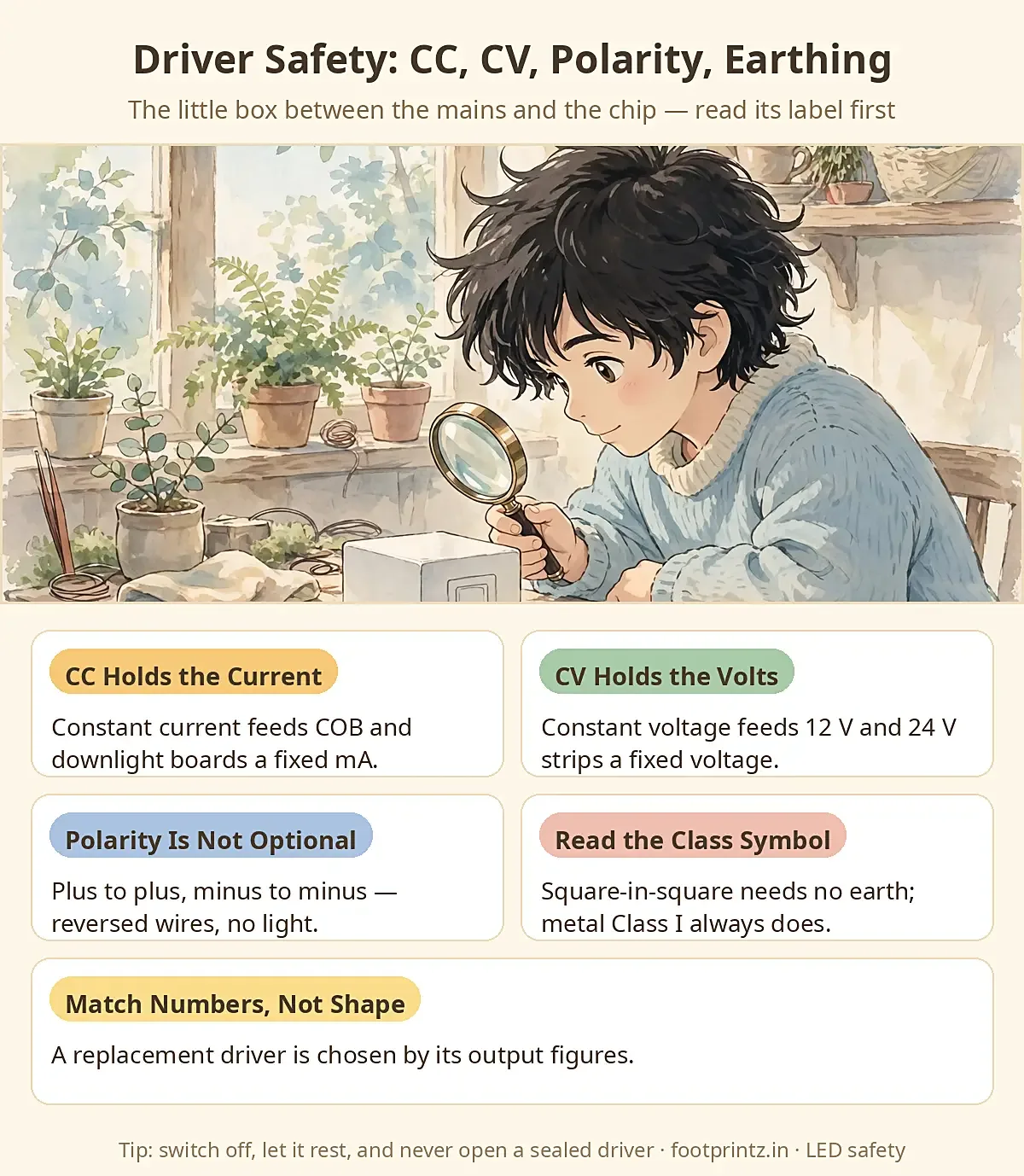
Two families: one fixes current, the other fixes voltage
Drivers come in two families, and the IEC 61347 standards for LED control gear treat the split as fundamental.
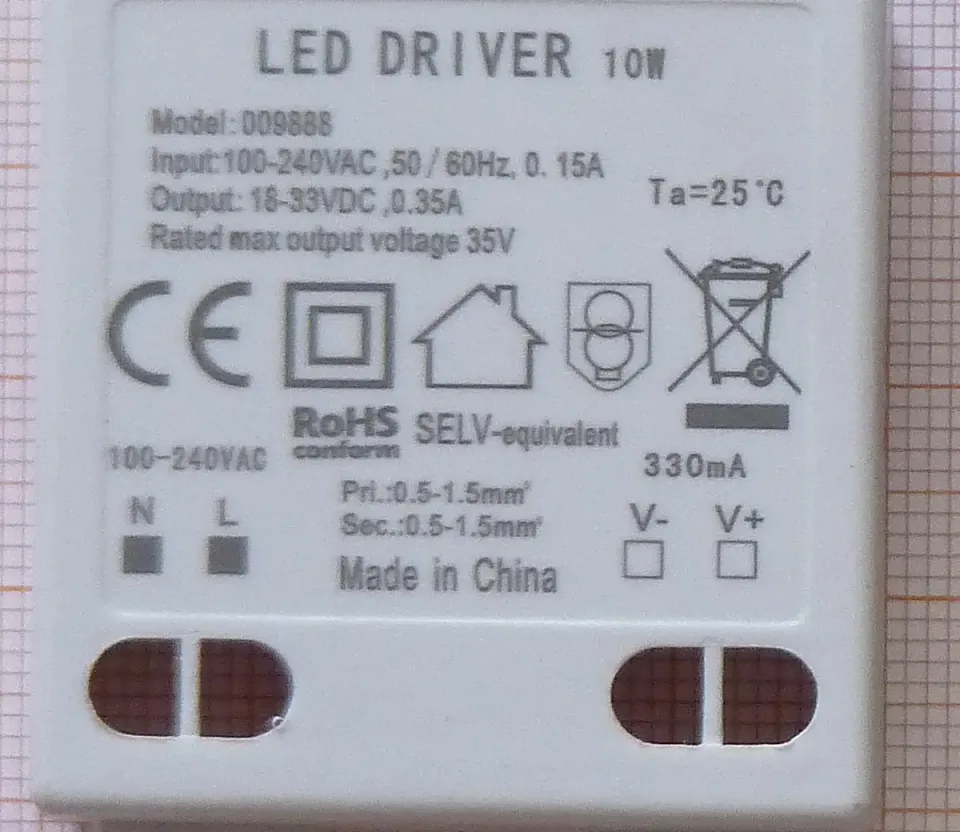
A constant-current driver (CC) holds its output current fixed, at a stated number of milliamps, and lets the output voltage rise or fall inside a stated window to suit the LED string connected. A label might read "Output: 350 mA, 18–33 V DC". This family feeds most downlights, panel boards, COB modules and high-power fittings — any load whose maker specifies a current rather than a voltage.
A constant-voltage driver (CV) does the opposite: it holds one fixed DC voltage — 12 V or 24 V, almost always — and lets the current vary up to its rated maximum. This family feeds LED strips and tape, and it works because each cuttable strip segment carries its own current-limiting parts on board; the strip sips from a fixed voltage rather than being force-fed a fixed current.
The families are not interchangeable, in either direction. Feed a CC load from a CV supply and nothing regulates its current — see the next section for where that ends. Feed a strip from a CC driver and the driver keeps raising its voltage, hunting for its set current, up to the top of its window — voltage a 12 V strip was never built to see. "It fits and the light came on" is not evidence the pairing is right; it is evidence it hasn't failed yet.
Why the current has to be fixed at all
An LED has no self-control. Below its forward voltage it passes almost nothing; above it, the current climbs steeply — a rise of a few percent in voltage can roughly double the current through a power LED. Worse, the relationship moves as the chip warms up: a hot LED's forward voltage drops, so on a fixed voltage it draws more current, grows hotter, and drops further. Engineers call the loop thermal runaway; in plain words, the chip cooks itself in a spiral, and fades or dies long before its rated life.
A constant-current driver breaks the loop by refusing to play: whatever the chip's voltage does with temperature, the current stays where it was set. Current is the number the chip lives or dies by.
Polarity: the + and the − are not a suggestion
Direct current has a direction, and an LED passes it one way only. Every driver marks its output terminals + and − (or V+ and V−), and every strip, board and module marks its own. Plus lands on plus, minus on minus. Get it backwards and the usual result is mercifully boring: nothing lights. But "usually" is doing work in that sentence — some modules and controllers can be damaged by reverse connection, and cheap units rarely print their limits. So wire polarity with the power off, check before switching on, and treat a dark load as a wiring question first — not a reason to swap live wires around and see what happens.
Earthing: read the class off the label
Whether a fitting needs its earth wire is not a matter of opinion. It is a design class, defined in the IEC protection-class system, and printed on the label.
Class I fittings protect you two ways: basic insulation, plus every touchable metal part bonded to the protective earth, so a fault that makes the body live trips the breaker instead. That protection exists only if the earth is actually connected — a Class I downlight with its earth left loose has its safety system unplugged. And household earth wiring is an electrician's job, not a first DIY project.
Class II fittings take the other route: double or reinforced insulation, so no single failure can put a dangerous voltage on the outside. They need no earth — often there is no earth terminal at all — and they announce themselves with the mark worth memorising: a small square inside a larger square. The driver in this post's photo carries exactly that symbol. If the square-in-square is on the label, the insulation is the protection.
Class III is the low-voltage end: the fitting runs from SELV (below), as a strip system does when its driver is a proper SELV unit.
SELV and isolation: the two quiet words that matter
SELV — safety (or separated) extra-low voltage — means the output is electrically separated from the mains by proper insulation and held within extra-low-voltage limits, so the output circuit is designed to be safe to touch: 12 V or 24 V from a genuine SELV driver will not give you a mains shock. But the word has to be earned by the whole design. Low voltage alone is not SELV, and a no-name unit printing the letters has not necessarily built the separation behind them.
That separation is the isolation question, and it is where the cheapest drivers cut their deepest corner. An isolated driver passes energy across a transformer barrier — no direct electrical connection between mains side and LED side. A non-isolated driver skips the barrier: a continuous path runs from input to output, so its LED board can sit at mains potential even while glowing at a "low" voltage. Non-isolated drivers are not automatically illegal — a maker can build a compliant product around one, by making the fitting's insulation do the protecting. The catch: you cannot see or test that insulation. So inside a sealed, double-insulated fitting, trust the maker's design; in anything metal-bodied, user-touchable or opened for maintenance, prefer an isolated, SELV-marked driver — and treat any unknown board as live until proven otherwise.
Handle drivers like sealed boxes — because they are
A driver is not a user-serviceable part. Its case is sealed because inside are components, including capacitors, that can hold a charge after switch-off — the wall switch is no guarantee everything inside has gone quiet. Never pry one open or probe its board; a dead driver is replaced, not autopsied. Any mains-side work — input terminals, earth, house wiring — belongs to a qualified electrician, full stop.
Replacing a driver: match numbers, not shapes
Drivers are the usual first failure in an LED light, so replacement is a normal job — and drivers are matched by their label's output numbers, never by whether the new box looks like the old one. Copy the dead driver's identity across: family first (CC or CV); then, for constant current, the same milliamps, with an output-voltage window that covers the old one; for constant voltage, the same voltage, with wattage capacity at least equal to the old unit. Carry over the safety marks too — same class symbol, SELV where the old one had it. A 700 mA driver is not an "upgrade" for a 350 mA board; it is double the designed current, and will spend the chips' lifespan in weeks. Label unreadable? Stop, and hand it to an electrician or a lighting shop.
None of this asks you to become an electrician — just to read one small label (family, current or voltage, polarity, class symbol) before trusting a box with your ceiling. Four checks, in plain sight.
Sources: IEC 61347-2-13 and IEC 62384 (LED control gear — constant-voltage and constant-current types, SELV requirements); IEC 61140 protection classes (Class I earth, Class II double insulation and the square-in-square symbol, Class III SELV); US Department of Energy solid-state lighting guidance on drivers and thermal behaviour; driver-maker technical notes on isolated vs non-isolated designs.
Featured photo: "10W LED driver" by Dmitry G, via Wikimedia Commons — CC BY-SA 3.0.
Frequently asked questions
Can I power a downlight board from a 24 V strip power supply? The voltage looks about right.
No. The board is a constant-current load, expecting a driver that fixes its milliamps. A constant-voltage supply fixes nothing about current, so the board draws whatever its temperature curve dictates — the thermal-runaway spiral. Match the family first, then the numbers.
I connected my strip backwards and it stayed dark. Have I killed it?
Probably not — a plain strip refuses to conduct in reverse, so darkness is expected. Switch off, swap so + meets + and − meets −, and try again. Still dark, or a module with a controller? Damage is possible; don't experiment under power.
My metal ceiling light has an earth wire in the ceiling but the fitting has only two terminals. What do I do?
Check the label for the square-inside-a-square mark. If it's there, the fitting is Class II, designed to run without an earth. No mark, metal body? Stop — that is exactly the situation an electrician should resolve, not a wire to leave tucked away.
Is a non-isolated driver always dangerous?
Not automatically — a well-made fitting can provide the insulation around one, and such products can be fully compliant. The problem is verification: you can't inspect that insulation from outside. In a metal or touchable light, an isolated, SELV-marked driver removes the doubt.
The switch is off. Can I open the driver to check a loose wire?
No. Drivers are sealed, non-serviceable units, and their capacitors can hold charge after switch-off. A loose wire on the low-voltage side can be re-seated with the fitting isolated — but the driver's case stays shut, and the mains side goes to an electrician.