
Guide
LED heat: why an LED light is hot inside, and why its driver dies first
Hold a lit LED light and it feels barely warm — nothing like the scorching glass of an old bulb. That cool feeling is real, and it is also a trick. Almost none of an LED's heat leaves in the beam, so it stays inside, concentrated at a chip smaller than your fingernail. This post follows that heat on its journey — chip, board, heatsink, room air — and shows where the journey gets blocked: dusty fins, closed shades, recessed ceilings, hot roof spaces. Then it looks at what the trapped heat quietly does. It fades the chip, year by year, toward the point the industry calls L70. And it cooks the electronics feeding the chip, especially one small can-shaped part whose liquid insides slowly dry out. That, more often than the chip itself, is why a light that promised decades dies in a few years — and why the same light can thrive in one home and fail fast in another.
Here is a puzzle everyone notices sooner or later. An LED light runs for hours and feels almost cool — yet the same model, in a friend's house, died within two years, while yours is still going after six. Both have the same explanation: heat. Not the heat you can feel. The heat you can't.
Cool to touch is not the same as cool inside
An old incandescent bulb throws most of its energy away as infrared — invisible heat radiation streaming out with the light. That is why the glass scorches. An LED barely radiates in its beam at all: its light is genuinely cool.
But electricity that doesn't become light doesn't vanish. In an LED it becomes heat at the junction — the tiny working heart of the chip, a speck you could cover with a match head. The US Department of Energy (DOE) puts it plainly: thermal management is arguably the most important part of LED system design, because all that heat has to be conducted away through solid parts. It cannot float off in the beam.
And here is the number that surprises people: under normal running at room temperature, with proper heatsinking, the junction inside still typically sits at 60 °C or more. The surface you touch is the end of a long cooling chain. The chip, at its start, is hot.
The thermal chain: four links between chip and room
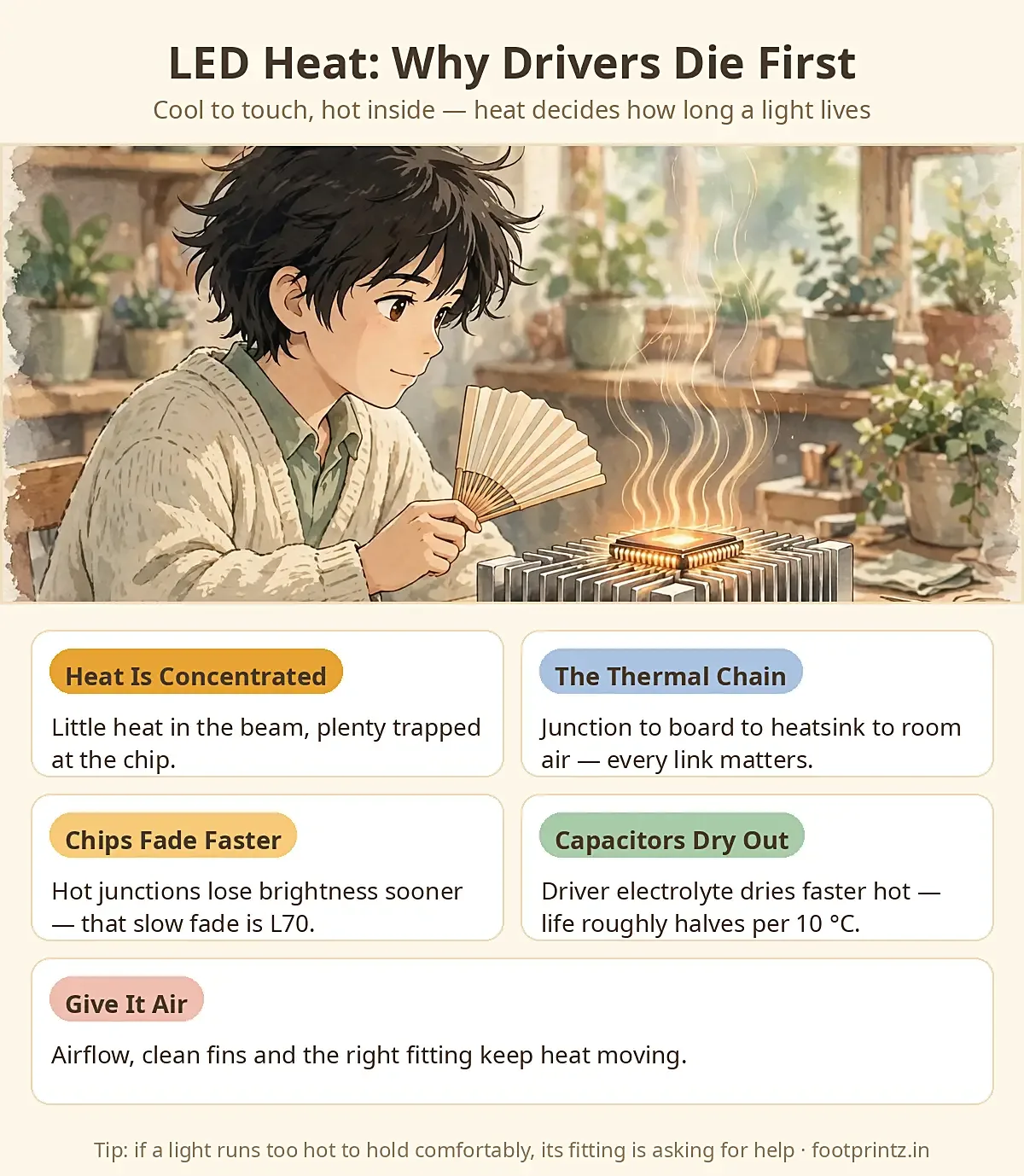
Heat escapes an LED light along a fixed path, only as fast as its narrowest point allows. The DOE describes the usual chain — four links.
Link one: the junction. Heat is born in the chip, in a space a few millimetres across. Everything downstream serves this speck.
Link two: the board. The chip is soldered to a metal-core circuit board — usually aluminium — which spreads the heat sideways, over a wider area.
Link three: the heatsink. The board is fixed to a heatsink: often that ribbed or finned metal body on a light's back or base. Fins are not decoration — each one adds surface area, and surface area hands heat to the air. In many designs the whole metal body is the heatsink.
Link four: the room air. Air drifting past the fins carries heat away. Trapped air does this badly; moving air does it well.
Three things decide how hot the junction ends up, according to the DOE: the drive current, the quality of that thermal path, and how warm the surrounding air already is.
Where the chain breaks
Dust. Fins work by touching air. Kitchen grease and household dust coat them like a blanket, and the heatsink's skin no longer meets clean moving air.
A closed shade. A bulb designed to breathe in open air, screwed into a sealed shade, recycles its own heat — and hot surrounding air pushes junction temperature straight up.
A recessed ceiling. A downlight buried in a ceiling void, insulation packed around it, gives its heat nowhere to go. It is wearing a winter coat indoors.
A hot roof space. Summer air inside a roof or false ceiling can be far hotter than the room below. A driver up there starts every evening heat-soaked.
An oversized bulb in a small fitting. More power means more heat. Cram a bigger bulb into a smaller fitting and you raise the heat while shrinking its escape space — the worst trade here.
Harm one: heat makes the chip fade
LEDs rarely die the way filament bulbs do, with a ping and darkness. Left to themselves, they fade — losing brightness and shifting colour slightly as the years pass. Heat speeds that fading up. The DOE separates the effects: while a chip runs hot, output drops and colour shifts, reversibly. Run it hot continuously, though, and the fading becomes permanent — accelerated lumen depreciation, in the industry's language.
Because fading is gradual, the industry needed a definition of "worn out", and it chose L70: the operating hours after which output has fallen to 70% of what it was when new. Not off — just noticeably dimmer. Behind the claim sits a careful system: a test method called LM-80 measures how LED packages hold brightness over at least 6,000 hours at set temperatures, and a companion method, TM-21, projects those measurements forward — sensibly capped at six times the hours actually tested.
How much does temperature matter? In one DOE-published comparison, two identical LEDs ran at the same current, one with a junction 11 °C hotter. The hotter one's estimated L70 life fell from about 37,000 hours to about 16,000. One device family, not a law of nature — but a few degrees, sustained for years, are not a detail.
And one warning about box numbers: L70 describes the chip. It says nothing about the electronics feeding it — where most early deaths actually happen.
Harm two: heat cooks the driver, one small part first
Between the mains and the chip sits the driver — the small power supply in a bulb's base or a fitting's body, converting household AC into the steady DC current an LED needs. The DOE's luminaire lifetime guidance is blunt: driver electronics can be as important a reliability concern as the LED sources themselves, sometimes more, and driver failure is the likely eventual cause of a light simply stopping.
Inside most drivers, one component ages fastest: the aluminium electrolytic capacitor, a small can holding liquid electrolyte. Its job is to smooth the power. Its weakness is that the liquid slowly evaporates over its life — and heat makes it evaporate faster. As it goes, capacitance falls and resistance rises, until the driver can no longer deliver clean, steady current.
Capacitor makers put a rule of thumb on this, drawn from the Arrhenius equation governing how fast chemical ageing runs. Roughly: for every 10 °C rise in the capacitor's own temperature, its expected life halves; for every 10 °C fall, it doubles. Treat it as what it is — a rule of thumb for that one component, not a promise about a whole light — and remember its own temperature includes heat it generates itself, so it runs hotter than the room. Even so, the direction is steep: a driver baking in a hot ceiling void ages its capacitors several times faster than the same driver in cool, open air.
How a dying driver announces itself
A fading chip dims politely over years. A dying driver misbehaves, in a recognisable pattern.
It flickers — sometimes obviously, sometimes as a shimmer at the edge of vision — because the driver can no longer smooth its output. It starts slowly, pausing or glowing weakly where it once snapped on. It buzzes, as strained components sing. And most tellingly, it dies young while its twins live: four identical lights bought together, three fine after years, one dead. Identical drivers in different fittings do that — because the dead one's fitting was the hot one.
These are signs, not proof — the honest test is a swap, seeing which fitting the problem follows. But in a light only a few years old, suspect the driver before the chip.
Same light, two homes
Now the opening puzzle solves itself. Take one LED light and install it twice.
In the first home it hangs in an open fitting in a breezy room, a few hours each evening. Its heatsink breathes, its driver stays relatively cool, and it will probably outlive its box claims.
In the second, the same light is sealed in a shade in a steaming kitchen, under a baking roof, on twelve hours a day. The DOE's three factors have all turned against it — same current, strangled thermal path, hotter air — and its driver ages at multiples of the first one's rate. Add a rough mains supply with spikes, which capacitor makers count among the stresses in their lifetime models, and "identical" lights living wildly different lives stops being a mystery. It is arithmetic.
Habits that keep LED lights alive
None of this asks for money. It asks for air.
Give the light room to breathe. Open fittings over sealed shades, and never pack insulation tight around a recessed light unless it is rated for that.
Match the bulb to the fitting. Heat must suit the space. If a fitting is marked with a maximum wattage, treat it as a heat limit, not a brightness suggestion — and if a light is marked not for enclosed fittings, believe it.
Clean the fins. Now and then, power off and light cool, wipe dust off heatsink fins and fitting tops, especially in kitchens. You are removing a blanket.
Feel the body when you buy. A light whose body is solid metal — a real heatsink with some weight to it — has somewhere for its heat to go. A featherweight all-plastic light of the same claimed brightness may not keep its promise. Weight is not quality by itself, but here it is a clue.
Mind the hot rooms. Kitchens, sun-baked porches and roof spaces are the hardest lives. Where a light must work there, choose one built generously — bigger body, honest ratings — not the smallest, hottest-running option.
The chip in a decent LED light is rarely in a hurry to die. Heat is what hurries everything — the chip's slow fade, and far sooner, the little capacitor drying out. Keep the heat moving, and the light keeps its side of the bargain.
Sources: US Department of Energy — "Thermal Management of White LEDs" fact sheet and "LED Luminaire Lifetime" guide (driver and capacitor reliability); Illuminating Engineering Society — LM-80 and TM-21 (lumen maintenance measurement and projection, L70); capacitor manufacturer engineering guidance on electrolytic capacitor life and temperature.
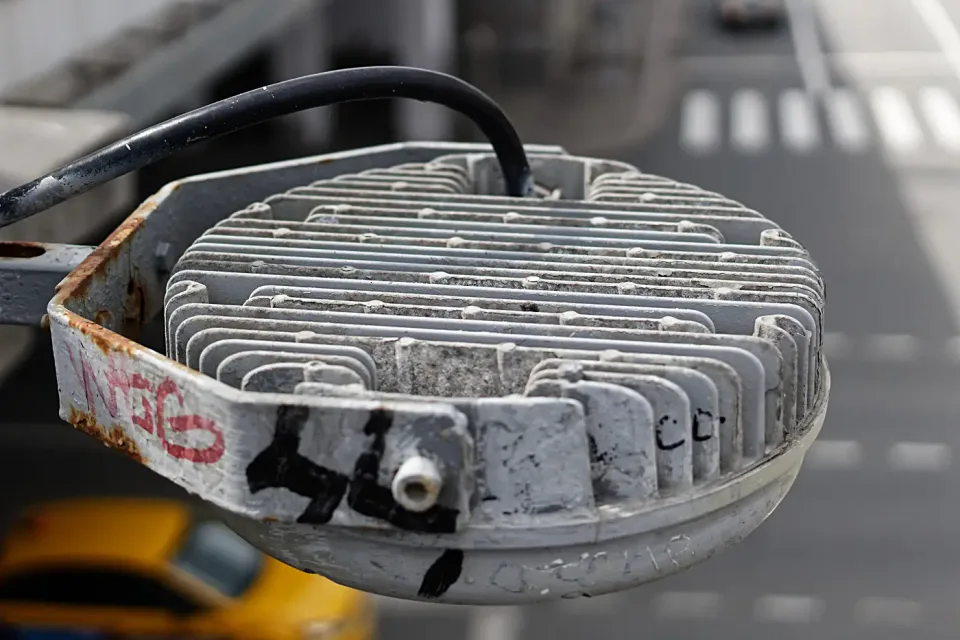
Featured photo: "LED floodlights — heatsinks" (Moscow, Novospassky Bridge) by Retired electrician, via Wikimedia Commons — CC0.
Frequently asked questions
Why does my LED light feel cool if it's hot inside?
Because almost none of its heat leaves in the light beam, unlike an old bulb that pours out infrared. The heat stays at the chip and travels out slowly through the metal body — so the surface can feel mild while the junction inside runs at 60 °C or more.
What is L70, in simple words?
It's the industry's definition of an LED's useful life: the number of running hours after which its brightness has faded to 70% of what it was when new. The LED hasn't failed — it's just meaningfully dimmer. Figures come from LM-80 measurements projected forward by the TM-21 method.
My LED light flickers and buzzes. Is the chip dying?
Probably not the chip. Flicker, buzzing and slow starting are classic signs of a tiring driver — most often its electrolytic capacitors drying out with heat and age. A swap test settles it: if the problem follows the light to a different fitting, the light (and likely its driver) is at fault.
Does leaving an LED light on longer wear it out faster?
Running hours are what life ratings count, so a light used twelve hours a day reaches any hour-based limit sooner than one used three hours a day. Heat makes it worse: a light that never gets a chance to cool, in a hot fitting, ages its driver faster per hour as well.
Can dust really shorten an LED light's life?
Indirectly, yes. Dust coats the heatsink fins that are supposed to hand heat to the air, so the light runs hotter — and running hotter is what accelerates both the chip's fading and the driver's ageing. A quick wipe with the power off removes the problem.