
Guide
Dead LED lights and solar batteries: safe disposal and battery basics
Every home now has a small graveyard of dead lights: a bulb that faded, a strip that quit, a solar garden light that stopped bothering. The bin feels like the obvious ending, and it is the wrong one. In India a dead LED light is e-waste under the E-Waste (Management) Rules, 2022 — lighting equipment is written into the rules, and producers carry recycling targets they can only meet through registered recyclers. This post covers where a dead light should actually go, what recyclers recover from it, and the part most people never think about: the rechargeable battery hiding inside every solar light. How to tell a tired cell from a dangerous one, why swollen means stop, how to store spares safely, and why most "dead" solar lights need a new battery, not a funeral.
Sooner or later every LED light dies, and what happens next is usually the dustbin — dropped in with the potato peels, forgotten by morning. It feels harmless: a bulb is small, it isn't leaking anything, and unlike the old tube lights it contains no mercury. But a dead LED light is not kitchen waste. It is a small piece of electronics — a driver circuit, a metal body, a board of chips — and electronics have their own waste stream, rules and collection points. And if the dead light is a solar one, there is a battery inside it that deserves more respect than a toss into the bin.
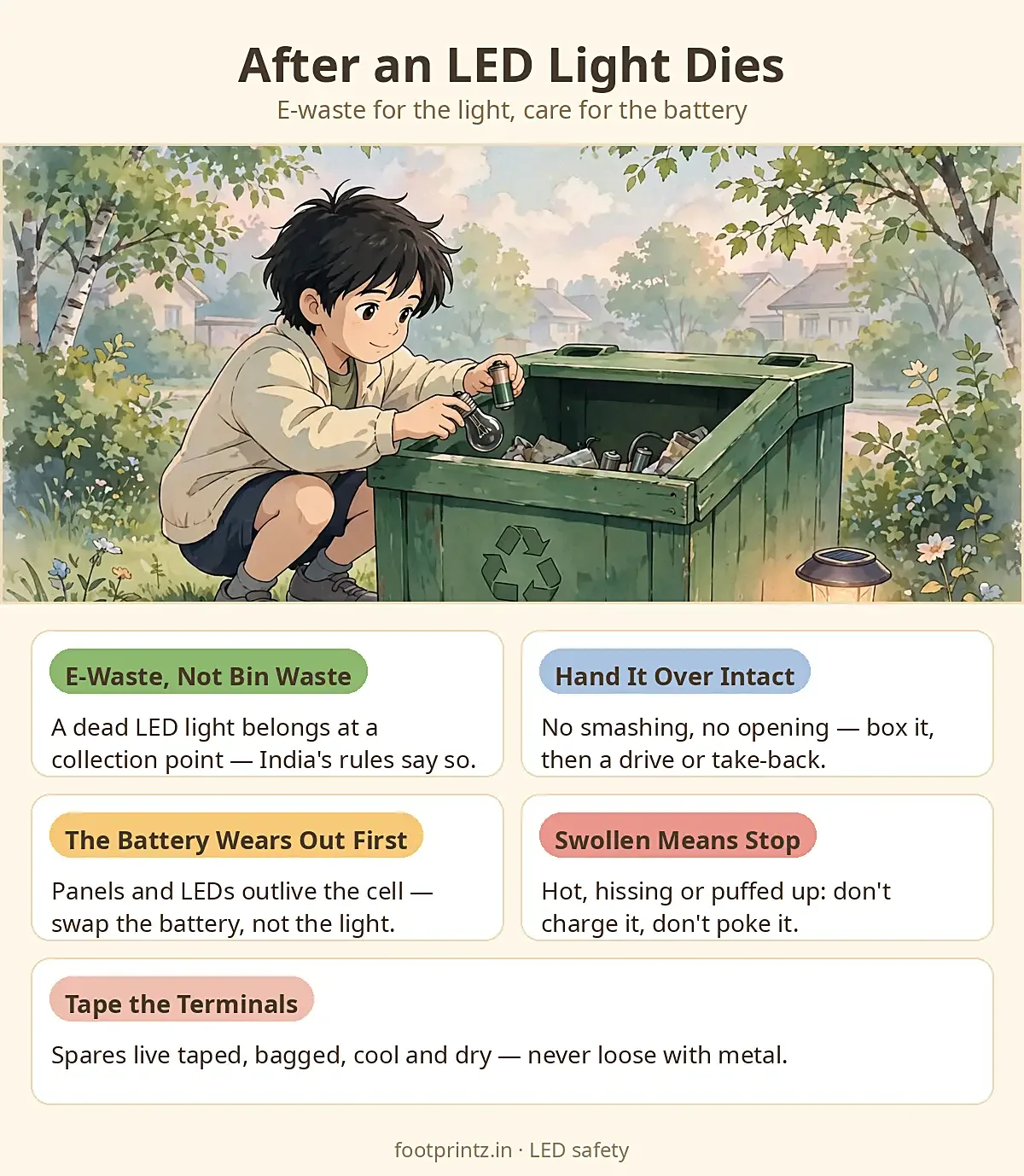
A dead LED light is e-waste — the rules say so
India's E-Waste (Management) Rules, 2022, in force since April 2023, list the equipment they cover in a schedule — and lamps and lighting equipment are in it: fluorescent and mercury-containing lamps, luminaires, discharge lamps, and a catch-all for "other lighting or equipment for the purpose of spreading or controlling light". Tellingly, the only bulb type the schedule names as excluded is the old filament bulb. An LED light — bulb, tube, panel, strip — is lighting equipment with electronics inside, and at the end of its life it is e-waste.
The framework also puts duties on the companies that sell these lights: under extended producer responsibility, producers carry recycling targets that may only be met through recyclers registered with the Central Pollution Control Board. That is why collection drives, take-back counters and authorised collection points exist — the system needs your dead light back. Discarded solar panels and cells are named in the same schedule, so a dead solar light is covered at both ends.
Does it matter, for one small bulb? Look at what a recycler pulls out of it: a plastic cover, metal housing and screw base, the driver circuit board, and the aluminium heatsink the chips sit on — with aluminium, copper and small amounts of silver among the recovered metals. Per bulb it is grams, not riches; recovery pays in bulk, which is why collection matters. And the no-mercury point cuts the other way than most people assume: an LED light is far cleaner than a CFL, but its solder can contain small amounts of lead, and its driver is a circuit board. Clean enough to handle safely, electronic enough to keep out of a landfill.
Handing a dead light over, the easy way
None of this asks much of you. Keep the light whole — one piece, as it came off the fitting. Smashing, opening or stripping a dead light at home helps no one; dismantling is the recycler's job, and a bulb that arrives intact is safer to transport.
Then use any route the system offers: municipal e-waste collection drives (most cities run them, often on announced weekends), retailer take-back at the counter — ask when you buy the replacement — or a producer collection point or authorised e-waste collector. The habit that makes it effortless is a box: keep one in a store-room corner, drop dead bulbs, tubes and small lights into it as they die, and empty it at a drive once or twice a year. Dead lights stop being clutter and start being a single trip.
The hidden half of a solar light: its battery
A solar light is really three products wearing one coat: a small solar panel, an LED, and a rechargeable battery in between — the part nobody sees, and the one almost everything depends on. What you find inside depends on the size of the light:
| Battery type | Voltage | Usually found in |
|---|---|---|
| NiMH (nickel-metal hydride) | 1.2 V per cell | Garden, path and string lights — AA or AAA |
| NiCd (nickel-cadmium) | 1.2 V per cell | Older solar lights; being phased out |
| Lithium-ion | 3.7 V per cell | Brighter floodlights and security lights, often 18650-size |
| LiFePO4 (lithium iron phosphate) | 3.2 V per cell | Newer, better solar lights; the long-life option |
In plain words: NiMH is the gentle workhorse — cheap, tolerant, easy to replace like-for-like. NiCd is its older relative; if an old light has one, a NiMH cell of the same size is the standard modern swap. Lithium-ion packs more energy into a small space, which is why brighter lights use it. LiFePO4 is a calmer lithium chemistry, known for shrugging off heat and lasting through many more charge cycles.
Two rules protect you here. First, read the old cell before buying: its chemistry, voltage and size are printed on it, and the replacement must match all three — a 3.7 V lithium cell in a slot built for 1.2 V is nearly triple the intended voltage. Second, never put an ordinary alkaline AA in a solar light "just to try": it is not rechargeable, the panel will keep trying to charge it, and leaking or swelling is how that ends.
Most dead solar lights need a battery, not a funeral
Here is the good news: when a solar light stops working, it usually hasn't died. The panel and the LED are the long-lived parts of the trio. The battery is the wear part — a cell asked to charge by day and discharge by night, outdoors, in heat and rain — and after a few years it simply holds less and less. The symptoms match: the light comes on at dusk but gives up by nine, or glows dimly where it once shone.
If your light has a battery compartment that opens — many garden and path lights do, with a small cover or a couple of screws — a like-for-like cell, matched for chemistry, voltage and size, is very often the whole repair. Treat the old cell as battery waste (below) and fit the new one. If the light is sealed with no way in, don't force it open — it goes whole into the e-waste stream.
When a battery is finished — and when it's dangerous
A tired battery fades. A dangerous battery announces itself, and the announcement is always a reason to stop, never to tinker. The warning signs are the same across fire-service and regulator guidance: the cell or device has swollen or changed shape; it gets unusually hot; it hisses, pops or makes other sounds; it leaks, smells strange, smokes, or is physically damaged. Any one of these means: stop using it. Do not charge it — charging a damaged cell is how a bad situation becomes a fire. Do not press on a swollen cell, flatten it, or puncture it to "let the gas out": puncturing a swollen lithium cell can trigger fire on the spot. Keep it away from heat and anything flammable.
If a battery is hot, hissing or smoking, don't pick it up or try to move it — move people away and call the fire service. If it is cool and quiet but swollen or damaged, it still skips the ordinary routes: tell the collection point the cell is damaged, because damaged batteries get separate handling. And healthy-but-dead lithium cells follow one firm rule everywhere: never into household rubbish or the recycling bin. The US Environmental Protection Agency's reason is blunt — batteries crushed in collection trucks and sorting machines start fires, more than 240 of them at American waste facilities in under a decade.
Storing spares without starting a fire
Spare and removed batteries cause trouble in a boring way: two terminals, one piece of metal, a short circuit. The standard defence is simple, and it is also the US EPA's preparation advice for batteries going to recycling: tape over the terminals of each loose cell with ordinary electrical tape, or keep each battery in its own small plastic bag. Store them cool and dry, away from radiators and sunlight, never rattling loose in a drawer or tin with keys, coins or tools — metal across both terminals is a short, and a short is heat. Keep them out of children's reach: small cells are a swallowing hazard too. And don't let "waiting for a collection trip" become years.
Bigger batteries at home: the short version
The same respect scales up to the bigger rechargeable batteries around the house — power banks, tool packs, home storage batteries. The basics are the fire services' standard list. Charge with the charger and cable the maker supplied or approved; a random charger that happens to fit is not the same thing. Charge on a hard, flat surface in a ventilated spot, out of direct sun and away from anything that burns — not on a bed, not under a pile of cloth. Charge larger batteries while someone is home and awake, and unplug when full. The warning signs above apply unchanged, with bigger consequences: swelling, heat, hissing, leaks or a strange smell mean stop, unplug if that can be done safely, and get advice from the maker or a professional — big batteries are never a DIY repair.
An LED light asks for very little in life: the right voltage and a bit of airflow. In death it asks for one correct bin. The light goes to e-waste, whole and unbroken, through a collection drive or take-back; its battery — taped, bagged, never in the household rubbish — goes to battery collection. And before you declare a solar light dead at all, check the one part that was always meant to wear out. Most of the time the funeral was premature: it just needed a new battery.
Sources: E-Waste (Management) Rules, 2022 (MoEFCC, G.S.R. 801(E)) — Schedule I lighting categories, EPR through registered recyclers; US EPA, "Used Lithium-Ion Batteries" and lithium-ion battery recycling FAQ, and EPA report on lithium-ion battery fires in waste management (2021); University of Reading fire safety guidance on swollen batteries; NFPA lithium-ion battery safety guidance; Resources, Conservation and Recycling (2020) — recycling of end-of-life LED bulbs.
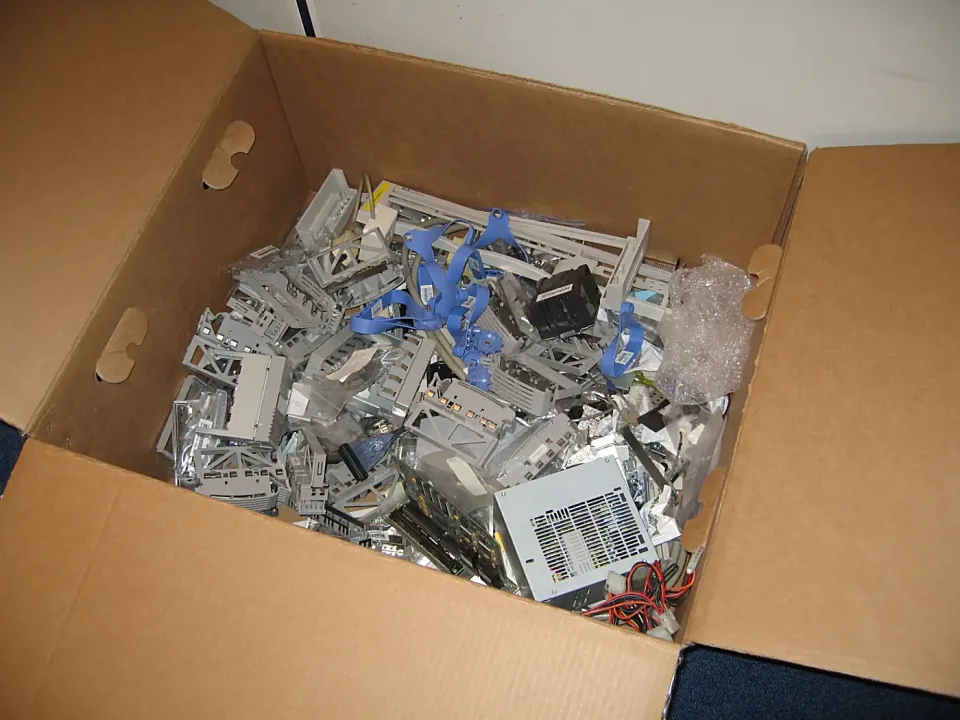
Featured photo: "Box of e-waste" by Jemimus, via Wikimedia Commons — CC BY 2.0.
Frequently asked questions
Can I throw a dead LED bulb in the household bin?
No. In India a dead LED light is e-waste: lighting equipment is listed in the E-Waste (Management) Rules, 2022, and only the old filament bulb is named as excluded. Keep dead lights in a box and hand them to a municipal e-waste drive, a retailer's take-back counter, or an authorised collection point.
My solar garden light has stopped working. Is it dead?
Probably not. The panel and the LED are the long-lived parts; the rechargeable battery is the wear part and fades after a few years of daily charge and discharge. If the battery compartment opens, a replacement cell matched for chemistry, voltage and size usually revives it. If the light is sealed shut, it goes whole into e-waste.
The battery in my solar light has swollen. What should I do?
Stop using the light and do not charge it. Never press, flatten or puncture a swollen cell to let the gas out — puncturing a swollen lithium battery can start a fire. Keep it away from heat and anything flammable, and take it to an e-waste or battery collection point, telling them the battery is damaged so it gets separate handling. If it is hot, hissing or smoking, don't touch it — move away and call the fire service.
Can I put an ordinary AA battery in my solar light?
No. An ordinary alkaline AA is not rechargeable, and the light's solar panel will keep trying to charge it, which can end in leaking or swelling. Use a rechargeable cell of the same size, chemistry and voltage as the one that came out — for most small solar lights that means a 1.2 V NiMH AA or AAA.
How should I store spare batteries at home?
Tape over the terminals, or keep each battery in its own small plastic bag, so the ends can't touch metal or each other. Store them cool and dry, away from heat and sunlight, out of children's reach — never loose in a drawer with keys, coins or tools. Take dead ones to a battery collection point rather than letting them pile up.