
Guide
An LED light for every room: a room-by-room guide
Most homes are lit by habit: one ceiling light per room, whatever bulb was on offer, and a vague feeling that the kitchen is somehow both gloomy and glaring. This guide replaces the habit with a method. Three moves do most of the work — aim at a target lux for the room's job and turn it into lumens with one multiplication, slide the colour temperature from warm to neutral depending on whether the room is for resting or working, and build the light in layers instead of asking one fitting to do everything. Then it walks the house room by room: the layered living room, the kitchen's two-level trick, the desk, the bedroom, the bathroom mirror, the stairs, and the balcony after dark — with one table that sums the whole house up.
Walk through most homes after dark and you can spot the pattern within two rooms. Every ceiling holds one light. Every light is roughly the same brightness and roughly the same colour. And yet the kitchen feels dim where the chopping happens, the living room feels like a waiting room, and the bathroom mirror seems personally opposed to you. The bulbs are not broken. They were just never chosen room by room.
Two earlier posts in this series did the groundwork — colour temperature, and the lumens-watts-lux trio. This one spends them. What follows is the same small method applied to every room in the house, because a room is not a smaller version of the room next door. Each one has a different job, and the job decides the light.
The method, in three lines
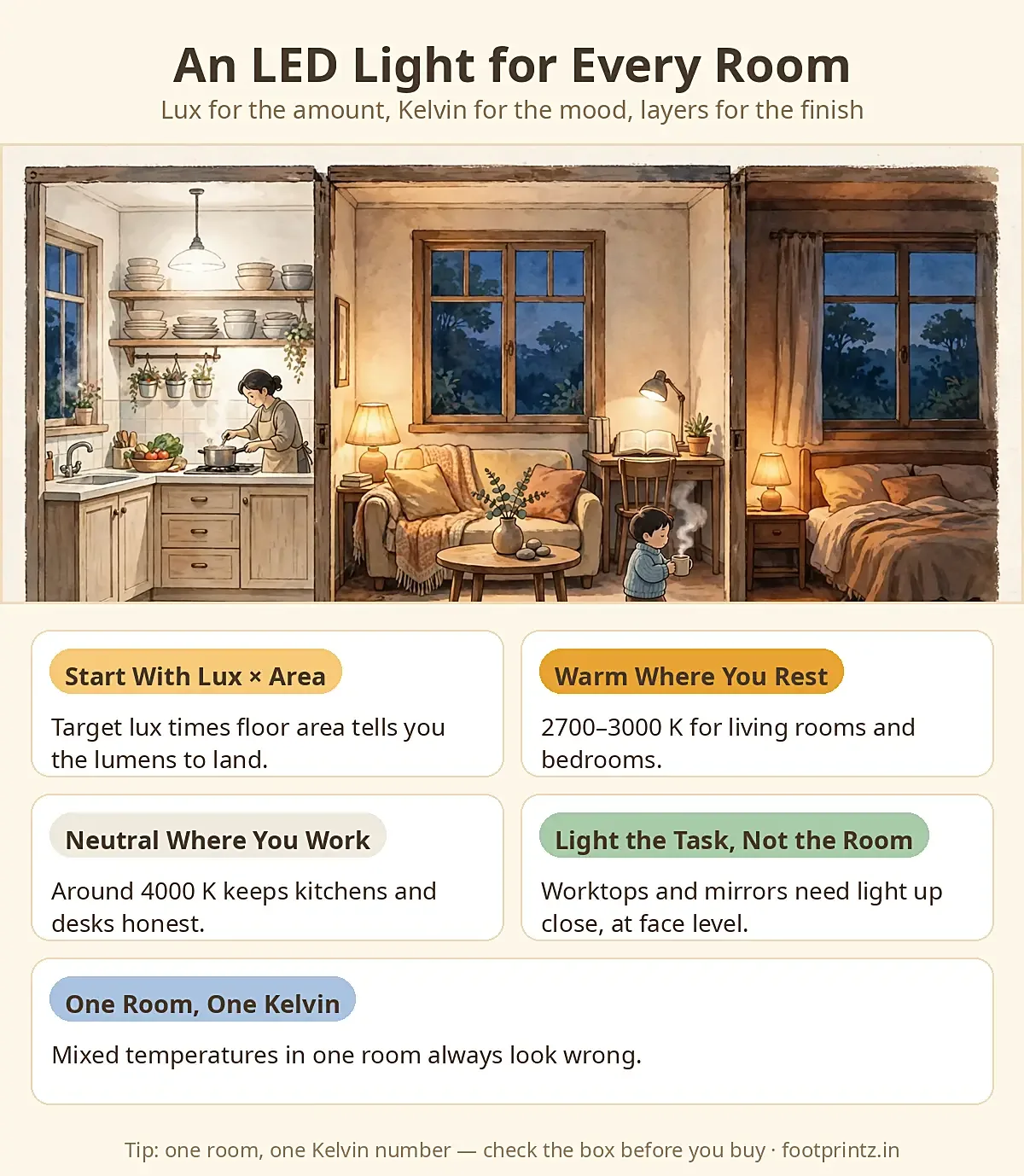
One: amount. Pick a target lux for the room's job, multiply by the floor area in square metres, and you have roughly the lumens that need to land in the room. Buy somewhat more than that in total bulb lumens — shades, walls and fittings keep a share. Everything below uses the typical recommended ranges from the standards family (EN 12464-1 task values, CIBSE home guidance, IES recommendations). Treat them as aims, not laws: no standard mandates a lux figure for your living room, and published tables differ between bodies.
Two: colour. Warm where the room is for resting, neutral where it is for working — roughly 2700–3000 K at the restful end, around 4000 K at the working end. The full Kelvin ladder lives in the colour-temperature post; here it is just applied.
Three: layers. Almost no room wants one light doing everything. Think in up to three layers — ambient light to move around by, task light where eyes actually work, and a little accent light for depth. Most of the rooms below are just those three layers in different proportions.
Living room: layered, warm, dimmable
The living room does the most jobs — conversation, television, reading, doing nothing — so it gets the full three layers. Aim ambient light at the lower, restful part of the range, about 100–300 lux across the room, and build it from several modest sources rather than one fierce ceiling fitting: a ceiling light for the base, a floor or table lamp or two for the pools of light people actually sit in. Warm white, 2700–3000 K. Reading gets its own task layer — a lamp beside the chair, bringing the page up toward the 300–500 lux reading band without raising the whole room.
The single most valuable fitting here is a dimmer. The same room wants brightness for a family board game and a murmur for a film, and dimming is how one set of lights does both. If you change one thing in a living room, make it layered and dimmable, in that order.
Kitchen: two levels, honestly coloured
The kitchen is two rooms wearing one name. General light — moving around, opening cupboards — sits around 150–300 lux, and a ceiling fitting or two handles it. The worktop is a different matter: knives, hot oil and small print on packets want about 500 lux on the counter itself. The way to get it is not a heroic ceiling light but a strip or slim fitting under the wall cabinets, close to the task, where the light lands on the worktop instead of on the top of your head — and so your own shadow stops falling exactly where you are chopping.
Colour goes neutral here, around 4000 K: it keeps the room feeling clean and awake. Add one shopping check — colour rendering. Under a low-CRI light, food colours flatten and it gets harder to judge whether the chicken is done or the greens are fresh. No standard forces a number on a home kitchen, but CRI 90 or above is the sensible shelf to shop from for the lights over food.
Study and desk: protect the page, mind the screen
Desk work lives in the 300–500 lux band, delivered by a desk lamp you can aim, not by flooding the room. Position is half the job: the lamp goes to the side opposite your writing hand, angled onto the page or keyboard so the light lands on the work and not in your eyes, and so the bare LED light never sits inside your field of view — glare is brightness in the wrong place, and a shiny desk or screen will happily bounce it back at you.
The other half is contrast. A bright pool of lamplight in an otherwise dark room makes your eyes re-adjust every time you look up, so keep a modest ambient light on behind the task layer. If you work at a screen, the same logic applies doubled: the screen is its own light source, and the room around it should sit nearer to its brightness, not at the extremes.
Bedroom: warm, low, and nothing fierce overhead
The bedroom's general light can stay low — around 100–150 lux is plenty for dressing and winding down — and it should be the warmest in the house, 2700 K or below if you like it amber. The fitting to avoid is the single bright downlight directly over the bed: it is the one light in the house you will regularly look straight up into, lying down, with tired eyes.
Give the bedside its own small task light instead — a shaded lamp you can read by without lighting the whole room or your partner's side of the bed. Warm, low and local is the whole recipe.
Bathroom: light the face, respect the water
Bathroom general light sits around 200–300 lux, but the mirror is the real task. What matters there is light landing on your face — lighting guidelines put vanity grooming at roughly 430 lux measured vertically, on the face itself. A single ceiling light fails this job structurally: it lights the top of your head and shadows your eyes and chin, which is why shaving and makeup go wrong under it. Lights at face level, on both sides of the mirror where the room allows, are the fix — even, frontal, and honest. Keep the colour rendering high here too, for the same reason as the kitchen: you are judging colours on skin.
Then the safety layer. Near the bath and shower, fittings fall under the bathroom-zone rules: inside the bath or shower space itself a fitting needs at least IPX7, and above or beside it at least IPX4 — IPX5 where water jets are used for cleaning. An ordinary ceiling light elsewhere in the room is fine; anything near the water gets chosen by its IP rating first and its looks second, and an electrician confirms which zone a spot falls in if there is any doubt.
Stairs, corridors and the entrance: even, and awake before you are
Circulation spaces want about 100 lux, but evenness matters more than the number: a bright patch followed by a dark patch is how a step edge disappears. Keep the light continuous along stairs, with no fitting positioned so you climb toward your own shadow.
These are also the rooms where sensor lights earn their keep. A low-level light that wakes as you approach is worth more at 3 a.m. than a bright one behind a switch you have to find — a gentle night light along the route to the bathroom is a genuine safety fitting, not a gadget. At the entrance, one warm, welcoming light at face height beats a floodlight glare; guests should see your face, not your security arrangements.
Balcony and garden: warm, shielded, only as bright as needed
Outdoors, restraint is the skill. The responsible-outdoor-lighting principles shared by DarkSky International and the IES ask for light that is useful, pointed where it is needed, low in level, switched off or dimmed when not needed, and warm in colour — 3000 K or lower is their warm benchmark, and 2700 K keeps colours honest while staying gentle. Choose fittings rated for outdoor use (IP65 is the usual weatherproof shelf), aim them down, and let a sensor or timer do the discipline.
The ecology point, stated carefully: warm, low-blue light attracts fewer night insects than cool, blue-rich light of the same brightness — fewer, not none, and brightness and hours of use matter as much as colour. Warm and shielded is a way to be a better neighbour to everything outside the glass, moths included. It is not a force field.
The whole house on one table
| Room | Target lux (typical range) | Colour temperature | The fitting that does the job |
|---|---|---|---|
| Living room | 100–300 ambient; 300–500 at the reading chair | 2700–3000 K | Layered lamps + ceiling base, on a dimmer |
| Kitchen | 150–300 general; about 500 on the worktop | Around 4000 K | Ceiling light + under-cabinet strip, CRI 90+ |
| Study / desk | 300–500 on the desk | 3500–4000 K | Aimable desk lamp + gentle ambient behind |
| Bedroom | 100–150 general | 2700 K or warmer | Shaded bedside lamps; nothing fierce over the bed |
| Bathroom | 200–300 general; about 430 vertical at the mirror | 3500–4000 K | Face-level lights both sides of the mirror; IP-rated near water |
| Stairs / corridor | About 100, kept even | 2700–3000 K | Continuous fittings + sensor night light |
| Balcony / garden | Low — enough to see the step, no more | 3000 K or warmer | Shielded, downward, IP65, on a sensor or timer |
The mistake that undoes it all
You can do every room correctly and still spoil the house in the shop, with one habit: buying bulbs at different times and letting each room collect a mixture of colour temperatures — a leftover 6500 K in one holder, a 2700 K in the next, something unlabelled in the lamp. Mixed temperatures in one room never read as variety. They read as a mistake, because the eye compares them side by side and one always looks dirty-yellow or hospital-blue against the other.
So the closing rule is the simplest in this whole series: one room, one Kelvin number. Check the box before you buy, keep a spare bulb of the room's temperature in the drawer, and let each room disagree with the next one as much as it likes — across a doorway, a change of colour looks like a change of mood. Inside one room, it just looks wrong.
Sources: recommended levels — EN 12464-1 task values, CIBSE residential guidance and IES recommendations, presented as typical ranges (EN 12464-1 itself covers workplaces, not homes); bathroom vanity and kitchen counter figures — US Department of Energy residential lighting guideline, drawn from the IES Lighting Handbook; bathroom zones and IP minimums — IEC 60364-7-701 and national wiring rules in that pattern; outdoor principles — DarkSky International and IES, Five Principles for Responsible Outdoor Lighting. Full research notes with per-claim citations are kept with this draft.
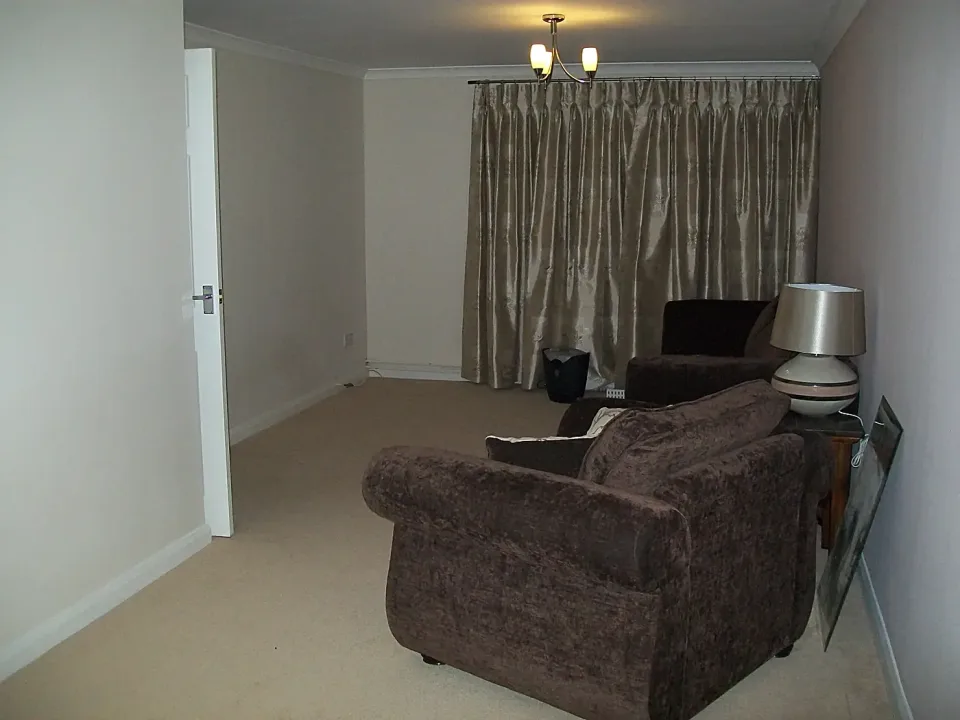
Featured photo: "Living room" by AnemoneProjectors, via Wikimedia Commons — CC BY-SA 2.0.
Frequently asked questions
How many LED lights does one room actually need?
Array
Can I use the same bulb colour in every room to keep it simple?
Array
My room feels bright but still gloomy. What is wrong?
Array
Are sensor lights worth it on the stairs?
Array
How do I check the colour temperature of bulbs I already own?
Array