
Guide
LED light troubleshooting: the glow, the buzz, the dark patch — what each symptom is telling you
An LED light rarely fails silently. It glows after you've switched it off. It buzzes. It works for twenty minutes, gives up, then quietly comes back on. A strip loses one section; a white light turns faintly pink. Each behaviour is a symptom with a short list of likely causes — and usually one cheap first check that separates them. This post works through eight symptoms in a table, then one by one: why a switched-off light can glow (a trickle of current an older bulb would never have noticed), why buzzing is the driver vibrating rather than the chip singing, why a light that cuts out hot and returns cool is protecting itself, and why the driver — not the LED chip — is the first suspect when a light dies outright. It ends with the one test to run before blaming your wiring, and the red flags that mean stop and call an electrician.
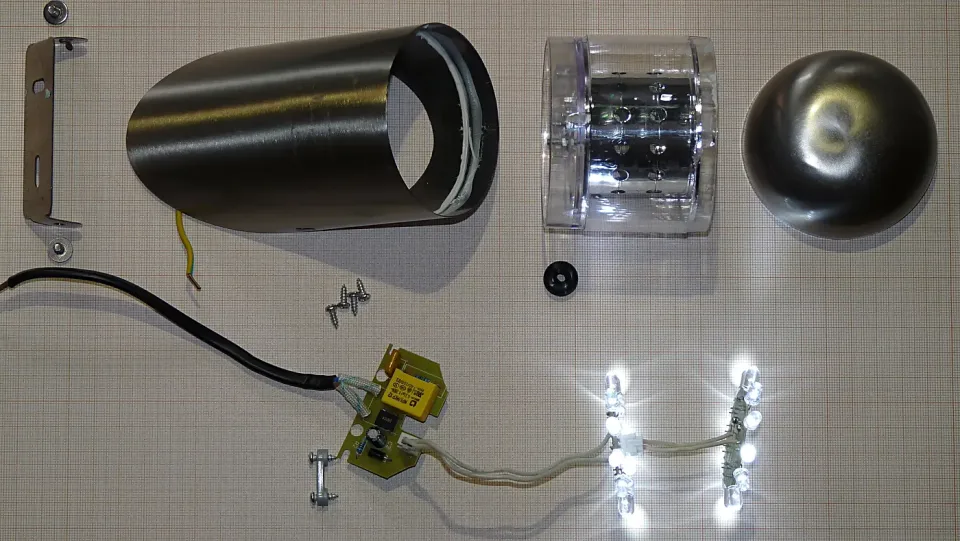
An LED light is two things wearing one coat: a chip that makes light, and a small power supply — the driver — that feeds it. Almost every strange behaviour comes from one of those two, or from the switch and wiring in front of them. Symptoms are not random, and most have a first check that costs nothing.
Work down the table, find your symptom, then read its section. One boundary throughout: everything here is observation and bulb-swapping. A symptom involving the switch, the socket or the board is an electrician's job — the last section says where that line falls.
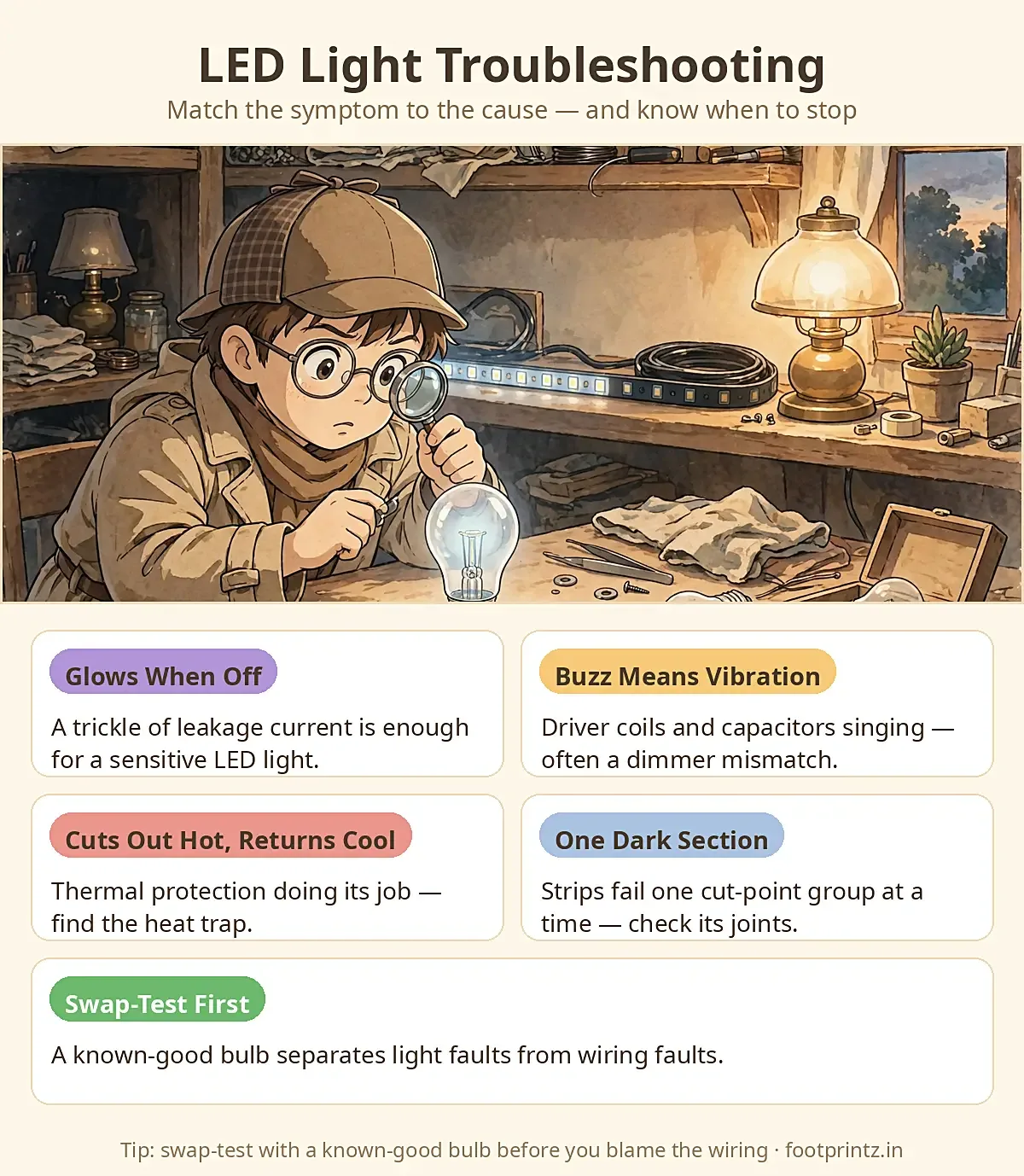
The symptom table
| Symptom | Likely causes | First check |
|---|---|---|
| Glows faintly when switched off | Leakage trickle via an illuminated/smart switch; capacitive coupling in cable runs | Switch has an indicator? One light glowing, or several? |
| Buzzing or humming | Driver coils/capacitors vibrating; dimmer mismatch | Buzz from the light, or the switch? Worse when dimmed? |
| Flickers, but only on the dimmer | Dimmer and driver not made for each other | Steady at full brightness and on a plain switch? |
| One section of a strip is dark | Failed LED group, broken track, tired connector | One cut-length dark, or everything past a joint? |
| Turns off after minutes, back on later | Thermal protection tripping on trapped heat | Regular on–off rhythm? Fitting enclosed or insulated? |
| Colour has drifted warm, pink or odd | Phosphor/encapsulant ageing, sped up by heat | Compare with a newer twin; is the fitting a hot one? |
| Starts late, or only sometimes | Ageing driver capacitors (if the delay is growing) | Always this slow, or getting slower? |
| Dead completely | Driver failed; or no power reaching the light | Swap-test with a known-good bulb, both ways |
It glows faintly when switched off
The eeriest symptom, and usually the most innocent. An LED light needs remarkably little current to glow visibly — far less than a filament bulb, which would swallow the same trickle and show nothing. So a switched-off light can glow on a current its predecessor never revealed.
Where does the trickle come from? Two usual paths. First, the switch itself: switches with an indicator light pass a small current through the lamp to keep the indicator alive, and dimmers and smart switches that power their electronics through the load do the same. Second, capacitive coupling: live and switched wires running side by side over a long run — two-way switching is the classic — act as a small capacitor, coupling a whisper of current across. Either way, the trickle charges the capacitor inside the driver — some lights glow steadily on it, others flash softly as it fills and empties.
A faint glow on one light is a nuisance, not a hazard; the fix lives at the switch or fitting — a plain switch, an LED-compatible control, or a bypass fitted by an electrician. But a bright glow, or several fittings glowing together, can mean the switch interrupts the neutral instead of the live: a wiring fault. Electrician.
It buzzes or hums
The chip makes no sound; it has nothing to move. The noise is mechanical, from the driver: coils wound around magnetic cores flex microscopically as the field through them changes — magnetostriction — and some ceramic capacitors vibrate too. The housing then amplifies the result, like a guitar body.
Most buzz is a pairing problem. An older dimmer built for filament bulbs chops the mains in a way the driver dislikes, and its parts vibrate in protest — why buzz so often arrives with dimming and changes pitch as you slide. A dimmer also has a minimum load a couple of LED lights may not reach, leaving it regulating badly. A faint hum audible only in a silent bedroom, from the light itself, is a quality complaint: solve it by matching bulb and dimmer, or replacing a cheap light.
Location is the whole diagnosis, though. Buzz or crackle from the switch, a socket or the board — not the lamp — is not driver noise: treat it as a loose connection, and stop using that circuit until an electrician clears it.
It flickers — but only on the dimmer
Kept short, because flicker has its own full post in this series. A light steady at full brightness and on a plain switch, but shimmering when dimmed, is almost always a dimmer–driver mismatch — the dimmer cuts the waveform into pieces the driver wasn't built to eat. Fit a bulb that states it is dimmable, on the dimmer type its maker specifies. Flicker at full power too belongs to the other post — and possibly the red flags below.
One section of a strip has gone dark
Strips are built in repeating groups: a few LEDs and a resistor in series between each pair of cut marks, all groups fed in parallel along the strip. That architecture writes the failure pattern. One dead LED, resistor or solder joint takes out its own group — a dark stretch exactly one cut-length long is a local fault. If instead everything past a point is dark, power has stopped travelling: look first at the joint, connector or track where lit meets dark, especially where the strip bends or was cut and rejoined.
Inspect with the power off: kinks, crushed spots, browned patches, connectors not fully home. The repair is to cut out the dead group at its marked points and rejoin — covered in this series' strip guide. (A far end merely dimmer on a long one-end-fed run is voltage drop, not a break.)
It turns off after a while — then comes back on
A light that works for twenty minutes, dies, revives after a rest, and repeats like a metronome is rarely haunted. Many drivers carry thermal protection: pass a temperature limit and the driver shuts down; cool below it and it restarts. The protection is behaving correctly — the fault is the heat.
Heat traps are mundane: a bulb in an enclosed shade it isn't rated for, a downlight buried under insulation, a driver in a sealed void, fins packed with dust. Run the light in open air if you can; if it stays on there, the fitting is the problem. And don't ignore a cycling light — every hot cycle ages its capacitors, so today's nuisance becomes next season's dead light.
The colour has drifted — warmer, pink, just… off
Most white LED lights are a blue chip under a phosphor coating that converts part of its light to the longer wavelengths your eye reads as white. Over years, phosphor, encapsulant and chip all change — and the balance changes with them. Engineers call it chromaticity shift; you'll call it "this light used to be white".
Heat is the accelerator, which is why the worst-shifted light is so often the one cooking in an enclosed fitting. The direction isn't fixed: which ingredient degrades fastest decides whether the light slides warm, or strays pink or greenish. US Department of Energy testing found some products shifting visibly within a few thousand hours while well-made ones held their colour for years — an ageing symptom, never a wiring one, and not reversible. Replace the light, and fix the heat trap too.
It starts late — or only when it feels like it
A short, consistent pause — the same blink it had when new — is just the driver starting up. Personality, not a fault. The symptom worth watching is a delay that grows: a light that used to start instantly, then needed a second, then sometimes a second flick of the switch, or starts dim and gathers itself. That's the classic signature of the driver's electrolytic capacitors ageing — as they dry out, their internal resistance rises, charging and smoothing get ragged, and starting suffers first. DOE reliability work names capacitor failure as a leading cause of driver failure, and this is often how it introduces itself. No bulb-level repair exists; the light or its driver is nearing replacement. A clue: slowest on the first start after hours off, brisker on an immediate restart.
It's dead completely
Total darkness feels like the worst symptom and is the easiest to sort — the chips are rarely the culprit. DOE's reliability consortium puts it plainly: driver electronics typically fail before LED packages wear out, and driver failure is the likely cause when a light simply stops. Suspect, in order: power reaching the fitting (breaker, switch), the bulb's seating in its holder, then the driver — inside a sealed bulb, that means the bulb itself. Sort it with the swap-test below, not by buying parts. (Several lights killed together after a storm probably died by surge, not old age.)
The golden rule, and the red flags
Before blaming wiring, run the swap-test. Reseat the bulb firmly. Put a bulb you know works into the suspect holder; put the suspect bulb into a holder you know works. Three minutes, no tools, and the fault convicts itself: good bulb fails in that holder — fitting or circuit; suspect bulb fails everywhere — the problem is in your hand.
Then the red flags — symptoms that end troubleshooting on the spot. Switch the circuit off if you can do so safely, and call an electrician, if you find: a persistent burning smell; scorch marks or discolouration on a switch, socket or fitting; a switch or socket that feels hot; buzzing or crackling from a switch, socket or the board; a breaker that trips repeatedly; or several rooms flickering together. These are Electrical Safety First's warning signs — the ones that precede electrical fires. A glowing bulb is a curiosity. A hot switch is not.
Sources: US Department of Energy / PNNL, "Color Maintenance of LEDs in Laboratory and Field Applications" (2013) and "LED Luminaire Lifetime: Recommendations for Testing and Reporting" (2014); EngineerFix troubleshooting guides (glow-when-off, LED noise, strip segmentation); Power Supplies Australia, driver protection guide; Electrical Safety First, home warning-signs guidance; IEEE Std 1789-2015 (flicker background).
Featured photo: "Disassembled LED lamp" by Dmitry G, via Wikimedia Commons — CC BY-SA 3.0.
Frequently asked questions
Is a light that glows when off using much electricity?
No — the currents involved are minute, far below what the light uses when on. It's worth fixing for sleep and sanity, and worth an electrician's look if the glow is bright or appears on several fittings at once, but it won't move your bill.
My light buzzes. Is it about to fail?
Not necessarily. A faint hum from the light itself, especially on a dimmer, is usually vibration in the driver — annoying, not dangerous, and it can stay stable for years. Buzzing that is new, loud, or coming from the switch or socket is different: stop using that circuit and get it checked.
Can I fix a strip with one dark section, or is it scrap?
Usually fixable. If the dark stretch is one cut-length, that group has failed; cutting it out at the marked points and rejoining the strip restores the rest. If everything past a joint is dark, the joint itself is the first suspect and may just need reseating or replacing.
Why does my light work again after it cools down?
Because its driver protected it. A thermal cut-out switched the light off when it got too hot and allowed a restart once it cooled. The light is telling you it lives somewhere too hot — an enclosed fitting, insulation over a downlight, a sealed driver void. Fix the heat, not just the light.
The colour of my light changed. Can it be cleaned back to white?
No. Dirt on a diffuser can warm light slightly and is worth one wipe to rule out — but real colour shift is change inside the chip's phosphor and encapsulant, and it doesn't reverse. It's an end-of-life symptom, and a hot fitting will do the same to the replacement.