
Guide
LED lights around children, pets and plants: what actually matters at home
One evening lamp in a family home serves three very different audiences. A child reads under it, with eyes that the headlines keep warning you about. A dog dozes beneath it, seeing a different palette — and possibly a flicker you can't. Seedlings lean toward it from the windowsill, treating it as food. Each audience attracts its own set of warnings, and most of those warnings dissolve under scrutiny — but not all of them, and the ones that survive are genuinely useful. This post works through all three, claim by claim, using what ophthalmologists, veterinary researchers and university extension services actually say: why shaded fittings beat bare bright points for children, why dim and warm is the whole secret of the evening wind-down, what your dog's eyes register that yours don't, and why your plants care about the amount of light and the hours it runs — not the words on the box.

Stand in a living room at eight in the evening and count the audiences for one lamp. A child is reading under it. The dog is asleep under it, or staring at it. On the windowsill, a tray of seedlings is leaning toward it like it owes them money. Three audiences, three completely different sets of eyes — and a small industry of alarming claims aimed at each. Here is what survives checking against the people who study these things.
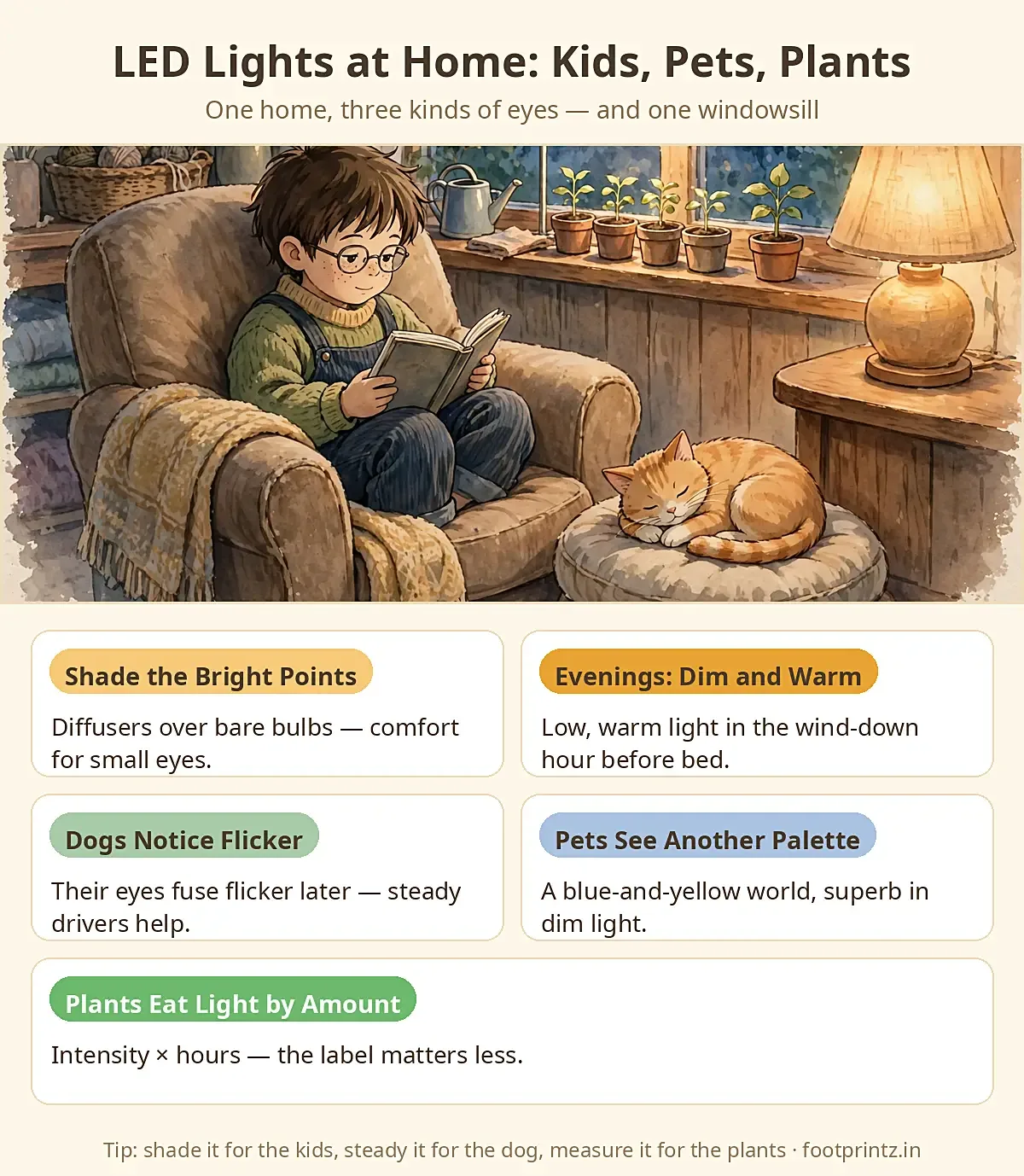
Children: the honest worry is glare, not damage
Start with the fear. Headlines say the blue light in LED lights is damaging children's eyes. The American Academy of Ophthalmology's position is blunt: there is no scientific evidence that blue light from devices causes eye damage, and no meaningful link to retinal damage. The CIE adds the context: the real "blue light hazard" is a photochemical risk of staring into extremely bright sources — the sun, a welding arc — and ordinary white lamps, LED lights included, do not exceed the exposure limits in normal use. A lamp bright enough to approach those limits would hurt to look at first — glare is the body's own warning.
So the practical rule for children's rooms is about comfort, not fear. Put shades and diffusers between small eyes and bright points of light. A bare, bright LED light at a child's eye level — a naked bulb in a low fitting, an exposed downlight over a desk — is unpleasant to look toward and tiring to read under. Shaded, diffused light is simply pleasanter to read in. And one caution from the CIE is worth keeping: it flags products that mainly emit blue light, such as some glowing toys, as a place for care with young children. Torches are not staring toys, for children or anyone. Look at the light, not into it.
Evenings: dim, warm, and boring on purpose
The second children's topic is sleep, where the advice is real but modest — a routine, not a treatment. Children's hospital sleep guidance (Sydney Children's Hospitals Network publishes a typical version) runs like this: in the wind-down before bed, dim the lights; keep screens off for the last hour, because their light holds back melatonin; and if a child wants a night-light, choose one with a dim, warm glow — red or orange tones are the least likely to disturb melatonin.
Translated into lighting: the last hour is not the time for a bright, cool-white ceiling light at full blast. A low, warm lamp does the job — enough to read a story by, not enough to tell a body clock it is noon. A night-light should be the smallest, warmest, dimmest thing that reassures: a faint amber glow at skirting level, not a small sun beside the bed. None of this is medicine — just not fighting the clock.
Pets: different eyes under the same lamp
Your dog does not see the room you see. Dogs — and cats too — are dichromats: where you have three types of colour-sensing cone, they have two, peaking in the blue and in the yellow-green. They distinguish blues and yellows well, and muddle reds, greens and oranges into similar greyish tones. So the rainbow of colours a smart bulb cycles through is mostly lost on them. In exchange they get retinas packed with rods and a reflective layer, the tapetum, that bounces light back through the eye for a second pass. Cats can work in light about six times dimmer than the faintest humans can manage.
Two practical things follow. First, brightness at their eye level: an animal whose eyes are built to gather light meets a bare, harsh downlight very differently from you. A dog on the floor looks up into them; a cat on a shelf is level with them. Angle lights away, keep shades on low fittings, and don't park a bright spotlight where a pet stares. Second, flicker. Behavioural studies of beagles — the classic work is Coile, Pollitz and Smith, 1989 — put the fastest flicker a dog can still register at around 70–80 times a second, against roughly 50–60 for humans. That gap means a cheap light with a rough driver, steady-looking to you, may not be steady to your dog. Nobody can tell you a given lamp annoys a given dog — but a decent driver and smooth dimming, in the room your dog lives in, cost little and close the question.
One clarification: a laser pointer is not an LED light. It uses a laser diode, and veterinary behaviourists warn that the dot a dog can never catch can frustrate it and feed obsessive chasing of lights and shadows. Keep it out of eyes — pet and human — and give the dog something it can catch.
Plants: light is food, and food is measured
The seedlings on the windowsill are the only audience eating the light. Plants use a band of light called PAR — roughly the visible spectrum, 400 to 700 nanometres. What matters is how much of it lands on the leaves, measured as PPFD, and for how many hours. University of Minnesota Extension puts indoor needs in three rough bands: low-light foliage plants manage on 50–150 µmol/m²/s, medium-light plants want 150–250, and high-light plants — herbs, succulents, seedlings of sun-lovers — want 250–450.
Notice what is missing from that: the words "grow light". A plant responds to the amount of PAR delivered, not to the label on the box. Intensity falls away fast with distance, which is why extension guidance hangs lights close — 4 to 6 inches above seedlings, 6 to 12 above lettuce and herbs, 12 to 24 above foliage plants. At those distances an ordinary white LED light can feed leafy plants and seedlings; people start seeds under plain shop lights every spring. A ceiling light three metres away cannot do the same job — the leaves get a fraction of what they need, and stretch, pale and leggy, to tell you so.
Hours are the other half of the ration. Extension guidance counts window and lamp light together: roughly 12–14 hours a day for foliage plants, 14–16 for flowering ones, 16–18 for seedlings — and then darkness. Plants need a night too; a light left on around the clock is not generosity, it is a broken day. A timer is the cheapest good decision in indoor gardening. Heat is one worry LED lights mostly retire — they run far cooler than older lamps — though a powerful unit still wants air around it and should never rest against leaves. And UV add-ons? Extension guidance builds everything on visible PAR. For a windowsill herb garden, UV is a marketing extra, not a missing nutrient.
The short version
Shade the bright points and dim the evenings for the children. The dog sees a dimmer-adapted room than you do, and may see flicker you can't. For the plants, forget labels and count amount × hours, close up, with a night off. One lamp can serve all three — chosen like it has three audiences.
Sources: American Academy of Ophthalmology, "Digital Devices and Your Eyes" and "Should You Worry About Blue Light?"; CIE, Position Statement on the Blue Light Hazard (2019); Sydney Children's Hospitals Network, "Creating a healthy sleep environment"; Jacobs et al. (1993) and reviews in Journal of Vision and dvm360 on canine and feline vision; Coile, Pollitz & Smith (1989), Physiology & Behavior 45; American Kennel Club, "Laser Pointers: More Frustration Than Fun"; University of Minnesota Extension, "Lighting for indoor plants and starting seeds".
Featured photo: "Pair of domestic cats sleeping on a couch" by Javier Perez Montes, via Wikimedia Commons — CC BY-SA 4.0.
Frequently asked questions
Are LED lights bad for children's eyes?
No evidence says so. The American Academy of Ophthalmology finds no scientific evidence that blue light from devices damages eyes, and the CIE notes that white lamps, LED lights included, stay within exposure limits. The real issues are glare and comfort — use shades and diffusers — and one habit worth teaching: never stare into torches or bright lights.
What is the best night-light for a child's room?
The dimmest, warmest one that does the job. Children's hospital sleep guidance suggests a dim, warm glow — red or orange tones, least likely to disturb melatonin. Keep it low and faint; a night-light is a landmark, not a lamp.
Can my dog really see flicker that I can't?
Probably, yes. Research puts a dog's flicker-fusion threshold around 70–80 Hz, against roughly 50–60 Hz for humans. A light that pulses between those rates can look steady to you and flickery to your dog — one more reason to buy lights with decent drivers.
Do pets see the colours from colour-changing LED lights?
Only some of them. Dogs and cats are dichromats — two colour channels, tuned to blue and yellow-green. Blues and yellows register clearly; reds, greens and oranges blur into similar muted tones. The light show is mostly for you. Their party trick is the opposite end: far better vision in dim light than yours.
Can an ordinary white LED light grow plants, or do I need a special grow light?
An ordinary white LED light can grow leafy plants and seedlings if it is close enough and runs long enough — extension services specify light at the leaf (PPFD) and hours, not a product label. Hang it inches above the plants, run it on a timer, and raise it as they grow.