
Guide
Lumens, watts and lux: how bright is bright enough?
Two LED lights can both say 9 watts on the box and yet one lights a room while the other barely manages a corner — because watts never measured brightness in the first place. They measure what a light consumes. What it produces is lumens, and what actually lands on your book or worktop is lux. This post separates the three numbers properly: where the buy-by-watts habit came from and why it broke, what each unit really counts, why the same bulb gives different lux in different spots, and the one honest efficiency score — lumens per watt — that explains why two "identical" bulbs are nothing of the sort. It closes with the typical lux ranges lighting standards recommend for each room, and a simple way to shop: choose the lumens, check the lumens per watt, then think about where the light will land.
Here is a small mystery from the lighting aisle. Two LED lights, side by side, both marked 9 watts. You take one home and it lights the room properly. Your neighbour buys the other and complains it is dim. Same watts, different light — how?
The short answer is that watts were never a brightness unit. They just behaved like one for about a hundred years, and the habit outlived the reason. This post separates the three numbers that crowd every light's packaging — watts, lumens and lux — and gives each one its actual job.
Watts: the electricity bill, not the brightness
A watt measures power — how much electricity a light consumes while it runs. It says nothing, directly, about light. So why did generations buy bulbs by wattage? Because for most of the twentieth century, nearly every bulb in a home was an incandescent, and incandescents all waste energy in roughly the same way. When every bulb turns power into light at about the same poor rate, consumption tracks brightness well enough: a 100 W bulb really was about twice as bright as a 50 W one, because both were the same machine at different sizes.
LED lights broke that arrangement. An LED light is not one machine at different sizes; it is a family of designs that convert electricity to light at very different rates. The wattage still tells you something real — what the light costs to run — but as a brightness guide it is finished. The standard replacement chart used by US energy agencies now works the other way round: it starts from brightness and treats watts as the thing that varies. To replace an old 40 W incandescent you need about 450 lumens; a 60 W took about 800; a 75 W about 1,100; a 100 W about 1,600. How many watts each of those costs depends entirely on the light you pick.
Lumens: how much light a source actually makes
The lumen is the unit of luminous flux — the total amount of visible light a source emits, in all directions. This is the brightness number, the one to shop by.
One refinement worth knowing: lumens are counted the way your eyes count. Photometry weights light by the eye's sensitivity, which peaks in the green and falls to nothing outside the visible band. That is why an infrared LED can be working perfectly and still rate essentially zero lumens — it makes plenty of radiation, none of it visible. Lumens only ever describe light a person can see.
A lumen figure belongs to the source, not to your room. An 800-lumen LED light emits 800 lumens whether it hangs in a cupboard or a hall. What changes from place to place is how much of that light lands where you need it — and that is the next unit's business.
Lux: how much light actually lands
Lux measures illuminance: the light arriving on a surface. One lux is one lumen spread over one square metre. The definition alone explains most lighting disappointment. Take 1,000 lumens and concentrate them on one square metre and that surface sits at 1,000 lux — bright, task-level light. Spread the same 1,000 lumens over ten square metres and each metre gets 100 lux — a gentle ambient glow. Same bulb, same lumens, tenfold difference in what you experience, decided purely by spread.
Distance does the same thing, faster. Light spreads as it travels, so illuminance falls with the square of the distance: double the distance from a lamp and a surface keeps roughly a quarter of the lux. A desk lamp that gives you a crisp 400 lux on the page at one distance gives about 100 lux if you double that distance. This is why a modest lamp close to your book beats a powerful ceiling light across the room, and why moving a lamp is often a better fix than replacing it.
Lux is also how lighting standards talk. They don't ask how many lumens your bulbs emit; they ask how many lux land on the desk, the worktop, the page. Which leads to the practical bit of arithmetic in this whole post: the lumens that need to land on a room's surfaces are roughly the target lux multiplied by the area in square metres. Want a 12 m² living room at about 150 lux? Around 1,800 lumens need to arrive at floor and furniture level. In practice you install more than that — walls, shades and fittings keep some of it — but the multiplication tells you whether you are shopping in the right ballpark or an order of magnitude out.
Candela: the beam number (briefly)
One more unit turns up on spotlights, and it earns a short paragraph. The candela measures luminous intensity — how much light a source sends in one particular direction. Optics concentrate light: a narrow-beam spotlight can push a modest number of lumens into a tight cone and post a very high candela figure, which is exactly what you want for highlighting a picture or a counter. For general room lighting you can mostly ignore candela; for comparing two spotlights, it is the number that tells you how hard the beam itself punches.
Lumens per watt: the honest score, and the mystery solved
Divide lumens by watts and you get efficacy — lumens per watt, lm/W — the one figure that says how good a light is at its actual job. An old incandescent managed roughly 15 lumens per watt (the US Department of Energy puts incandescents at about 10–17). A typical LED light today delivers roughly 80–100 lumens per watt. Everything else is heat in the first case and headroom in the second.
Now the two 9-watt lights explain themselves. Build one to 70 lm/W and 9 watts buys you about 630 lumens. Build the other to 120 lm/W and the same 9 watts buys about 1,080 lumens — over 70% more light for identical running cost. Nothing about the wattage was ever going to tell you that. The gap comes from the whole design: how efficient the LED chips are, how much power the driver consumes itself, how much light the diffuser absorbs, and how well heat is managed, since a light running hot loses output. Two lights with the same watts differ because they were never the same light. The wattage is the one thing they share.
How much lux do you actually need?
Standards bodies publish recommended illuminance levels by task. EN 12464-1, the European workplace standard, sets maintained values for work tasks; CIBSE publishes guidance for homes, and the IES publishes recommendations in North America. The figures below are the typical recommended ranges those sources point to for household rooms and tasks — guidance to aim at, not legal mandates, and published tables differ somewhat between bodies.
| Room or task | Typical recommended lux |
|---|---|
| Living room, general | 100–300 |
| Kitchen, general | 150–300 |
| Kitchen worktop | about 500 |
| Reading / desk work | 300–500 |
| Bathroom | 200–300 |
| Hallway | about 100 |
Notice the pattern: rooms you relax in sit low, tasks you look at sit high, and the worktop — where knives are involved — tops the list. Notice also that these are lux on the surface, which brings placement back in: hitting 500 lux on a worktop usually means a light fitted under the cabinet, close to the task, not a brighter ceiling light further away.
Shopping with the three numbers
In the shop, the order of operations is simple. First, choose by lumens: how much light does this job need — remembering the replacement anchors above if you are swapping old bulbs, or the lux-times-area estimate if you are lighting a room from scratch. Second, sanity-check the lumens per watt: divide the lumens on the box by the watts, and prefer the light that makes more light for the same running cost. Third, think in lux before you install: where will the light land, how far will it travel, and would moving it closer do more than buying it brighter? Watts come last — as the running cost they always were.
Sources: unit definitions — BIPM/CIE, "Principles Governing Photometry" (2019) and NIST, "Photometric Units and Nomenclature"; replacement brightness chart and "look for lumens, not watts" — ENERGY STAR / US Department of Energy consumer lighting guidance; efficacy ranges — US Department of Energy, "Lighting Basics"; recommended levels — EN 12464-1 task values, CIBSE residential guidance and IES recommendations, presented as typical ranges.
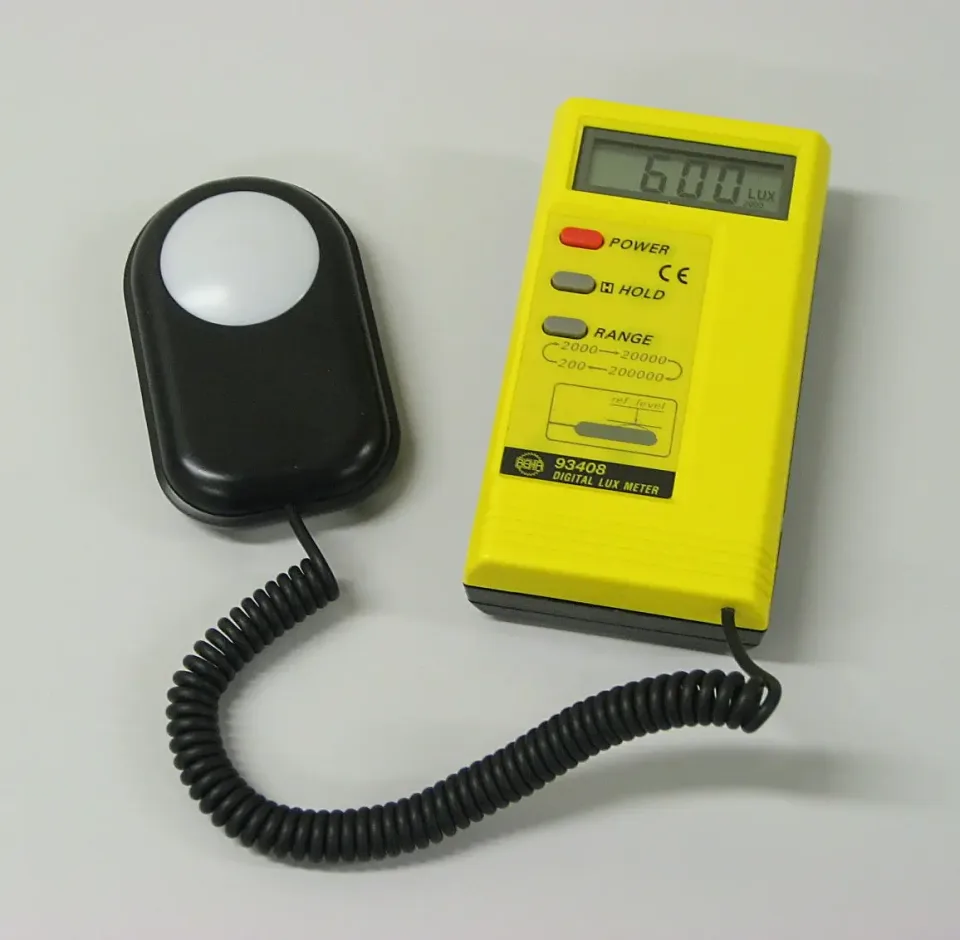
Featured photo: "Lux meter" by Hankwang, via Wikimedia Commons — public domain.
Frequently asked questions
How many lumens do I need for a living room?
Work backwards from lux. A living room typically wants about 100–300 lux on its surfaces, so multiply your room's area in square metres by the lux you're aiming at: a 15 m² room at 150 lux needs roughly 2,250 lumens actually landing around the room. Buy somewhat more than that in total bulb lumens, because shades and walls absorb a share — and spread it across more than one light rather than one fierce central bulb.
Are two 9 W LED lights always the same brightness?
No. Watts only fix what both lights consume. Their brightness is set by their efficacy: a 9 W light at 70 lm/W gives roughly 630 lumens, while one at 120 lm/W gives roughly 1,080. Always compare the lumen figures; the wattage can't tell you.
Can I convert watts to lumens?
Not in general. There is no universal conversion, because the ratio between them — efficacy — is a property of each individual light. You can only convert for a specific light whose lumens per watt you know: lumens = watts × lm/W for that light. Any chart that converts without naming the technology is quietly assuming one.
My bulb has plenty of lumens, so why does the room still feel dim?
Because lumens describe what leaves the bulb, and you live in lux. The light may be spread over too large an area, travelling too far from ceiling to task, soaked up by dark walls, or sent upward into a shade. A lower-lumen lamp placed close to where you read or work can easily deliver more lux there than the big bulb across the room.
What is candela, and do I need to care?
Candela is luminous intensity — how much light a source pushes in one direction. It matters for spotlights and other directional lights, where optics squeeze lumens into a beam: higher candela means a harder-hitting beam. For bulbs and panels lighting a whole room, shop by lumens and let candela be.