
Guide
Solar LED lights: the pre-monsoon check that saves them
A solar LED light almost never dies suddenly. It fades — a shorter night here, a dimmer corner there — and the monsoon, with its grey weeks and driving rain, is when the fading turns into failure. The good news is that nearly everything the rains will exploit is visible in May or June, in daylight, for free: the dust film throttling the panel, the battery quietly losing its stamina, the gasket that has gone hard, the bracket working loose, the ants moving into the junction box. This post is a six-part check that takes about fifteen minutes per light: clean the panel properly, runtime-test the battery, inspect the seals, tighten and tilt the mounting, clear wires and sensors — and then set honest expectations for what monsoon weeks will do to even a healthy light. No instruments, no purchases, no ladder work — just eyes, hands, a soft cloth and one timed evening.
A solar LED light is a fair-weather friend by design: it earns its keep all summer and asks for nothing. Then the monsoon arrives — weeks of grey sky, rain hammering every seal, wind worrying every bracket — and the light that was fine in April is dead by the second week of July. Owners usually blame the rain. In most cases the rain only delivered the verdict. The causes moved in earlier, quietly, during the dry months.
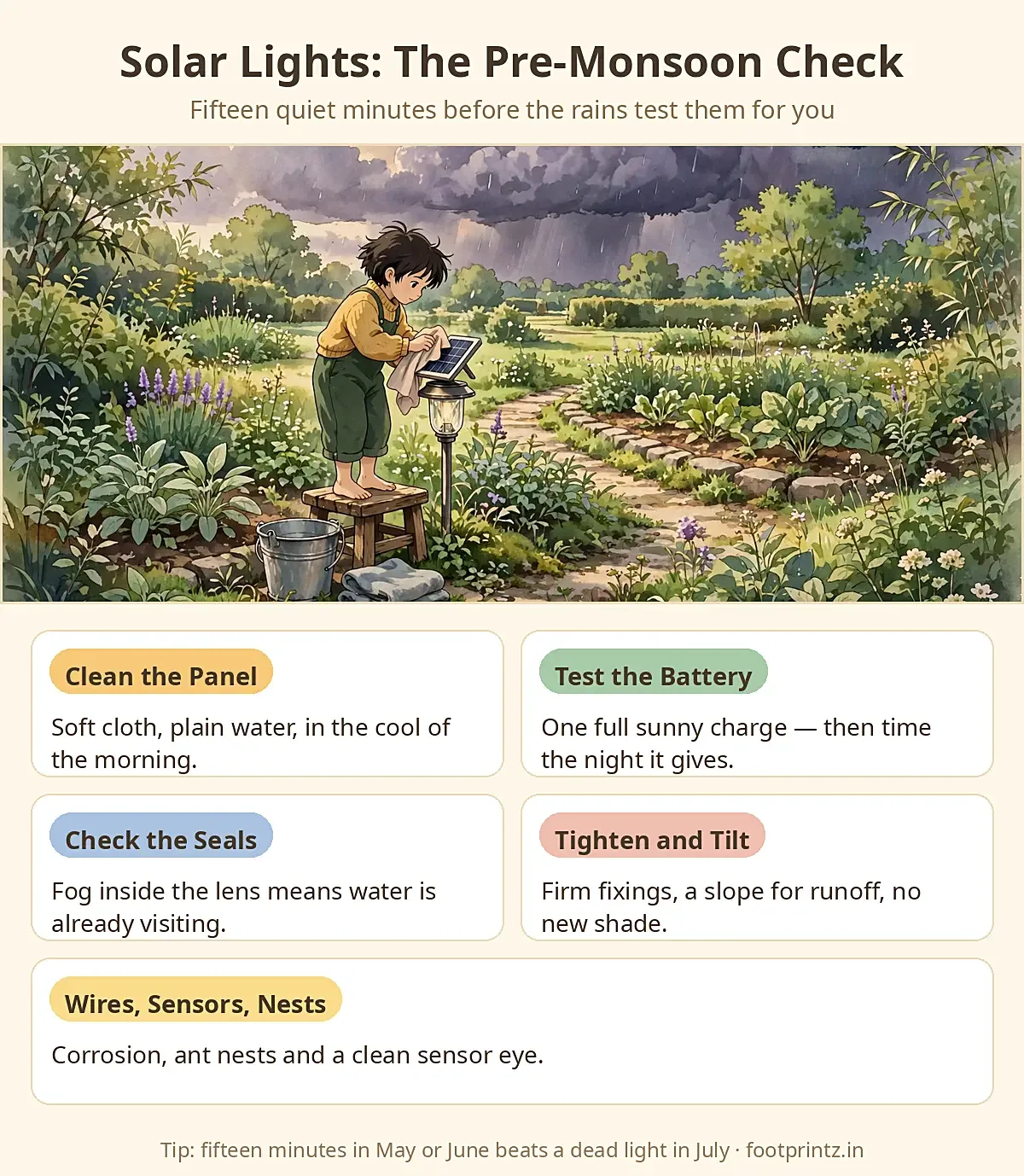
That is fixable, and cheaply. Before the clouds settle in, give each light fifteen minutes and these six checks. None of them needs a tool you don't own, and together they cover almost everything that actually kills a solar light.
Check 1: Clean the panel — properly, and in the morning
The panel is the light's only income, and by the end of the dry season most panels are earning through a film of dust, traffic grime and the odd bird dropping. That film blocks light before it ever reaches the cells, so the battery starts every night part-charged. The US National Renewable Energy Laboratory's maintenance guidance for solar systems is blunt about it: soiling reduces output, and a patchy deposit in one spot is worse than an even film. On a garden light you won't see a graph dip — you'll see a light that gives up at midnight.
The method matters more than the effort. Plain water and a soft cloth or sponge is the whole recipe; a mild detergent only if the light's manual allows one. No scouring pads, no solvents, no strong detergents, and never a pressure washer — the standard guidance bans all of them because they scratch the glass coating and chew at the seals you will be inspecting in Check 3. Do it in the early morning or at dusk, when the panel is cool: cold water on sun-hot glass can crack it, and morning dew has already softened the crust for you. Wipe, rinse, and let it dry before you judge the result.
Check 2: Runtime-test the battery
A solar light is three parts — panel, LED, and the rechargeable battery between them — and only one of those parts is designed to wear out. The battery lives a hard life: charged by day, drained by night, baked and rained on throughout. After a few years it simply holds less, and it tells you so in the only language it has: shorter nights.
So measure it, once, while the weather is still honest. Pick a clear day, clean the panel first (Check 1, so the test is fair), let the light charge all day in its normal spot, and that evening note when it comes on and when it fades. Compare with what the light used to do — a light that once ran dusk to dawn and now dies by ten has a tired cell, however bright it still looks at eight. There is no universal healthy number; your light's own history is the benchmark.
If the battery is the problem and the light has a compartment that opens, the fix is a like-for-like cell: same chemistry, same voltage, same size — all three are printed on the old one. Never substitute a different voltage, and never drop in an ordinary alkaline cell; it isn't rechargeable and the panel will keep trying to charge it. The full safety rules — above all, a swollen, hot or hissing cell means stop, don't charge it, don't poke it — are in our disposal and batteries post, and they apply here word for word. Sealed light with no way in? Don't force it. That one is a replacement decision, made now, not mid-monsoon.
Check 3: Seals and gaskets — is the IP promise still true?
The box said IP65, and when the light was new, it was: the rating describes the enclosure as tested, fresh from the factory. What delivers that rating is a humble rubber or silicone gasket, and gaskets age. Seasons of sun and heat harden them, they shrink and crack at the corners, and the rating quietly stops being true — usually a season or two before the failure shows.
Inspect, don't assume. Run a finger around the lid and lens seals: the rubber should still feel springy, not brittle or flattened. Press the housing gently and look for gaps. The giveaway, if water is already visiting, is fog — condensation misting the inside of the lens on a dry morning means moisture got in and couldn't get out. Corrosion tells the later chapters of the same story: white or green powder around screws, terminals or the board. If you find fog, open the light on a dry day, let it dry out fully, then renew the seal — a replacement gasket where one is sold, or a careful bead of silicone sealant along the joint. Wiping the fog and closing it up again just schedules the funeral.
Check 4: Mounting, angle and new shade
Monsoon wind tests every fixing you have been meaning to tighten. Do it first: screws, brackets, wall plugs, ground stakes. A mount that wobbles in your hand will work itself — and its cable, and its seals — loose in a storm, and a light face-down in a puddle fails every other check at once.
While you're there, look at the angle. A panel tilted at least about ten degrees lets rain sheet off, carrying dust with it; a flat panel pools water, and pooled water dries into dirt, sits against the seals, and eventually finds its way inside. Ten degrees is the figure installers' guidance uses as the minimum for rain to clean rather than stain, and most garden lights can be nudged or re-staked to roughly that. Finally, look up: trees and creepers grow, and a panel that had full sun last June may now spend its afternoons in leaf shade. A shaded panel charges like a cloudy day, every day. Trim the growth or move the light — before the season when charge is scarcest.
Check 5: Wires, connectors and the sensor's eye
Open any junction box or battery cover and look, really look, at the wiring. Green or white crust on a terminal is corrosion, and corrosion is resistance: the light dims, flickers, or dies at the exact connector you skipped. Clean connections should be bright and tight. Wiggle each plug gently — a connector that moves is a fault waiting for a wet night.
You may not be the only one inspecting the housing. Warm, dry electrical enclosures are prime real estate for ants and other insects, and solar equipment operators report nests inside combiner and junction boxes as a genuine failure cause — colonies enter through cable-entry gaps and have shorted and burnt boards. The monsoon, when every insect is house-hunting for somewhere dry, is peak season. If you find a nest, clear it out dry (no sprays inside a live enclosure), and close the gaps at cable entries with sealant or a grommet.
Last, the sensors. A motion light reads the world through its PIR lens, and a film of dust or a well-aimed dropping blinds it exactly like the dust on the panel — wipe the lens with the same soft cloth, nothing harsher. Then test the dusk sensor while it's still daylight: cover the panel completely with a thick cloth (on most small lights the panel doubles as the light sensor) and the light should wake within seconds. Uncover it, and it should go back to sleep. A light that passes that test has a working sensor and enough charge to prove it.
Check 6: Set your monsoon expectations
Even a light that passes all five checks will have harder weeks coming, and knowing that in advance is the difference between maintenance and panic. Under monsoon cloud, sunlight arrives scattered — diffuse light, which panels do still convert — so your lights will charge, just less, and a run of dark, rainy days can leave a battery part-filled and its night noticeably shorter. That is weather, not failure. Judge a light's health by what it does on the first clear day after the grey spell, not during it.
Plan around it. The lights you genuinely depend on — the steps, the gate, the dark corner by the door — deserve a mains-powered backup for the worst weeks, or at least your forgiveness. Purely decorative lights parked somewhere the sky barely reaches in July can be lifted, given a full charge, and stored under cover until the light returns, rather than left to sit flat and forgotten; a battery stored charged and dry ages far more gracefully than one abandoned empty in the rain. And don't replace a "dead" light in the third week of rain without giving it one honest sunny day first — more July funerals are misdiagnosed batteries and grey skies than broken lights.
Fifteen minutes in May or June: a wiped panel, a timed night, a squeezed gasket, a tightened screw, a clean sensor. That is the whole ritual — and it beats standing in the rain in July, holding a dead light, wondering when it started. It started months ago. Now you know where to look.
Sources: US National Renewable Energy Laboratory, "Best Practices for Operation and Maintenance of Photovoltaic and Energy Storage Systems" (NREL/TP-7A40-73822); manufacturer solar cleaning guidelines; Solar Victoria maintenance guide; Clean Energy Council guidance via SolarQuotes; Singapore URA advisory; Shizen Energy O&M case studies; pv-magazine India. Battery types, matching and safety per our LED light disposal and solar batteries post. Full source list kept with this post's research notes.
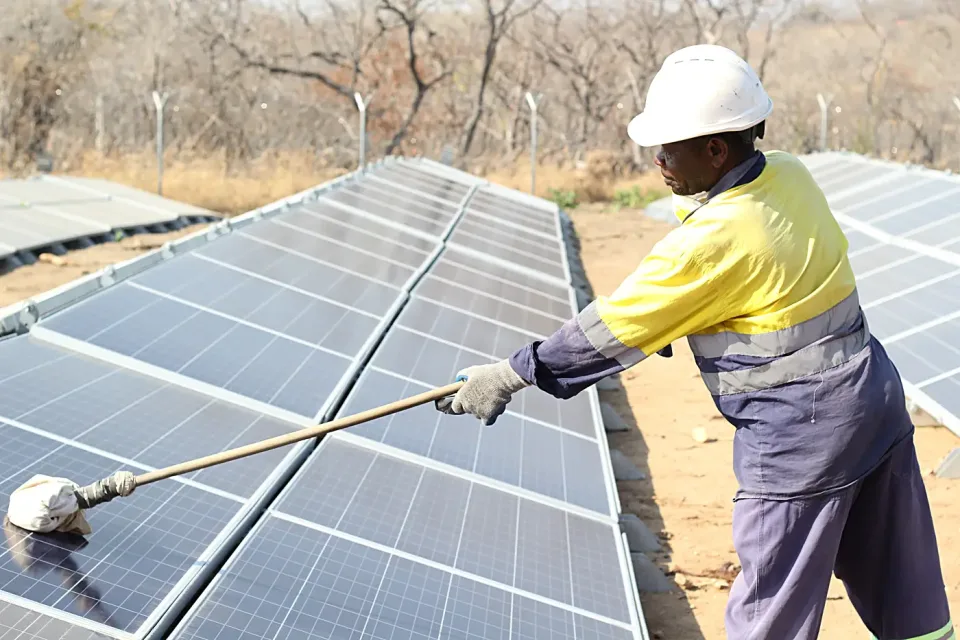
Featured photo: "Cleaning solar panel" by Deo photographer, via Wikimedia Commons — CC BY-SA 4.0
Frequently asked questions
Will the rain clean the panel for me anyway?
Partly. Rain rinses loose dust off a panel that has a decent tilt, which is one reason Check 4 matters. But the greasy film that builds up over a dry season, and bird droppings, survive ordinary rain — installers' guidance treats rain as a helper, not a cleaning method. The pre-monsoon wipe is what resets the panel to clean; the rain then has a chance of keeping it that way.
My solar light only lasts two hours now. Is it the battery or the panel?
Run Check 2 in order: clean the panel, give it one full sunny day in its usual place, then time the night. If the panel was filmed with dust, the clean alone may restore it. If it still fades after a couple of hours on a full charge, it's the battery — the wear part, and the cheapest fix if your light's battery compartment opens. Match the replacement's chemistry, voltage and size to the old cell.
There's fog inside the lens. Is the light ruined?
Usually not — but the fog is a message, not the problem itself. It means water has got past a seal and can't get out. Open the light on a dry day, let it dry completely, check for corrosion on the terminals, then fix the leak: a renewed gasket or a bead of silicone sealant. Fog that returns after resealing means the housing itself has cracked, and that light's outdoor career is over.
Can I wash the panel with detergent or a pressure washer to save time?
No — this is one of the few firm don'ts in solar care. Standard maintenance guidance is plain water and a soft cloth or sponge, with a mild detergent only if the maker allows one. Abrasives, solvents and pressure jets damage the glass coating and the seals, trading ten saved minutes for a panel that soils faster and a housing that leaks sooner.
Should I bring all my solar lights indoors for the monsoon?
No. A sound solar LED light is built to live outside, and a well-sealed one will ride out the season on its post. Bring in only the lights that can't charge where they stand — deep-shade spots that go fully dark in the monsoon — and charge them fully first. The lights guarding steps and gates stay out; just make sure they've had their fifteen minutes, and give the critical ones a mains backup for the greyest weeks.