
Guide
Types of LED, Plainly Explained: DIP, SMD, COB, High-Power and Filament
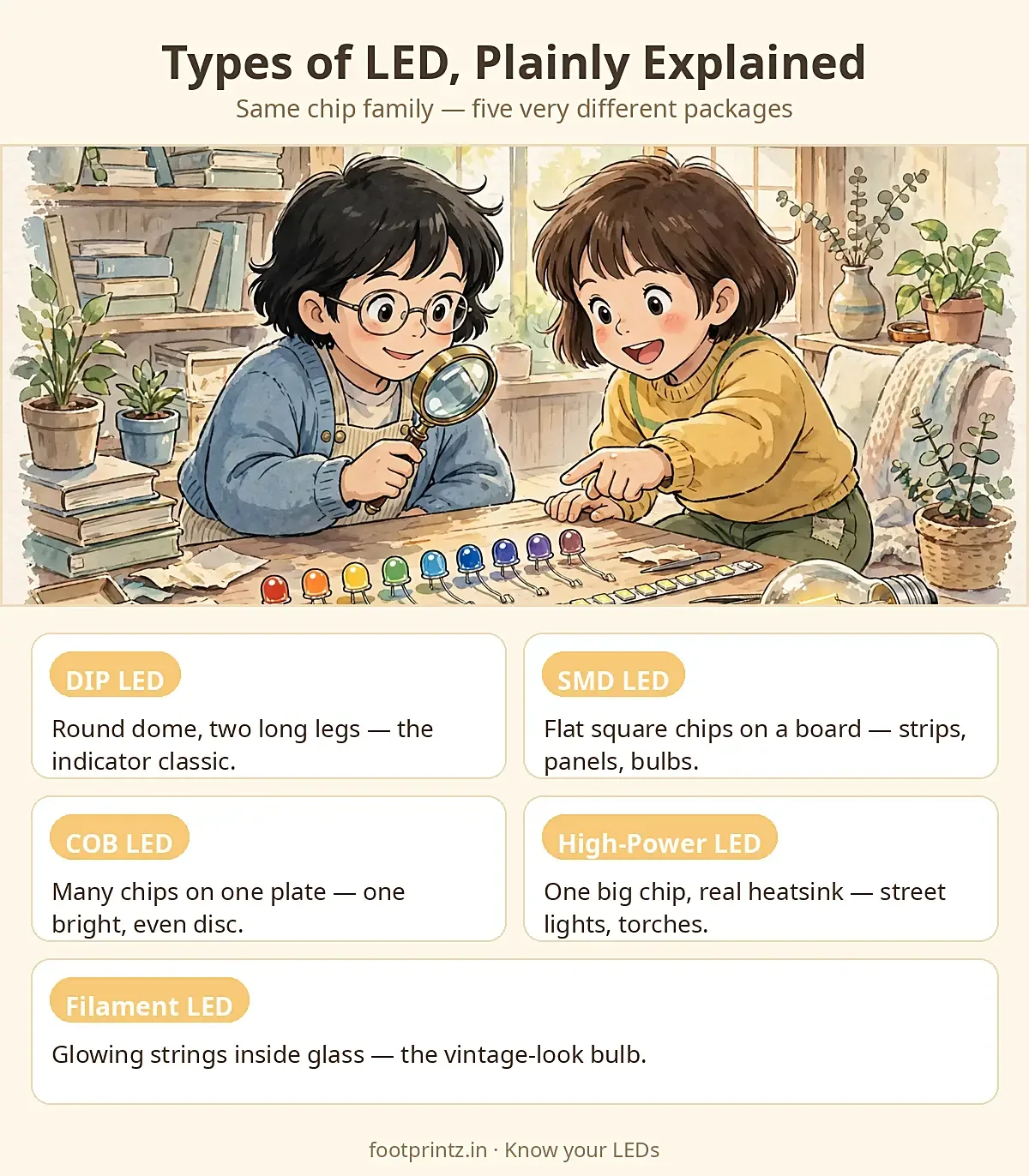
Stand in a lighting shop and you will hear DIP, SMD, COB, high-power, filament — five names that sound like five different inventions. They are not. Every one of them is the same semiconductor chip doing the same trick, turning electricity into light. What changes is the packaging: how the chip is mounted, how its heat escapes, and how its light is shaped. That packaging decides what the LED is good at. DIP is the tough old indicator lamp. SMD is the flat chip inside almost everything modern. COB packs many chips onto one plate for a single bright disc of light. High-power is one chip working hard, with a heatsink to prove it. Filament strings tiny chips along a strip inside a glass bulb, pretending to be a vintage wire. Once you can spot each one, the shelf makes sense.
Walk into any lighting market and the names come at you fast. DIP. SMD. COB. High-power. Filament. It sounds like five rival technologies, and salesmen are happy to let you believe one is simply "better" than the rest.
It isn't. Underneath every one of those names sits the same thing: a small semiconductor chip that glows when current passes through it. What actually differs is the packaging — how the chip is held, wired and cooled, and how its light is spread or focused. That decides how bright the light can be, how long it lasts, what shape of fitting it can live in, and what it costs.
So the five types are not a ladder from worst to best. They are five answers to five different jobs.
DIP: the one with legs
DIP is the original, and the one you have probably handled without knowing its name. The chip sits on a small metal frame inside a moulded epoxy dome — clear or coloured — and two metal legs come out of the bottom. Those legs push through holes in a circuit board and are soldered on the back — dual in-line package, through-hole mounting.
The dome is not just a cover. It is the lens. Milky, diffused epoxy spreads the light softly; crystal-clear epoxy concentrates it into a narrow beam you can see from far away. The common size is 5 mm across, with 3 mm and 10 mm versions too.
You've seen this in the standby dot on a TV, the power light on a charger, traffic signals, control panels — a thousand small "I am on" messages. DIP also survives outdoors as the pixels of big display boards, where each lamp must punch through daylight and can be swapped on its own if it fails. What it cannot do is light a room — each one runs on a trickle of current and gives a sip of light. Indicating, not illuminating, is its trade. It is cheap, tough, and easy to solder by hand, which is why, decades on, it is still everywhere.
SMD: the flat chip inside almost everything
SMD stands for surface-mount device. There are no legs and no holes. The LED is a small flat rectangle that solders directly onto the surface of a circuit board, placed by machine, hundreds at a time.
Open a panel light or peer inside most bulbs and you will find rows of little squares, each with a yellowish face. That face is the phosphor layer — most white LEDs are actually blue chips under a coating that converts part of the light to white.
Those squares come with numbers — 2835, 5050, 5630 — and the numbers are only the chip's footprint in tenths of a millimetre. A 2835 measures 2.8 × 3.5 mm. Nothing more glamorous than that. Crucially, the number is not a brightness grade: a recent 2835 can outshine an older, bigger chip. (We decode the numbers properly in a separate post.) One number worth remembering is 5050 — at 5.0 × 5.0 mm it has room for three separate chips inside one package, which is exactly why colour-changing RGB strips are built on it — red, green and blue in one package, mixing to any colour.
SMD won general lighting because it is small, cheap to place by machine, and easy to arrange in any shape — strips, panel grids, ceiling-light rings. Its weakness is repairability: fiddly by hand, and its heat escapes through the board, so board quality matters.
COB: many chips, one plate of light
COB — chip-on-board — takes the opposite approach to packaging. Instead of giving every chip its own little box, dozens of bare chips are bonded directly onto one shared plate — usually aluminium or ceramic — wired together and covered with a single layer of phosphor. The result is a flat disc or square with one yellow face, bolted straight onto a heatsink.
Because there are no individual packages and no gaps, the chips sit almost touching, and the whole face lights up as one surface. That is COB's signature: a lot of light from a small area, evenly, with none of the dotted pattern or multiple shadows of a row of separate LEDs. The heat path is short too — chip, plate, heatsink.
You've seen this as the single bright disc in a shop's track light, and in downlights, floodlights and camera lights. Stretched into a line, the same construction gives COB strip — a continuous ribbon of light with no visible dots.
The trade-offs are honest: stare at a lit COB and it glares, so fittings tame it with reflectors and diffusers; and if part of the array fails, you replace the whole module, not one chip.
High-power: one chip, working hard
High-power is not a shape at all. It is a power class. Most LEDs sip current; a high-power LED is a single chip built to be driven hard — a few hundred milliwatts and upward, with the serious parts commonly in the one-watt class and beyond. There is no single official line where "normal" ends and "high-power" begins, but the engineering changes completely up there.
Most of the electricity fed to an LED turns into heat, not light. Spread across many small chips, that heat is manageable. Concentrate the power in one die and the heat is intense and local. So a high-power LED is really a heat-management device that also emits light: a larger die on a ceramic or metal base, soldered to a metal-core board, fixed to a finned aluminium heatsink, often with a dome lens on top.
You've seen this wherever light has to travel: street light heads, floodlights, vehicle headlamps, a good torch, stage lights. If a fitting has a surprisingly chunky metal body, there is usually a high-power LED inside and the body is its heatsink, not decoration.
This is where shop talk muddles COB and high-power. A COB shares the work among many small chips on one plate. A high-power LED is one chip doing the heavy lifting alone. Both end up bright; they get there by opposite routes.
Filament: the impostor (in a good way)
The filament LED exists because people missed how old bulbs looked. Inside a clear glass bulb — same shape, same screw base as the incandescent it replaces — stand several slim glowing strips, arranged to imitate the wire filaments of a vintage lamp.
Each strip is a narrow substrate of glass, sapphire or ceramic carrying a row of tiny chips wired in series — typically a few dozen per strip — all of it coated in phosphor-loaded silicone, so the strip glows evenly along its length. Run each chip gently and the heat stays small; the sealed bulb is filled with a thermally conductive gas that carries what heat there is out to the glass, which is why a filament bulb needs no metal heatsink and can stay all glass.
You've seen these in café pendants, exposed-bulb fittings, and anywhere the bulb itself is part of the décor. Most are warm white, because nostalgia is the point. The limits follow from the design: output per bulb is modest, since a glass envelope can only shed so much heat, and the cheapest versions can flicker — the tiny driver in the screw base may have no room for the component that smooths the power.
And the two you will hear about but not buy for lighting
Briefly: mini LED and microLED belong to screens, not bulbs. Mini LED uses very small LEDs as the backlight behind an LCD TV or tablet screen, split into many dimming zones. MicroLED goes further and builds each pixel of a display out of microscopic LEDs. Neither is something you choose between when buying a light.
The five types at a glance
| Type | Looks like | Usually found in | Good at |
|---|---|---|---|
| DIP | A small dome on two wire legs | Indicators, signals, panels, big outdoor display boards | Being seen: cheap, tough status light |
| SMD | A small flat square on a board or strip | Strips, panels, bulbs, downlights | Fitting anywhere; the all-rounder |
| COB | One yellow disc or plate on a heatsink | Downlights, track lights, floodlights | Lots of even light from a small area |
| High-power | A single chunky chip on a star-shaped metal board | Street lights, headlamps, torches | Throwing serious light a long way |
| Filament | Glowing strips inside a clear glass bulb | Decorative and vintage-style bulbs | Looking like an old bulb, sipping power |
How to spot the type in a light you are buying
You rarely need to ask — you can see it. Rows of small squares behind a diffuser: SMD. One round yellow coin staring back at you: COB. Glowing "wires" in clear glass: filament. A heavy finned body on a street light or spotlight: high-power inside. And any tiny coloured dot that only says something is switched on: DIP, still doing its original job.
Knowing the types will not tell you whether a specific light is well made — the driver, the heatsinking and the honesty of the printed specs decide that. But it does tell you what a light was designed to do, and it makes the sales talk a lot easier to see through. Different packages, different jobs. That is all the mystery there ever was.
Sources: Wikipedia — "Light-emitting diode", "LED filament", "Thermal management of high-power LEDs", "MicroLED"; Green Building Advisor — "LED Filament Bulbs"; chip-on-board construction references; SMD package size guides. Full research notes with per-claim citations are kept with this draft.
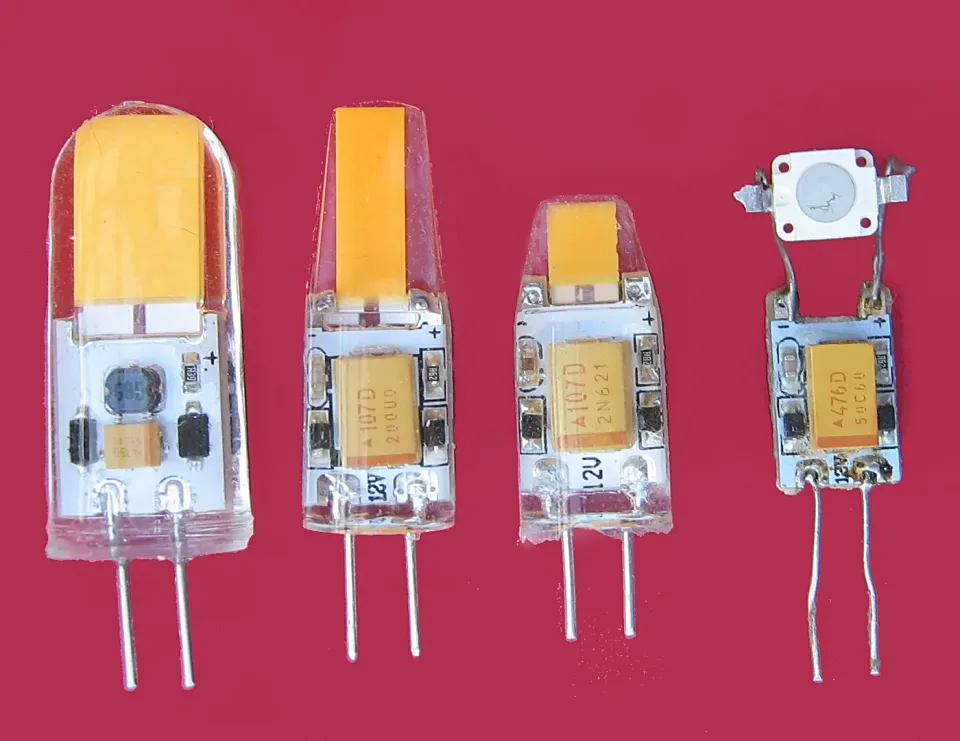
Featured photo: "COB and SMD LEDs on buck converters" by Hans Haase, via Wikimedia Commons — CC BY-SA 4.0.
Frequently asked questions
Which type of LED is the best?
There is no best type — there is a best fit. SMD suits most home lighting, COB suits focused downlights and spots, filament suits visible decorative bulbs, DIP suits indicators, and high-power suits street lights and headlamps. A “better” package in the wrong job is just the wrong package.
Is COB better than SMD?
COB gives more light from a smaller, single surface, which is better for spots and downlights. SMD is cheaper to arrange in large, even areas like panels and strips, and easier to spread out. Neither is universally better; fittings use each where it wins.
What do SMD numbers like 2835 and 5050 mean?
They are the chip package's footprint in tenths of a millimetre — a 2835 is 2.8 × 3.5 mm. The number describes size only, not brightness or quality.
Do filament LED bulbs last as long as normal LED bulbs?
They can, but they run closer to their limits: the glass envelope can only shed so much heat, and very cheap filament bulbs often skimp on the driver in the base. Buy them for the look, from a maker who states the specs plainly.
Why are there no DIP lights for rooms?
A DIP LED is an indicator device — each one produces very little light and is built to be looked *at*, not to light a space. Room lighting needs either many chips working together (SMD, COB) or individual chips driven hard (high-power).