
Guide
UV LEDs and IR LEDs: what they are actually for — and what they are not for
The hardest-working LEDs in your home emit light you cannot see. An infrared LED blinks coded orders at your television and air conditioner. Ultraviolet LEDs harden printing ink, adhesives and gel nails, and make the hidden marks on banknotes glow. A third kind, UVC, can genuinely kill germs — and genuinely burn your eyes, which is why the honest versions live inside ducts and cabinets, not in a wand waved around the living room. This post sorts the real jobs from the marketing: what UV and IR LEDs actually do, the wavelengths that matter (365, 850, 940 nanometres and friends), why your phone camera can see a remote control's flash when you can't, and which claims — ten-second sterilisers, infrared heaters, tanning gadgets — deserve a flat no. Plus the two safety rules that actually matter: never treat UVC as a toy, and never trust a wavelength the seller won't print.
Some of the busiest LEDs around you never light anything. Press the remote tonight and an LED fires off coded flashes in a colour no human eye can register. The gel polish at a salon hardens under another LED, glowing violet. A security camera over a shop shutter sees the street in total darkness using a third.
These are ultraviolet and infrared LEDs, and they live a double life: precise, well-understood jobs in factories, hospitals and cash desks — and some of the wildest claims in the gadget world online. The gap between the two is where money gets wasted and, occasionally, eyes get hurt.
Start with the map
Light your eyes can use runs from violet to red, ending at about 700 nanometres. (A nanometre is a billionth of a metre — wavelength is how we sort light into colours, including invisible ones.)
Step past violet and you're in ultraviolet: 100 to 400 nanometres, in three bands. UVA (315–400) is the nearest, gentlest band — most UV LEDs work in it. UVB (280–315) is the sunburn band of sunlight. UVC (100–280) is the fierce one — and the one nature keeps off us: the atmosphere absorbs solar UVC entirely, so all UVC you meet comes from a device.
Step past red and you're in near-infrared. Nothing exotic: light slightly too long-wave for your retina. Most IR LEDs cluster at 850 and 940 nanometres, and the IR half of this article happens almost entirely at those two addresses.
UVA: the shift worker
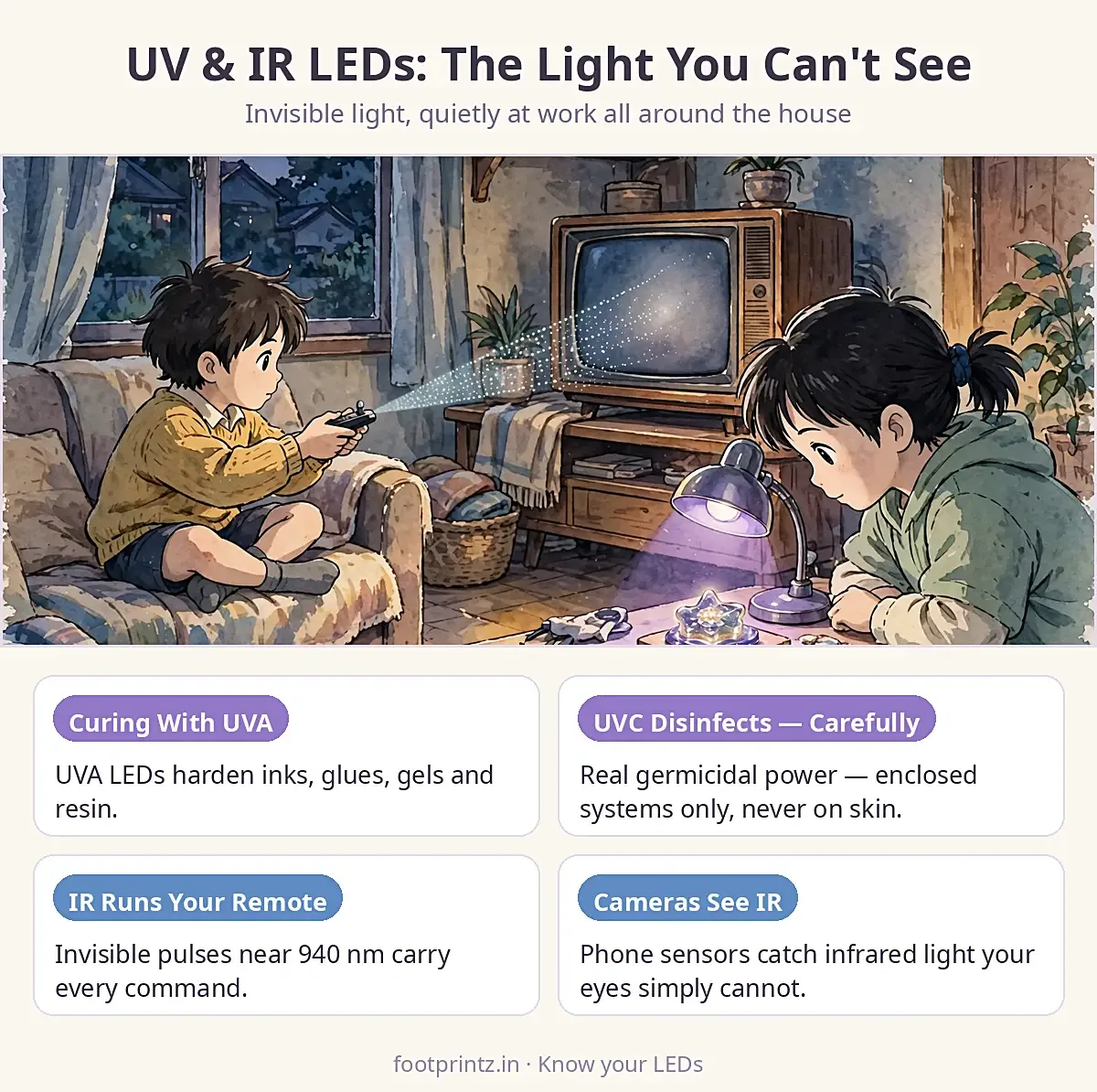
The honest living of the UV LED is curing. Shine the right UVA on certain inks, coatings, adhesives and resins and they don't dry — they polymerise in seconds. Print shops cure ink on the press, factories cure glue and coatings, and at human scale the same trick hardens gel nail polish and craft resin. They peak at 365, 385, 395 or 405 nanometres, and the number is not decoration — the chemistry must be formulated for it. A resin made for 365 nm under a 405 nm lamp cures slowly, shallowly, or not at all.
Nail lamps are the version most people meet. The US Food and Drug Administration views them as low risk when used as directed — even the worst lamp in the study it cites kept half an hour's daily exposure below occupational limits, and it holds no reports of burns or skin cancer from them. A tanning bed is a different machine entirely — rows of fluorescent tubes, mostly UVA — and the World Health Organization's advice on those is simply: avoid. The EU's scientific committee found no safe limit for sunbed UV at all. Anyone offering tanning or vitamin D from an LED gadget is selling nonsense: tanning isn't an LED job, and vitamin D comes from the UVB in sunlight.
UVA's other party trick is fluorescence. Shine roughly 365 nm at a banknote and hidden fluorescent-ink features light up, on paper made to stay dull — hence the UV checker at cash desks. The Bank of England is specific: a lamp at about 365 nm is ideal, and it advises against little LED key-fob detectors, because they often emit above 365 nm. That warning describes half the "UV torches" sold online: many peak at 395 or 405 nm — visible violet light that looks dramatic, glows purple, and excites fluorescence feebly. A torch that looks impressively purple is usually the wrong tool wearing the right label. If the wavelength isn't printed on it, assume it's the violet kind.
UVC: genuinely germicidal, genuinely unforgiving
Here marketing and physics collide hardest, so be careful in both directions.
UVC really does inactivate bacteria and viruses — no pandemic-era fad: germicidal UV has disinfected air and water for over seventy years, with 254 nm mercury lamps inside air-conditioning ducts, upper-room hospital fixtures and water plants. UVC LEDs exist too, mostly around 265–280 nm, in small water and surface devices. But notice where successful installations live: inside ducts, inside cabinets, in emptied rooms. That pattern is the whole lesson.
Two conditions rule everything. First, dose: disinfection is irradiance multiplied by time, delivered to the microbe. Second, line of sight: UVC only treats what it directly hits, and dust, dirt and shadow block it. The FDA makes both points to consumers, adding that many home lamps are too low-dose to work quickly.
Now the other direction: the energy that shreds a virus's proteins does not politely spare your cells. Direct UVC reddens skin like a burn; in eyes it causes photokeratitis — the FDA's description is severe pain and a feeling of sand in the eyes. The CIE — the international authority on light — warns with the WHO against ever using UV lamps on skin, calls home use inadvisable, and warns that consumer UV-C products may be unsafe or ineffective. The FDA has reports of burns from UVC lamps badly installed in occupied rooms.
Which brings us to the wand: the FDA tested handheld UV wands and found some emitting, at about two inches, up to 3,000 times the recommended exposure limit — injury within seconds. And it offers the neatest shopping rule in the field: when a product claims to disinfect in seconds, it probably emits an unsafe level of UVC. Switzerland's health office measured home UV-C devices and found the mirror-image failure: many emitted so little UV-C they couldn't disinfect anything. That's the cheap-gadget trap: output either too much for your eyes or too little for the germs — the narrow ledge between is called professional equipment.
One more name to file correctly: far-UVC, around 222 nm, advertised as the safe kind for occupied rooms. It comes from excimer lamps, not LEDs; it's an active research area, not a settled technology, and regulators aren't waving it through for homes. Interesting, promising, unfinished — don't buy it as proven.
IR: the remote in your hand, the camera in the dark
Infrared LEDs have the opposite reputation problem: none. Nobody fears them, nobody oversells them; they just quietly run the house.
The remote control is the type specimen: its LED, usually around 940 nm, blinks your button-presses as a coded pulse train that a photodiode in the TV reads. The same LED-and-sensor pairing, miniaturised, is what blanks your phone screen when you raise it to your ear. And in the fingertip oxygen meter, an infrared LED at 940 nm pairs with a red one at 660 nm: oxygenated and deoxygenated blood absorb the two differently, and the ratio is your SpO2 reading. An invisible LED doing medical measurements, for the price of a pizza.
After dark, IR becomes illumination — for cameras, not people. Security cameras carry rings of IR LEDs at 850 or 940 nm. At 850, sensors respond strongly and range is good, but the emitters glow a faint red if you look straight at them. At 940 there is no glow at all, but sensors are less sensitive, so range shrinks. "Invisible night vision" means 940; maximum range usually means 850, red dot and all.
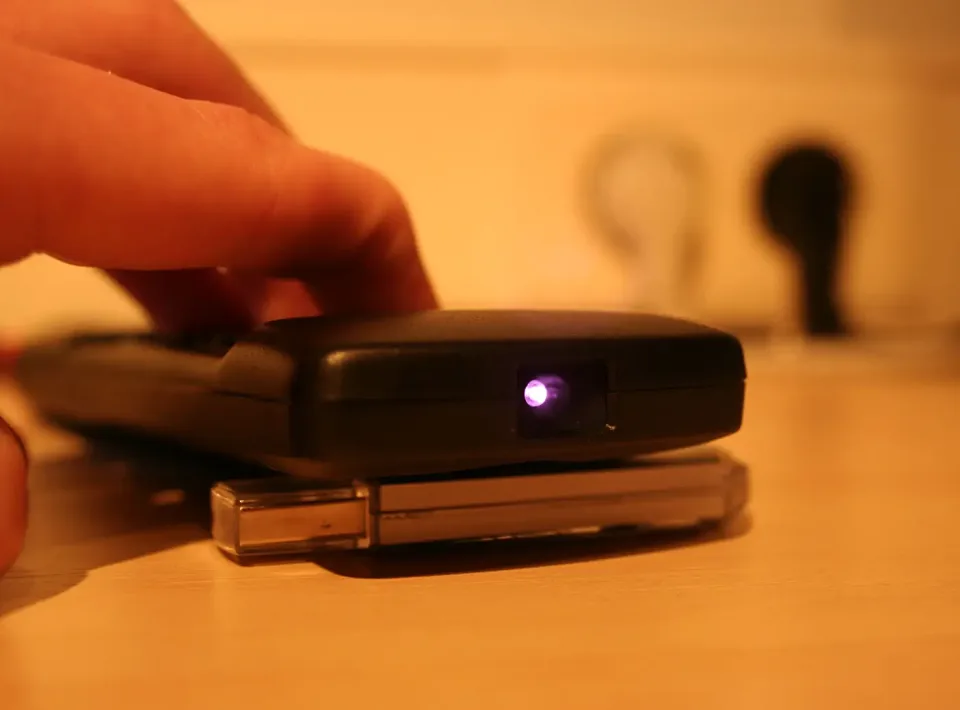
The neatest IR trick you've probably used yourself: point a phone camera at a remote and press a button — the LED blinks violet-white on screen, though your eyes see nothing. No mystery: camera sensors are silicon, sensitive out to about 1,100 nm, far past your retina's 700. Phones carry an infrared-blocking filter to keep colours honest, but it's an imperfect sieve, and enough leaks through — front cameras are usually leakier — to betray the flash. It's also the fastest remote diagnosis there is: blink on camera, remote works — problem is the TV. No blink, change the batteries.
Two modest cautions. Invisible light doesn't trigger a blink reflex, which is why IR emitters sit in the photobiological safety framework alongside other lamps — remotes and sensors are low-power, pulsed, and not worth a worry, but don't stare into a high-power illuminator array up close. And an IR LED is not a heater: a heat lamp warms you because a glowing filament pours out broad infrared, while an IR LED emits a narrow sliver of near-infrared at low power, made for signalling. It will no more warm your bathroom than a TV remote will. (Thermal cameras don't shine IR either — they passively sense the longer-wave infrared objects radiate. Different band, same confusing name.)
So what do you do with all this?
Buy by wavelength, not by adjective — if a product doesn't state its nanometres, it's telling you something. Match wavelength to job: 365 for fluorescence checks and serious curing, 940 when a remote or sensor must stay invisible, 850 when a camera needs reach. Treat every UVC device as enclosed-or-empty-room equipment, wear the glasses that come with curing lamps, and file wands under claims, not disinfectants. The invisible LEDs earn their keep, as long as you know which invisible light you're getting.
Sources: CIE, Position Statement on the Use of Ultraviolet Radiation (2020); US FDA, consumer guidance on UVC lamps and disinfection, Safety Communication on UV wands, and "How to Safely Use Nail Care Products"; WHO, "Ultraviolet radiation" fact sheet; Bank of England, banknote FAQs; Swiss Federal Office of Public Health, fact sheet on UV-C disinfection devices for home use; UV+EB Technology (RadTech), on LED curing wavelengths.
Featured photo: "Remote infrared" by Peter Hebels, via Wikimedia Commons — public domain.
Frequently asked questions
Can my phone really see infrared?
Yes — most phone cameras can. The sensor responds to near-infrared out to roughly 1,100 nm, and although an internal filter blocks most of it, a remote's flash leaks through as a violet-white blink. Front cameras usually show it best. It's how you check whether a dead remote is actually dead.
Is a UV nail lamp dangerous?
The FDA views nail curing lamps as low risk when used as directed, and has no reports of burns or skin cancer attributed to them. Follow the timer, and be careful if you take medicines that make skin light-sensitive — that's the group the FDA singles out. Sunscreen or fingertip-less gloves are cheap extra insurance if you go often.
Do UV steriliser wands actually work?
Treat the claim with suspicion. The FDA found some wands emitting up to 3,000 times the recommended UVC limit at close range — dangerous in seconds — while Swiss government measurements found other home UV-C devices emitting too little to disinfect anything. Real UVC disinfection exists, but it lives in enclosed, professionally designed equipment, not wands.
Can an IR LED light heat my room?
No. An IR LED emits a narrow band of near-infrared at low power for signalling and sensing. The warmth of a heat lamp comes from a hot filament radiating broad infrared. An “infrared LED heater” is a phrase, not a technology.
Is it safe to look at a UV curing lamp while it works?
Don't stare into it, and use the protective glasses supplied with workshop and resin-curing lamps. UVA is the gentlest UV band, but it is still UV, aimed at close range for minutes at a time — treat it with the same respect you'd give bright sun, and never look into a UVC source at all.