
Guide
UV LED safety: using ultraviolet LEDs without hurting your eyes or skin
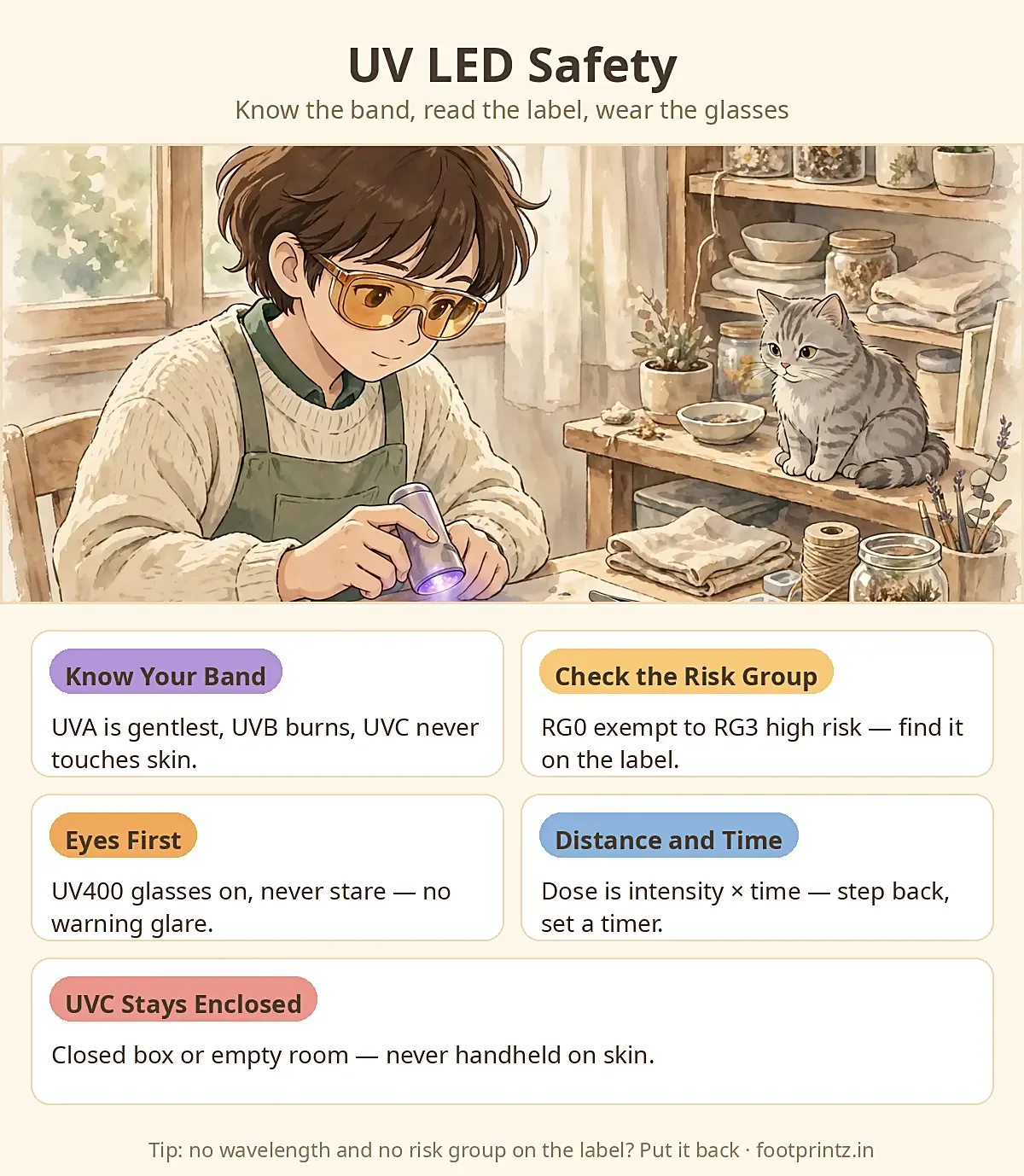
A UV LED is not a toy torch with a scary warning, and it is not a household light you can treat casually either. It sits in between, and where it sits depends on three things you can actually check: which band it emits (UVA, UVB or UVC), how much of it reaches you (intensity multiplied by time, cut fast by distance), and what its label tells you (the wavelength, and ideally an IEC 62471 risk group from RG0 to RG3). This post works through all three, then goes device by device — nail lamps, resin and curing lamps, UVC disinfection lights, UV torches — with the specific habits that keep each one safe: glasses that genuinely block UV, timers, shields, empty rooms for UVC, distance used properly, and the label red flags that should send a product straight back to the shelf.
Our earlier post on UV and IR LEDs was about what these invisible LEDs do — curing, checking banknotes, disinfecting. This one is about the other half of ownership: using them, sometimes at arm's length and sometimes for years, without quietly injuring the two organs UV reaches first — your eyes and your skin.
The good news is that UV safety is not guesswork. It reduces to three questions: which band does it emit, how much of it will reach me, and what does its label say? Answer those and the safe habits mostly choose themselves.
Risk follows the band
Ultraviolet is not one thing. UVA (315–400 nm) is the nearest band to visible light and the gentlest of the three — it is also the band nearly every consumer UV LED works in. Gentle is a relative word: UVA penetrates to the lens of the eye, its effects add up over years, and it still carries a formal exposure limit. UVB (280–315 nm) is the sunburn band of sunlight, far more potent per second than UVA; you will rarely meet it in a home LED device, and that is just as well. UVC (100–280 nm) never reaches us from the sun — the atmosphere absorbs it completely — so every bit of UVC you meet comes from a device, and it injures the surface of eyes and skin fast enough that the international guidance is blunt: never use it on skin, and never look at it.
The exposure limits scientists use weight UV by how damaging each wavelength is, and that weighting peaks in the UVC/UVB range and falls off steeply through UVA. Same family, very different tempers — a UVA curing lamp and a UVC disinfection lamp are both "UV LEDs" in roughly the way a candle and a welding arc are both "lights".
The label that grades the lamp: IEC 62471 risk groups
There is an international standard for exactly this problem. IEC 62471, the photobiological safety standard for lamps and lamp systems, tests sources — LEDs included — and sorts them into four risk groups:
- RG0, Exempt: no photobiological hazard. This is the group you want for anything used casually at home.
- RG1, Low risk: no hazard under normal behaviour — you would have to use it oddly, for a long time, to get into trouble.
- RG2, Moderate risk: no hazard because you naturally blink and look away from intense light. Note the catch for UV: that defence is triggered by visible brightness, and UV itself is invisible, so a high-UV source may not give you the glare that makes you flinch.
- RG3, High risk: a hazard even from momentary exposure. Equipment territory, with shielding and controlled access — not a gadget for a desk drawer.
Where do you find the group? On the specification sheet, in the manual, or on the maker's technical page — serious manufacturers test and publish it. Two caveats. A risk group is measured under stated conditions, including distance, so RG0 is not a licence to press any lamp against your eye. And many cheap UV products print no risk group at all. That absence is information too: nobody graded it, or nobody wanted to say.
Eyes first, skin second
With UV devices, eyes are usually the casualty, for a simple reason: UVC and UVB are absorbed at the surface, and the eye's surface — the cornea — is delicate, exposed, and pointed straight at the lamp. The classic injury is photokeratitis, an inflammation of the cornea that feels like sand ground into the eye. Two features make it treacherous. It is genuinely painful, and its symptoms typically arrive hours after the exposure — so "it didn't hurt while I was using it" is evidence of nothing. The World Health Organization lists photokeratitis among UV's acute eye effects, notes that it is reversible and easily prevented by protective eyewear, and lists cataract among the chronic effects of a lifetime of UV reaching the lens.
Skin is tougher and usually covered, so it comes second — but not nowhere. UV reddens skin in a sunburn-like reaction, and over years it drives photoageing; UV radiation in excess is classed as carcinogenic, which is why the working rule for skin is boring and effective: cover it, glove it when you are handling resin under a lamp, and never, ever use a UVC device on skin deliberately — not on hands, not on a wound, not "just for a few seconds".
Dose is intensity × time — and distance cheats the maths
Exposure limits are written as a dose: how much UV energy lands on you in total. Dose is intensity multiplied by time, which means you hold both halves of the multiplication. A timer caps the time. Distance attacks the intensity — and it attacks it quadratically. Light from a small source spreads as it travels, so doubling your distance cuts the intensity to a quarter; tripling it, to a ninth. Stepping back is the single fastest safety improvement available, and it costs nothing.
Treat that as a rule of thumb, not a promise: real lamps are not perfect point sources, and UV reflects off some surfaces, so no universal "safe distance" in centimetres exists for all devices. Follow the maker's stated minimum distance where one exists, use the timer, and let shields and lids block the light whenever the design allows — a closed curing box protects you better than your own discipline does.
Device by device: the habits that matter
Nail lamps. The calmest case. The US Food and Drug Administration views nail curing lamps as low risk when used as directed, and notes it has no reports of burns or skin cancer attributed to them. Use the built-in timer rather than extra rounds "to be sure". The named exception is medication: some medicines make skin photosensitive — extra reactive to UV — so if you take any and the leaflet warns about sunlight, ask your doctor or pharmacist before regular lamp use. Sunscreen on the backs of your hands, or fingertip-less UV gloves, cuts the dose further if you go often.
Resin and workshop curing lamps. UVA lamps used close, for minutes, with your face near the work — so the glasses habit belongs here most of all (next section). Don't stare into the lamp to check the cure; set the timer and look at the piece, not the emitter. If the lamp has a shield or a lid, cure under it. And ventilate the bench: uncured resin gives off fumes and irritates skin on contact — a chemical problem riding along with the light problem, solved by gloves and moving air.
UVC disinfection devices. The strict case, and the rules do not bend. Enclosed or empty room, full stop: inside a cabinet, inside a duct, or running on a timer in a room nobody — person or pet — is in. Never handheld against skin, never waved around an occupied room, never looked at, even briefly, even "through the door". If a UVC product is marketed as safe to use around people while it works, that claim itself is the warning sign.
UV torches. Both common kinds are UVA: 365 nm, which makes fluorescent materials glow properly, and 395–405 nm, which is partly visible violet light — brighter-looking, weaker at fluorescence. Neither should be shone into anyone's eyes, and the violet glare of the 395/405 kind practically invites a child to stare into it. Keep UV torches out of the toy box entirely; a torch that exists to be pointed should never be a child's toy, whatever the wavelength.
Glasses that actually protect
Proper UV safety glasses are usually orange or amber, and the colour is doing real work: the lens material absorbs ultraviolet, and the amber tint also swallows the violet-blue glare, which is why you can comfortably watch a workpiece fluoresce through them. But colour alone is not protection — an unlabelled tinted lens can be nearly transparent to UV. Buy by label, not by shade: look for UV400, or 99–100% UVA and UVB protection, which is the wording eye authorities tell consumers to look for. Polycarbonate lenses are the standard material for this. Ordinary prescription glasses may not block UV at all, and sunglasses are a gamble unless they carry the same UV400 label. Fit matters too: wraparound styles or side coverage, because UV arrives from the side and by reflection, not only from straight ahead.
Label red flags
Walk away from a UV product that shows any of these: no wavelength printed anywhere (you cannot judge a band you are not told); no risk group and no test standard mentioned; "sterilises in seconds" (real disinfection is dose over time — seconds-claims are the signature of either a dud or a hazard); "safe around children and pets while it runs" on a UVC device; or a UVC lamp with no timer, no interlock and no shielding, sold for open-room use. A maker who prints the wavelength, the risk group and a minimum distance is a maker who measured something.
None of this should put you off UV LEDs. It should put you in charge of them: know the band, read the group, wear the glasses, mind the dose, and keep UVC behind a door or a lid. Do that, and the violet lamp on your bench stays what it should be — a tool.
Sources: IEC 62471 photobiological safety risk groups (RG0–RG3), as summarised from EN 62471; ICNIRP Guidelines on limits of exposure to ultraviolet radiation (180–400 nm); CIE, Position Statement on the Use of Ultraviolet Radiation (2020); WHO, "Ultraviolet radiation" fact sheet; US FDA, consumer guidance on nail care products and on UVC lamps and disinfection; National Eye Institute, guidance on UV-protective eyewear.
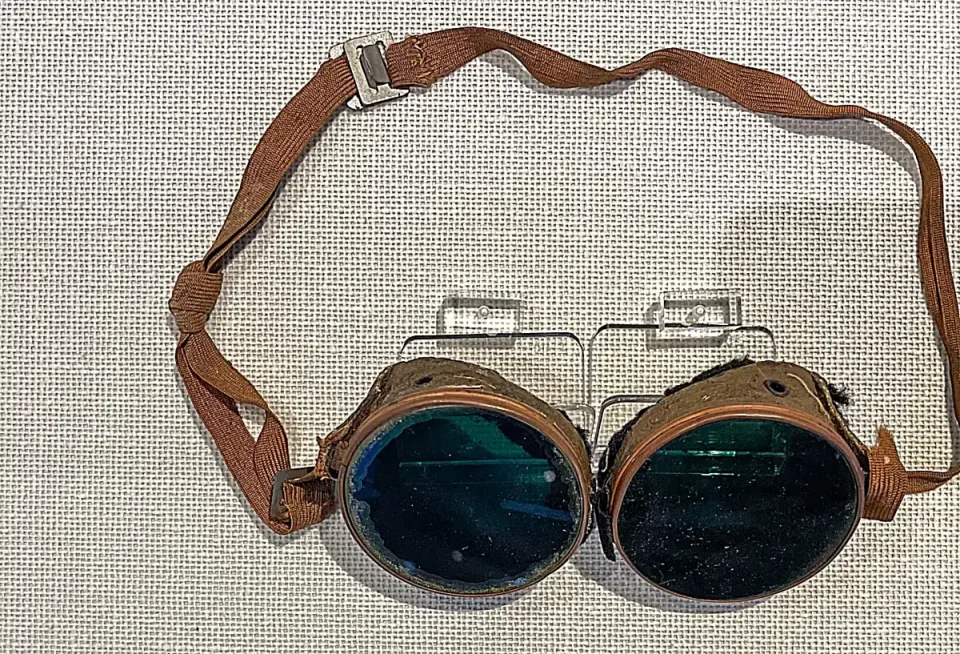
Featured photo: "At Tokyo 2024 132" (UV-shading goggles, cropped) by Mike Peel, via Wikimedia Commons — CC BY-SA 4.0.
Frequently asked questions
Are UV LED nail lamps safe to use every week?
On current evidence, yes for most people. The FDA views nail curing lamps as low risk when used as directed, and has no reports of burns or skin cancer attributed to them. Use the timer, don't add extra rounds, and take one exception seriously: if a medicine you take warns about sunlight sensitivity, check with your doctor or pharmacist first. Sunscreen or fingertip-less UV gloves are cheap extra protection for frequent users.
Will ordinary sunglasses protect me from a resin curing lamp?
Don't rely on them. Darkness is not UV blocking — an unlabelled tinted lens can let UV straight through while making your pupils open wider. Use safety glasses labelled UV400 or 99–100% UVA/UVB protection; the orange or amber kind made for UV work also cuts the violet glare, which makes the workpiece easier to watch.
Can a UVC light hurt me if I never look at it directly?
Yes. Skin counts too — UVC reddens and burns skin on contact, and reflections carry it around corners of a setup. That is why the rule is enclosed or empty room: inside a cabinet or duct, or running while nobody is in the room. "I wasn't looking at it" has never been a safety system.
How far should I stand from a UV lamp to be safe?
There is no single number that fits all lamps — it depends on the band, the output and the risk group. Distance helps fast: doubling it cuts a small source's intensity to about a quarter. Follow the maker's minimum distance if one is printed, prefer lower risk groups for close work, cap your time with a timer, and use shields where the lamp provides them.
Is a 395 nm UV torch safer than a 365 nm one?
Not in any way that changes how you should treat it. Both are UVA. The 395 nm torch looks brighter because more of its output is visible violet light, but that glare is exactly what tempts people — especially children — to stare into it. Neither belongs pointed at eyes, and neither is a toy.