
· Amit
What is an LED chip? How a tiny chip turns electricity into light
What is an LED chip? How a tiny chip turns electricity into light
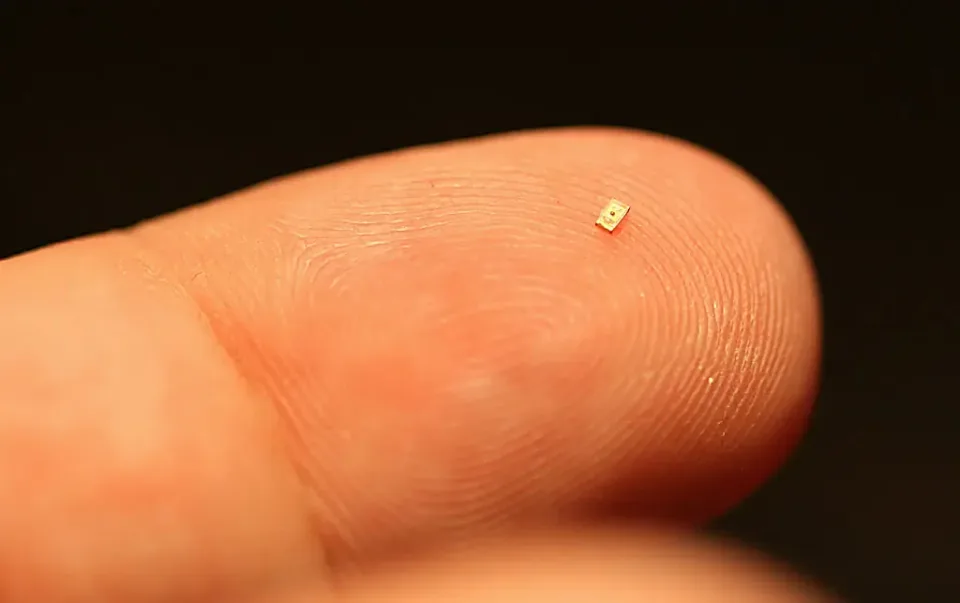
Hold an LED up to the light and look closely. Under the clear dome, sometimes barely visible, sits a small square — often under a millimetre across, a few millimetres in a powerful light. That square is the chip, and it is the whole show. Everything else in the lamp, the dome, the metal body, the electronics in the base, exists to feed it, protect it, and carry its heat away.
So what is the square actually doing? Something no bulb filament ever did. It doesn't get hot until it glows. It doesn't burn anything. It persuades electrons to fall — and each fall pays out exactly one tiny packet of light.
Two halves, deliberately made different
The chip is a slice of semiconductor, a material in the middle of the conducting scale: not a free-flowing conductor like copper, not a blocker like plastic, but something whose behaviour can be tuned. The tuning is called doping, and it produces the chip's two halves.
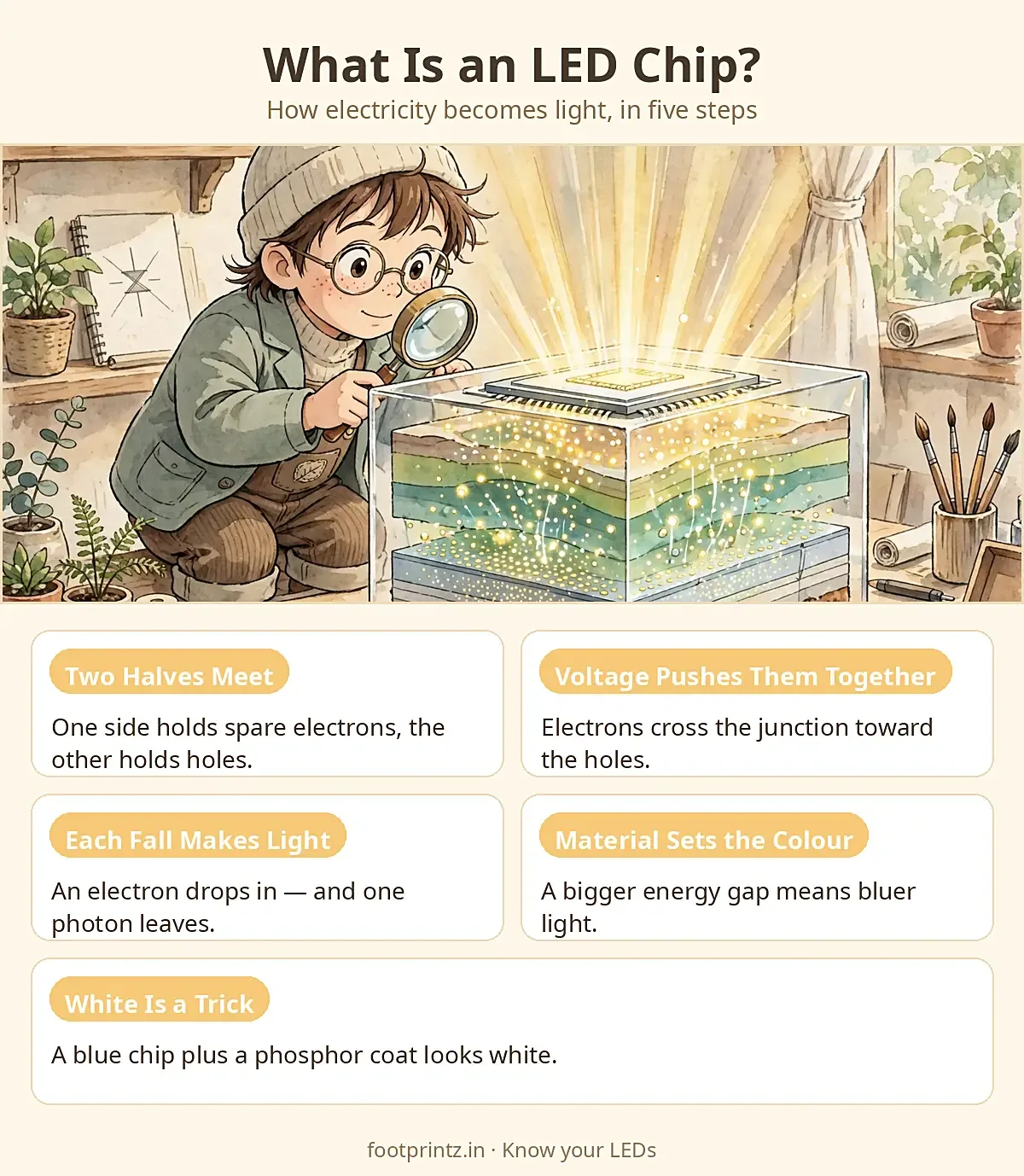
One half is treated to have spare electrons — loose, negatively charged particles with energy to move. That's the n-type side, n for negative. The other half is doped the opposite way, leaving it short of electrons. Each shortage behaves like a positive charge looking for an electron to fill it, and physicists call these shortages holes. That's the p-type side.
Where the two halves meet is the p–n junction, and it's a strangely quiet place at rest. Electrons near the border wander across and fill the nearest holes, leaving a thin strip with neither spare electrons nor empty holes — a no-man's-land that resists further crossing. Apply voltage the right way round, though, and the picture changes.
The fall that makes the light
Push voltage across the chip in the forward direction and you shove the two crowds toward each other. Electrons from the n-side cross the junction into p-side territory, where holes are plentiful. Sooner or later — usually very soon — each electron meets a hole and drops into it.
That drop is the entire trick. An electron in motion sits at a higher energy level; settled into a hole, it sits lower. The difference has to go somewhere, and in the right material it leaves as a photon, a single packet of light. Multiply that by the billions of electrons crossing every second and the packets merge into the steady beam you see. The process has a name worth knowing: electroluminescence, light from electricity, with no flame, no filament, and no gas in between.
Why doesn't an ordinary silicon diode glow the same way? Because material matters. In silicon, an electron's drop is awkwardly indirect, and the spare energy mostly leaks out as heat instead. LED chips are built from a different family of materials — gallium compounds, mainly — where the drop is direct and the energy escapes as light. Same physics, different material, completely different result.
The material chooses the colour
Here's the elegant part. The energy of each photon is set by the height of the fall — the gap between the electron's level and the hole's level, called the band gap. And the band gap is a property of the material mix the chip was grown from.
A small gap means a gentle fall and a low-energy photon: red light, or below red into infrared. A bigger gap means a harder fall: green, then blue, then ultraviolet at the top of the range. Colour isn't painted on afterwards and no filter is involved — the chip is born its colour. This is also why a chip's forward voltage climbs with its colour: red chips typically light at around 1.8–2.2 volts, blue and white ones need roughly 3.0–3.5. Each electron must be lifted at least as high as the fall it will take, and a blue fall is a tall one.
White is a blue chip in a coat
That last number raises a puzzle. If no material makes white directly, why do white chips need blue-chip voltage?
Because a white LED is not white at all. Open one up (or just look at it switched off) and you'll often notice the chip area looks yellow. It is a blue chip wearing a coat of phosphor. Part of its blue light escapes as blue; part is absorbed by the phosphor and re-emitted as a broad wash of yellow. Blue plus yellow, mixed in the right proportions, is what your eye reads as white. More phosphor in the coat, and more of the blue gets converted — the light comes out warmer. Less, and it stays cool and blue-ish. Warm white and cool white are, quite literally, the same chip in different thicknesses of coat.
Chip, package, light: three different things
One confusion worth clearing up, because sellers exploit it. The chip — properly, the die — is only the semiconductor square. What you buy as a single "LED" is a package: the die glued onto a metal base or into a small reflective cup, connected to the outside world by a wire finer than a hair, then sealed under a clear dome of epoxy or silicone. The dome protects the die, and its shape bends the light into a narrow beam or a wide spread.
An LED light — the bulb or panel in your ceiling — is a third thing again: one package, or dozens of them, plus a driver and a heatsink, all in a housing. When a listing makes grand claims, it helps to ask which level it's talking about.
Why the chip needs a minder
For all its elegance, the chip is a fussy eater. Once voltage passes the point where it starts to conduct, its appetite for current rises extremely fast — a small extra push in voltage can mean a large surge in current. And as the chip warms up, the voltage it needs actually falls slightly, so a fixed supply invites it to draw more current, get hotter, and draw more still. Left to itself, it cooks.
So chips are never fed raw voltage. Something must hold the current steady — a simple resistor for a tiny indicator, a proper constant-current driver inside a household light. The driver is the minder. When people say a light "flickers" or "died early", the chip is often innocent and the minder failed.
Heat is the other half of the care routine. An LED beam feels cool on your skin because the light itself carries almost no infrared heat. But the losses at the junction are real, and they exit through the back — down through the die's mounting, the board, and a metal heatsink. Keep that path clear and the chip stays cool, bright and long-lived. Block it, and the same chip dims and ages fast. The chip makes light out front; its survival depends on plumbing behind.
The smallest engine in the house
That's really all an LED chip is: two tuned halves of crystal, a border crossing for electrons, and a fall that pays out in light. No moving parts, nothing consumed, nothing burning away — which is why a well-fed, well-cooled chip can keep doing it for years. The engineering since has mostly been about the care and feeding: better materials, better phosphors, better drivers, better heatsinks. The fall itself hasn't changed at all.
Sources: LibreTexts, "Light Emitting Diodes" (Materials Science); Wikipedia, "Light-emitting diode physics"; Analog Technologies white paper, "LED Forward Voltage by Color"; Electronic Design, "Blend Blue LEDs And Phosphors To Make HB LEDs"; European Patent EP 2445021 A2 and US Patent 6,770,498 (LED package construction).
Featured photo: "SMD LED on a fingertip" by Fressmotron, via Wikimedia Commons — public domain.