
Guide
Why cheap LED lights die early: where the money was saved, part by part
A bulb that promised 15,000 hours and died inside a year rarely died because its LED chip wore out — chips usually fade slowly, they don't switch off. Something cheaper and quieter gave up first. This post maps the four places money disappears when an LED light is built down to a price: a driver with no margin, a heat path made of plastic and hope, chips bought from the wide end of the sorting bins, and protection and assembly corners cut where you can't see them. It lays out the failure timeline those savings produce — early flicker, fast fading, dead within a season or two — and then argues the honest counterpoint: a simple, well-made budget light in an open fitting can outlive a fancy one cooking in a closed shade. It ends with the checks a buyer can actually do in the shop: heft, label, warranty, and the seller's return desk.
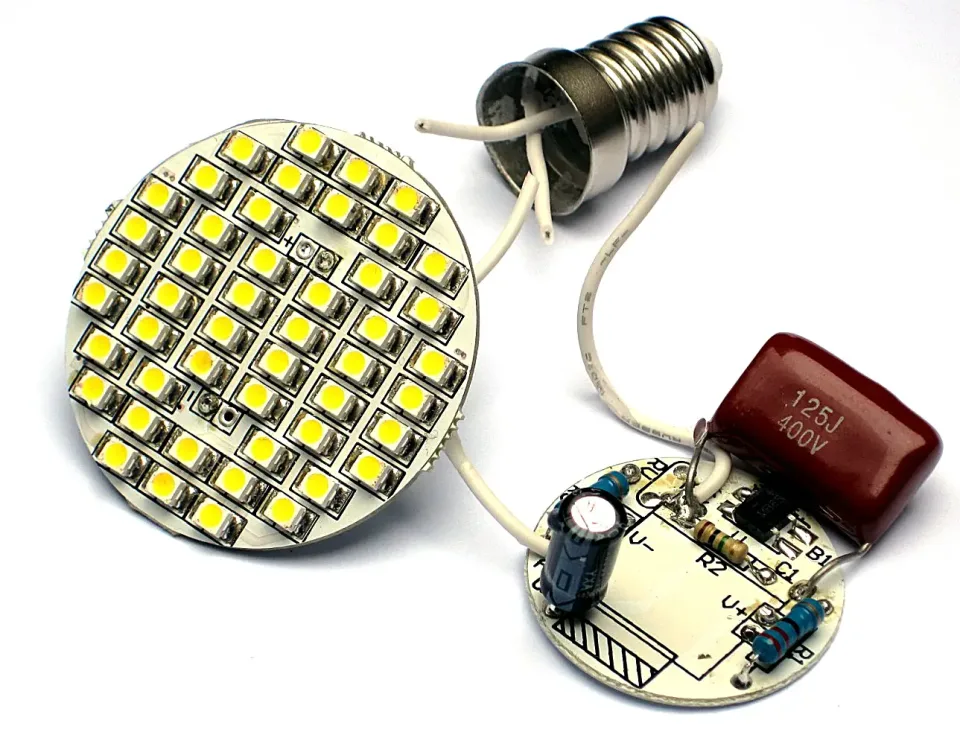
The box said 15,000 hours. The bulb lasted eleven months. If that has happened in your house, your first suspicion probably landed on the LED chip — the one part the box talks about. It is almost certainly the wrong suspect.
LED chips, left to themselves, don't usually die with a click. Testing by the US Department of Energy (DOE) found that LED packages rarely fail abruptly; they fade and shift colour gradually, over years. When a whole light switches off young, something around the chip gave up first. And "around the chip" is exactly where a low price is manufactured. Price itself proves nothing — this series has said before that a light is chip, driver, heatsink and optics, and any of the four can be starved. What follows is the map of where the money goes missing.
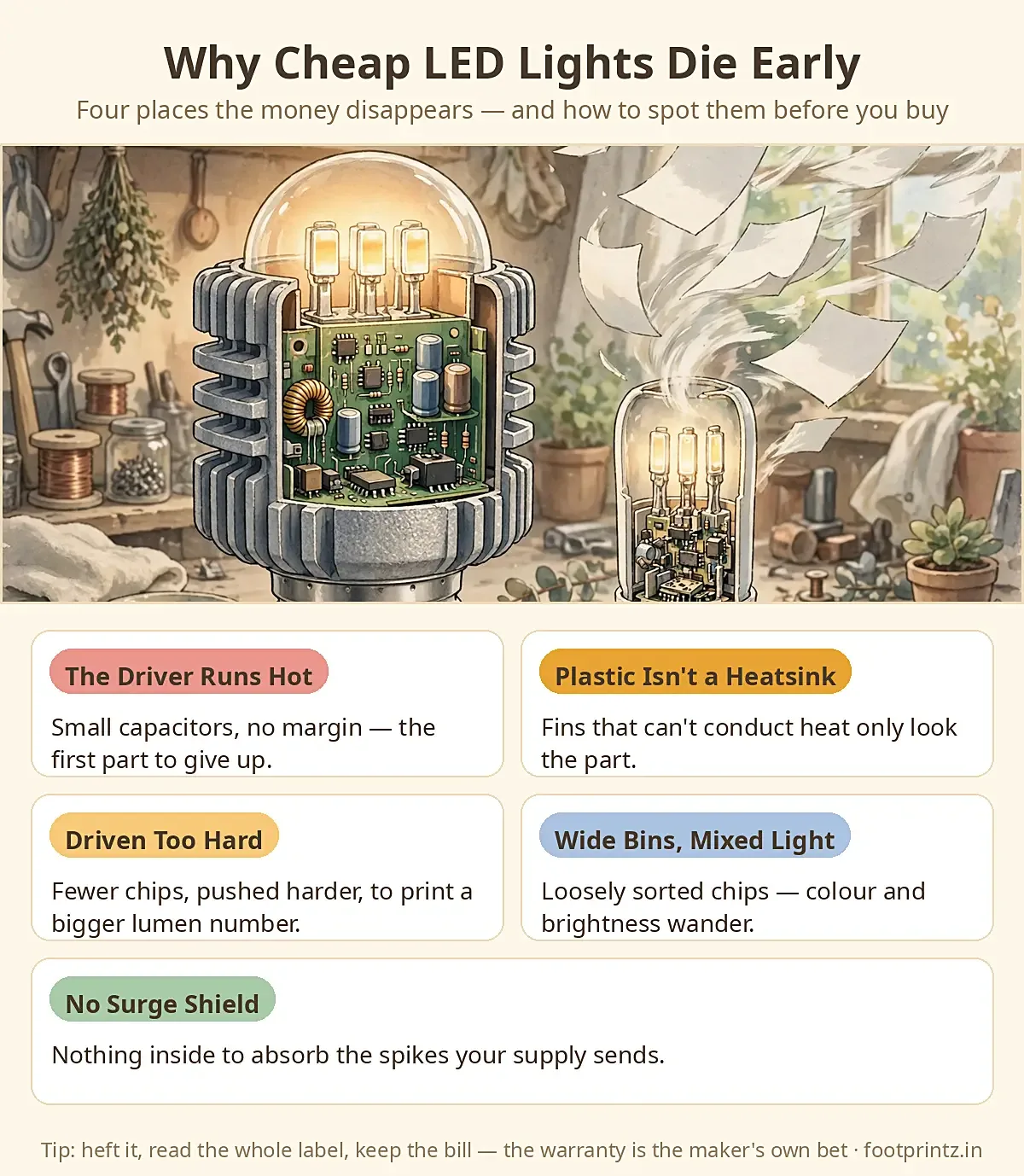
Saving one: the driver gets no margin
The driver — the small power supply in the base — is the easiest place to save money, because the buyer can't see it and the savings don't show on day one. A driver built generously uses components rated well above the job and a proper electrolytic capacitor with life to spare. A driver built to a price uses the smallest capacitor that will pass the first month, parts run at the edge of their ratings, and smoothing so thin the light output ripples with the mains.
The DOE's luminaire lifetime guide is blunt about the consequences: driver electronics can matter as much to reliability as the LED sources themselves, driver failure is the likely eventual cause of a light simply stopping, and capacitor failure is a leading cause of driver failure. The capacitor is the weak point because of how it ages — its liquid electrolyte slowly dries out, faster the hotter it runs (the makers' own rule of thumb: life roughly halves per 10 °C, for that component). A small, cheap capacitor, sealed inside a hot plastic base, is a countdown timer. We covered the heat side of this in the post on why drivers die first; the buying side is simpler: this is the part your money was not spent on.
Saving two: the heat path is made of plastic — and the chips are pushed
Heat leaves an LED chip by conduction: chip to board, board to heatsink, heatsink to air. The DOE names the three things that set the chip's temperature — drive current, the thermal path, and the surrounding air. A cheap light attacks two of them.
First, the path. Real heatsinks are metal because the job is conduction, and finned metal bodies are how serious lights shed heat. A light whose "fins" are moulded plastic is wearing a costume: plastic insulates far more than it conducts, so at anything beyond low power the heat pools around the board instead of leaving. Second, the current. Lumens on a box are a promise, and promises are cheapest kept on paper. Use fewer chips and drive each one harder, and the printed brightness is reached — at a junction temperature that eats the chips' life. Hotter chips fade faster; that is lumen depreciation, and it is permanent. So the light is bright in the shop, and on a schedule to be noticeably dimmer within the year.
This is not theory. Hong Kong's Consumer Council, testing ten LED bulb models in a laboratory with the government's Electrical and Mechanical Services Department, found one model where seven of ten samples had faded badly or burnt out within 3,000 hours — nowhere near the life claimed — while others in the same test held up far better. Same shelf category, wildly different insides.
Saving three: the chips come from the wide end of the bins
No factory makes identical LEDs. Output varies from chip to chip, so production is sorted into bins — by colour, by brightness, by forward voltage. Tight bins, where every chip is nearly identical, cost more: more sorting, more rejected parts. Wide bins are cheaper, and a light built from them shows it. Two "identical" bulbs, bought the same day, glow slightly different whites side by side — the colour standard for white LEDs (ANSI C78.377) allows quadrangles wide enough that differences inside them can be visible. A row of downlights where one is a touch greener, one a touch dimmer, one a touch brighter is not bad luck. It is a bin width, chosen at purchase time by the maker, and paid for — or not — in consistency.
Lower brightness bins do a quieter disservice: the light can still print a healthy lumen number by driving those chips harder, which loops straight back to saving two.
Saving four: protection and assembly, the invisible corners
India's own rules allow the declared supply voltage to move ±6% at the point of supply — call it roughly 216 to 244 volts around the 230 nominal — and that is only the steady variation. On top of it come momentary spikes: switching surges, lightning far away, a heavy load dropping off the line. Lighting equipment is expected to survive a defined level of this; IEC 61547 sets surge immunity requirements for general lighting precisely because surges are a normal design case. Surviving them takes protection components and design margin. Leaving them out saves money on every single unit, and the omission is invisible — until one spike on one evening ends a light that seemed fine.
Assembly is the other hidden line. Solder joints, the connector between the driver board and the LED board, wires dressed and fixed properly — none of it appears on a box. In one DOE stress-test programme on luminaires, the LED packages almost never failed; the failures were typically in the driver circuit, with board-level failures the most common and that driver-to-board connector a noted weak point. Heat cycling works on every joint, every day, for the light's whole life. Good assembly is labour and inspection time. It is very easy not to buy.
What this looks like from your ceiling
Put the four savings together and the biography of a built-down light writes itself. In the first weeks: a flicker you catch from the corner of your eye, or a buzz on the dimmer — the thin smoothing and strained driver announcing themselves. Within months: the light is perceptibly dimmer and its white has drifted, because the overdriven chips on their plastic heat path are depreciating at speed. Then an ordinary event — a surge, a hot week, one more thermal cycle on a tired joint — and it simply doesn't come on. The season it dies in feels random. It wasn't; the schedule was set at the factory.
The honest counterpoint: price is not the verdict
Now the part that matters just as much. None of the above says a budget light must die young, and none of it says an expensive light is safe. A simple light — modest power, a real metal body, an unambitious driver with margin, nothing clever — can run for years, because there is little in it to fail and what is there isn't stressed. Meanwhile a feature-stuffed light sealed into a closed shade in a hot kitchen is being cooked exactly as the heat post described, and its price tag will not save it: environment beats price, regularly. The Hong Kong test makes the same point from the other side — three of its ten models, across a wide price spread, earned its top score. Cheap can be fine. Expensive can be bad. Construction is the evidence; price is just a hint about where to look harder.
What you can actually check before paying
You can't X-ray a sealed bulb, but you are not helpless:
Heft it. At the same claimed brightness, the light with a solid metal body and real weight has a heat path; the featherweight all-plastic one is asking you to trust a costume. Weight isn't quality by itself — but here it is evidence.
Read the whole label. Actual lumens (not just "equivalent watts"), colour temperature, CRI, input voltage range, and a maker's name and address. A seller who prints complete, checkable specifications is behaving like someone who expects to be checked. Vague superlatives in place of numbers are also information.
Treat the warranty as the maker's own bet. A maker who expects returns prices that risk into the warranty it dares to offer — which is why certification schemes abroad set a floor of three years for certified bulbs. A long, clearly written warranty from a seller who will still exist next year is worth more than a big hour number on a box.
Buy where returns are real. A working return desk is the consumer version of quality control: sellers who must take dead lights back tend to stock fewer of them. And keep the bill — a warranty you can't claim is a rumour.
The chip was probably fine. It usually is. When a cheap LED light dies early, it dies of arithmetic done at the factory — money removed from the driver, the heat path, the bins and the protection, one invisible rupee at a time.
Sources: US Department of Energy — "LED Luminaire Lifetime" guide (2014) and LM-80 package reliability study summary; US DOE — "Thermal Management of White LEDs" fact sheet; Hong Kong Consumer Council / EMSD LED bulb laboratory test (CHOICE #466, 2015); ANSI/NEMA C78.377 chromaticity binning; IEC 61547 surge immunity for lighting equipment; Indian Electricity Rules, Rule 54; capacitor manufacturers' life-calculation guidance; Efficiency Manitoba on ENERGY STAR warranty minimums. Full research notes with per-claim citations are kept with this draft.
Featured photo: "Opened 3W LED lamp" by Dantor, via Wikimedia Commons — CC BY-SA 3.0.
Frequently asked questions
Is a cheap LED light always a bad buy?
No. A simple, modest-power budget light with a metal body and a driver that isn't stressed can last for years. The risk is a light built down in the four places this post maps — driver margin, heat path, chip bins, protection and assembly. Judge construction and warranty, not the price alone.
Why did my bulb die even though it says 15,000 hours on the box?
Hour ratings describe the LED chip's slow fading (to 70% brightness, the L70 convention) under test conditions — not the whole light. The driver, its capacitor, solder joints and surge events are not in that number, and they are what usually end a light's life early.
Two bulbs from the same pack glow different colours. Why?
Binning. Chips are sorted after manufacture into colour and brightness bins, and wider, cheaper bins let visibly different whites through. Side by side, the difference shows. It's a consistency saving made at the factory, not a fault in your wiring.
Does a heavier bulb really mean a better bulb?
Not by itself — but for LED lights, weight usually means metal, and metal is the heat path. A heavy, finned metal body at the same brightness as a featherweight plastic one is a genuinely good sign, because heat is what ages everything inside.
Should I just buy the light with the longest warranty?
It's one of the best single signals available to you, because the maker is betting its own money on the light's survival — as long as the warranty terms are written plainly and the seller will be around to honour it. Pair it with the label and heft checks, keep the bill, and you've done what a buyer reasonably can.