
Guide
Why LED lights flicker — and how to stop it
Your LED light is probably pulsing right now — a hundred times a second, too fast for your eyes to catch directly. That pulse is not a defect in the LED chip; it is the fingerprint of the little power supply driving it, and how much of it reaches your eyes depends on how cheap that supply is. This post explains where the pulse comes from, why you notice it on ceiling fans and phone videos rather than on the bulb itself, and how the engineers who study it measure it — percent flicker, flicker index, and the two newer scores with the odd names. Then it gets practical: the four causes, ranked; a slow-motion phone test you can do tonight; the fixes, in the order to try them; and the one kind of flicker that is not a lighting problem at all, but a wiring problem that needs an electrician.

Try a small experiment while you read this. Wave your hand quickly under your nearest LED light, fingers spread. If the moving hand looks smooth, fine. But if it breaks into a stuttering row of ghost hands — or the ceiling fan's blades seem to crawl, hesitate, or stand oddly still — you have just seen the thing this post is about. Your light is pulsing, and it probably has since the day it was installed.
Most LED flicker is invisible when you stare straight at the bulb — the light looks steady, yet the room feels tiring, videos shot under it crawl with dark bands, and moving things look wrong. The pulse is real. It is just fast.
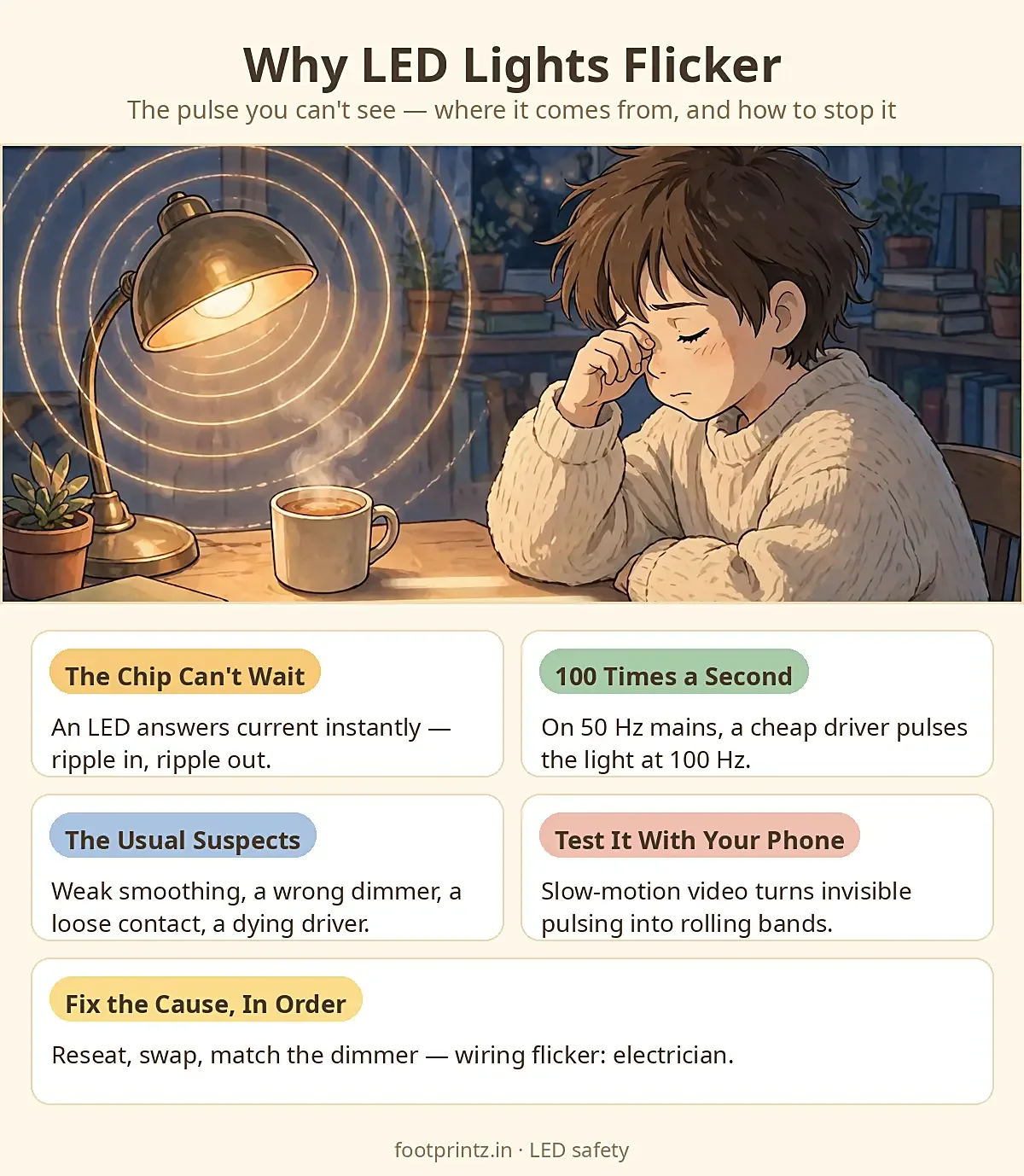
The chip is honest. The driver is the problem
An LED chip responds to electricity almost instantly. Feed it more current and it brightens in a time too small to measure without instruments; cut the current and it is dark just as fast. No warm-up, no afterglow — whatever shape the current has, the light copies it faithfully.
Older lights were lazier, and their laziness protected them. A hot filament cools slowly between the peaks of the mains supply, so its brightness barely dips. An LED has no such cushion: every wobble the driver lets through arrives at your eyes at full strength.
The driver's job is awkward. The wall supplies alternating current; the chip wants steady direct current. Between the two sits a small circuit whose one real smoothing trick is a capacitor — a tiny reservoir that fills at the peaks and empties into the gaps. A generous reservoir means steady light; a thimble-sized one means the gaps show. Smoothing costs money, and the capacitors that do it best are also the parts most likely to fail first — so the cheapest lights skip it, and their light pulses hard. The chip is identical. The driver is where your money went, or didn't.
A hundred pulses a second
India's mains supply alternates 50 times a second — 50 Hz. After the driver straightens that into direct current, what remains is a ripple that rises and falls twice per cycle: 100 times a second. A good driver irons it nearly flat; a poor one passes it on as light that swells and fades 100 times a second; a truly crude one lets it drop to nothing between peaks.
That is too fast to see as blinking — your visual system merges it into "steady", which is why the bulb looks innocent. But the pulse leaks out sideways. Anything moving under it is lit in snapshots, not continuously: fan blades, a waved hand, water from a tap, each frozen at successive positions. That is the stroboscopic effect — motion that looks stepped, slowed, or briefly stopped — and scientists place it roughly between 80 Hz and 2,000 Hz of modulation, squarely where driver ripple lives. Flick your gaze across a strongly pulsing light and it smears into a dotted trail. And a phone camera, recording its picture in strips in short time slices, catches the pulse at different brightnesses: hence the dark bands rolling through videos shot under cheap lighting. The camera is not malfunctioning. It is the only honest witness in the room.
Four causes, and their signatures
A cheap driver, smoothing almost nothing. The light pulses evenly at 100 Hz, steadily, from new. It looks fine head-on and misbehaves on video and around moving objects. The most common cause by a wide margin, and the least dangerous — just poor light.
A dimmer that doesn't match the bulb. A dimmer cuts pieces out of the mains waveform, from the front of each wave (leading edge) or the back (trailing edge), and the driver must cope with the chopped result. A bulb not built for dimming, or built for the other kind, answers with shimmering, buzzing, or flicker that changes as you slide the dimmer — and dimming worsens flicker in general, even in decent lights.
A loose connection. The signature here is irregular: the light blinks at random, flutters when a door slams or the switch is touched, behaves for days then acts up. That is not ripple; it is contact being made and broken. Remember it — it matters later.
A driver dying. A light steady for a year that now pulses or strobes erratically is often a driver at the end of its life, its smoothing capacitor dried out. The flicker is uneven and worsens as the light warms up.
How the engineers measure it
Percent flicker compares the brightest and dimmest points of one pulse. Zero percent is a perfectly steady light; a hundred percent means the light falls all the way to off, every cycle. Simple — but it ignores the wave's shape and its speed. Flicker index fixes the shape half, measuring areas instead: how much of the cycle's light sits above its average line, on a scale from 0 to 1.
The helpful idea comes from IEEE 1789, a recommended practice — guidance, not law — that ties depth to speed: how much flicker is tolerable depends on how fast it is. Its "low risk" line works out to percent flicker below about 8% at 100 Hz, with a stricter "no observable effect" line near 3.3%, and it relaxes as frequency climbs. So honest comparison needs frequency and depth — and a lone "flicker-free" claim on a box tells you almost nothing. No regulator defines that phrase.
Two newer scores grade what people actually perceive: PstLM for directly visible flicker, SVM for the stroboscopic effect. On both, 1 is where an average observer notices the effect about half the time. European rules cap new light sources at PstLM 1.0 and SVM 0.4; India has no equivalent cap yet — precisely why cheap, hard-pulsing lights remain easy to sell here.
Will it hurt you? The honest version
Here is what the evidence supports, without the scary headline in either direction. Flicker in older office fluorescent lighting was linked — in studies the US Department of Energy summarises — to headaches, fatigue, blurred vision, eyestrain and poorer performance on visual tasks, for some people; migraine sufferers and children are among the more susceptible. That is an association, mostly from fluorescent-era research — not proof that a pulsing LED light damages eyes, and no authoritative source says it blinds or injures. For most people, bad flicker is a comfort and tiredness problem. Reason enough to fix it, without inventing worse ones.
One group deserves precise words. People with photosensitive epilepsy — roughly 1 in 4,000 — can have seizures provoked by flashing light, most readily at about 5 to 30 flashes per second. Ordinary 100 Hz driver ripple sits far above that range; it is not the hazard. For them, the hazard is a light that flashes visibly at low rates — a faulty lamp blinking on and off.
Test your own lights tonight
Open your phone's camera, switch to slow-motion video, and point it at the light. A steady light looks steady; a pulsing one rolls with dark bands or shimmers hard. Walk it around the house and compare rooms — on camera, the difference between a good driver and a bad one is not subtle. The no-battery version: wave a pencil under the light. Smooth blur, good; ghost pencils, pulsing.
Treat the result honestly, though: the test proves a light pulses, and roughly how badly. It cannot give you a percent flicker number — that takes a meter. A sorting tool, not a measurement.
Fixes, in the order to try them
- Reseat and swap. Switch off, reseat the bulb firmly; if the flicker stays, swap in a bulb you know is steady. Half of all "flicker" is a dying bulb or a loose fit announcing itself.
- Interrogate the dimmer. Test at full brightness and, if you can, on a plain switch. Flicker that vanishes in both tests is a matching problem: fit an explicitly dimmable bulb, on a dimmer of the type its maker specifies — usually trailing edge.
- Replace the driver or the light. For a fitting with a separate driver, a quality replacement cures ripple flicker outright. For a sealed bulb the driver is inside, so the whole bulb is the replacement — buy on stated flicker figures or SVM where published, not "flicker-free" slogans.
- Stop, if the signature is wiring. Flicker across several rooms or the whole house, buzzing or crackling at the switchboard, a burning smell, a warm switch, scorch marks — none of that is a bulb problem. A loose connection can arc, and arcing makes intense heat in hidden places. Switch off the affected circuit if you safely can, and call an electrician. This is the one kind of flicker you do not troubleshoot through.
Sources: IEEE Std 1789-2015, "Recommended Practices for Modulating Current in High-Brightness LEDs"; CIE TN 006:2016, "Visual Aspects of Time-Modulated Lighting Systems"; US Department of Energy, SSL Technology Fact Sheet: Flicker and "Flicker Measurement and Standards"; IEC TR 61547-1 (PstLM) and IEC TR 63158 (SVM); Epilepsy Foundation of America Working Group consensus on photic- and pattern-induced seizures.
Featured photo: "Bouncing ball strobe" by MichaelMaggs, edit by Richard Bartz, via Wikimedia Commons — CC BY-SA 3.0.
Frequently asked questions
My LED light looks perfectly steady. Can it still be flickering?
Yes. The usual driver pulse runs at 100 Hz, too fast to see as blinking head-on. It gives itself away on moving objects — fan blades that seem to hesitate — and on phone video, as rolling dark bands.
Is flickering LED light bad for my eyes?
There is no evidence it damages eyes. What research does link flicker to — mainly from older fluorescent lighting — is eyestrain, headaches, fatigue and blurred vision in some people, with migraine sufferers and children more sensitive than most. Worth fixing for comfort — but it is not an injury claim.
Why does the flicker only happen when I dim the light?
Because dimming is the driver's hardest job. The dimmer chops the mains waveform, and a driver that smooths full power easily may pass the chopped result straight through — or the bulb wasn't built for your type of dimmer at all. Test at full brightness, then on a plain switch; if it is steady both times, the pairing is the fault.
Can a flickering light trigger epilepsy?
Only in a specific situation. Photosensitive epilepsy affects about 1 in 4,000 people, and the provocative range is roughly 5 to 30 flashes per second — visible flashing. The 100 Hz pulse of an ordinary LED light is far above that range. A faulty light that visibly blinks on and off is a different matter, and should be replaced promptly.
When should I call an electrician instead of changing the bulb?
When the flicker isn't one light's behaviour: several rooms or the whole house flickering together, buzzing or crackling from the switchboard or a switch, a burning smell, heat, or scorch marks. Those point to a loose connection that can arc and overheat. Switch the circuit off first if you can do it safely.